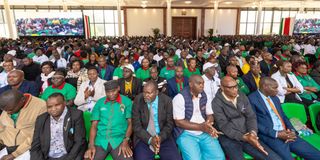
Teachers are staring at an uncertain future as unions clash with the government over plans to migrate them and their dependents from the Sh20 billion Minet medical scheme to the Social Health Authority (SHA).
Union leaders have warned that the transition, set to take effect when the current contract expires, next month could trigger a crisis.
They said that the rushed transition could strip more than 400,000 teachers of critical benefits, even as government officials promise wider access to health facilities.
Teachers Service Commission Acting CEO Evaleen Mitei.
Photo credit: File | Nation
Recently, TSC acting Chief Executive Officer Evaleen Mitei told the Education Committee of Parliament that consultations are under way to move teachers to SHA by December 1.
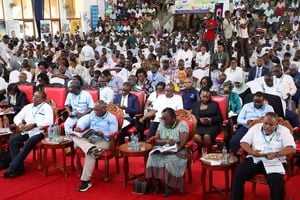
On Friday, the union leaders met with the Teachers Service Commission (TSC), officials from the Office of the President, and representatives from SHA. The unions said the presentations by SHA attempted to address gaps in the current Minet scheme, but concerns remain unresolved.
During the meeting held at the TSC boardroom in Nairobi, SHA presented its plan, saying it would give teachers broader access to more than 9,000 health facilities nationwide compared to about 800 currently accessible under Minet. It was resolved that further consultations will be held ahead of any transition.
Collins Oyuu, the Kenya National Union of Teachers (Knut) secretary-general, said they will not rush into endorsing the government’s proposal to transfer medical insurance from Minet to SHA. He stressed that with more than 400,000 teachers in public schools and millions of dependents affected, such a decision must go through a thorough consultation with the union’s membership.
“It’s a matter we have to take back to our members very carefully. The SHA took us through several presentations yesterday. In our opinion, the process is not complete. We feel it is only right to take this matter to the National Executive Council (NEC) for a final decision,” he said.
Knut Secretary-General Collins Oyuu.
Photo credit: File | Nation Media Group
The urgency of the matter arises from the fact that the current Minet medical cover for teachers expires next month. The secretary-general also pointed to President William Ruto’s recent remarks at a State House meeting.
“When the President stood there and said he would look into the medical cover, some assumed he was already talking about SHA. Yes, he consulted unions and teachers, but we must be very clear: what he spoke about was a review of the medical scheme. That is very different from moving all teachers into SHA overnight. A review is welcome, but adopting SHA wholesale requires proper consultation,” Mr Oyuu said.
He confirmed that SHA officials had already met the unions to explain their model. He insisted that the government must subject the proposal to public participation and address persistent inefficiencies in the medical cover before making any changes.
“They came and told us what they stand for and what they are offering. Personally, I am not alarmed by their proposal. As a union, we must listen to all voices before taking a stand,” Mr Oyuu said.
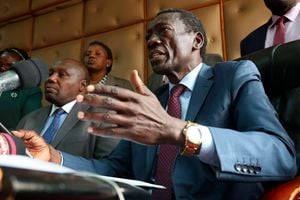
Moses Nthurima, the Kenya Union of Post-Primary Education Teachers (Kuppet) deputy secretary-general, warned that the government would face resistance if it rushed teachers into the SHA scheme without proper consultation.
“The government seems determined to migrate the teachers. We have not accepted, but we are telling them to go and talk to the teachers themselves. If we sit at headquarters and make decisions that are likely to affect the teachers negatively, then we shall not be acting in their best interest,” he said.
Kenya Union of Post Primary Education Teachers Deputy Secretary-General Moses Nthurima.
Photo credit: File | Nation Media Group
Mr Nthurima stressed that union leaders have not endorsed the move, insisting that teachers cannot be herded into a system that lacks clarity, transparency, and guarantees on benefits.
“You cannot wake up one morning and tell teachers to abandon a scheme they know for one whose details are still unclear,” he said.
Mr Nthurima faulted the TSC and government officials for holding meetings on the matter without addressing long-standing complaints about teachers’ current medical cover under Minet. He accused insurance companies of prioritising profits over service delivery.
“For example, pre-authorisations take long, and when doctors recommend that a teacher be admitted, they often refuse, saying their doctors disagree. This conflict has persisted because the insurer seems more interested in making money from teachers’ health than in providing services,” he said.
Ndung’u Wangenye, the national secretary of the Kenya Teachers Health and Welfare Association, cautioned the government against moving teachers to SHA without guaranteeing them a comprehensive health cover.
He warned that the lives of more than 400,000 teachers and their dependents could be jeopardised if the new scheme is implemented without proper structures and clear benefits.
“If SHA is going to ask a teacher to pay as much as Sh60,000 every year, then the cover must be comprehensive enough to include outpatient, inpatient, maternal, dental, and optical services. Teachers should not be forced into a scheme that gives them less than what they currently enjoy,” Mr Wangenye said.
He urged the government to engage education stakeholders in developing a framework that ensures teachers and their families are not disadvantaged under the new system.
“We will have to scrutinise everything SHA is offering because, at the end of the day, teachers were already suffering under Minet. This new cover must be truly comprehensive, and if it fails to meet the needs of teachers, then we will have no choice but to oppose it,” he said.