A nationwide strike by 44,000 teachers employed on contract and deployed to junior schools by the Teachers Service Commission (TSC) threatens to expose wide staffing gaps in the segment that has suffered myriad problems since roll-out in 2023.
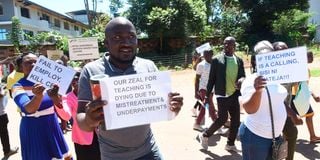
The work boycott called by the teachers, commonly referred to as interns, has disrupted learning in several parts of the country. They are demanding employment under permanent and pensionable terms since the Court of Appeal has declared the model unlawful.
The controversial recruitment programme was introduced in 2019 to bridge staffing gaps as the country transitioned to competency-based education (CBE). When junior school was introduced, the expectation was a gradual transition supported by adequate recruitment and deployment of trained teachers. However, schools were largely staffed through the recruitment of teachers on short-term contracts, leaving a thin buffer for continuity when disputes arise.
The current strike has now turned that vulnerability into a nationwide disruption, with schools reporting empty classrooms and suspended lessons in key learning areas.
“The court declared internship illegal, and we believe the Teachers Service Commission and the government must respect that ruling and confirm us into permanent and pensionable terms. Some of us have served for two years, while others were recruited recently, but we are all affected equally. We have played a critical role in implementing the CBC curriculum, especially in science subjects, and even supported national examinations last year. Now, by withdrawing our services, we are making it clear that many schools will be left without science teachers,” said Rodgers Odhiambo, chairperson of the Kenya Junior School Teachers Association (Kejutsa).
Junior Secondary School teachers hold a protest match.
Photo credit: Isaac Wale | Nation Media Group
In a memorandum submitted to the TSC, the teachers across the country have petitioned the commission to immediately confirm the 44,000 teachers to permanent and pensionable terms, citing a recent court ruling that declared the internship programme illegal and exploitative.
In the petition addressed to the TSC Chief Executive Officer, the teachers argue that the internship model has denied them job security, fair remuneration and dignity despite performing the same duties as permanently employed teachers.
The teachers said the programme, which was initially introduced as a temporary measure, has instead become a barrier within the profession, delaying career growth and reducing trained educators to cheap labour.
“A nation that values education must first value its teachers. The quality of education can never rise above the treatment of the teacher,” the petition reads in part.
They also noted that despite the Ministry of Education placing Science, Technology, Engineering and Mathematics (STEM) at the centre of CBE, thousands of trained STEM teachers remain under internship terms for years.
The teachers want the commission to immediately confirm all the 44,000 teachers to permanent and pensionable terms and publish an official implementation roadmap outlining clear dates and procedures for their confirmation.
They also want the internship service period recognised for salary progression, pension, promotions, leave benefits and career advancement.
Further, the teachers have called for the abolition of the internship employment model for trained teachers and the prioritisation of employment and deployment of STEM teachers.
The petition also urges the commission to consider the needs of teachers living with disabilities through supportive working conditions and provide medical cover for those managing special health conditions.
Additionally, the teachers want the confirmation, posting and deployment process to be transparent and free from favouritism.
“The salary we are paid as interns is Sh17,000. This has made life very difficult for us. You find many teachers are stressed and not comfortable, yet teaching requires someone who is well composed and stress-free. We have said enough is enough. The government has not listened to the 44,000 interns, so we are on the streets to push for our confirmation,” said Mr Odhiambo
Education stakeholders argue that the staffing model effectively built a national system on temporary labour, without a clear long-term absorption plan.
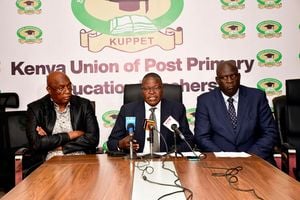
The secretary-general of the Kenya Union of Post-Primary Education Teachers (Kuppet), Akelo Misori, on Tuesday issued an ultimatum to the TSC, demanding the immediate absorption of the teachers currently serving as interns into permanent and pensionable (PnP) terms.
Kenya Union of Post-Primary Education Teachers (Kuppet) Secretary-General Akelo Misori speaks to the media at the union’s headquarters in Nairobi on August 11, 2025.
Photo credit: Dennis Onsongo | Nation Media Group
“What is required is that the Teachers Service Commission takes up the challenge. The court has already ordered that engaging teachers as interns in the way it has been done is illegal. The Constitution is clear that the Teachers Service Commission is created to register and employ qualified teachers. These teachers are qualified and registered, so there is no reason to deny them employment on permanent and pensionable terms,” he said.
However, unions and education analysts warn that temporary staffing may have lowered immediate costs but increased long-term instability in learning delivery.
The union urged the National Assembly to allocate sufficient funds to enable the commission to absorb the 44,000 teachers into permanent positions, saying they are already serving in schools and are critical to addressing teacher shortages.
“We have directed our members that the only correct thing for the commission to do is ask Parliament to allocate sufficient resources so that these teachers can be employed on PnP terms. They are already useful in our schools,” Mr Misori said.
Mr Misori warned that failure by the commission to respect the court ruling could amount to contempt of court, noting that the commission had been given time to comply with the judgment.
“We want a government that respects court rulings. The Teachers Service Commission must be reminded that they are in breach of a court judgment if they continue engaging teachers as interns,” he said.
Speaking to the Daily Nation, TSC acting CEO Evaleen Mitei said the commission is in talks with government agencies to secure funding for hiring intern teachers on permanent, pensionable terms.
Teachers Service Commission CEO Evaleen Mitei.
Photo credit: Bonface Bogita | Nation Media Group
“As articulated before the Education Committee on 17th March, 2026, the additional allocation of 21B in the Supplementary Budget will be majorly utilised for the deficit in the employee Remuneration budget, which was less by 12.8B and the Teachers Medical Scheme of 7.5B. The rest will cater for Secretariat emolument and field operations,” said Ms Mitei.
“The commission is still consulting with other relevant government agencies to secure funds for the recruitment of interns on permanent and pensionable terms of service,” she added.