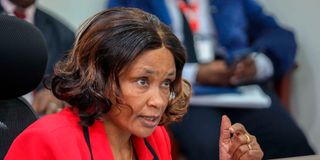
The Teachers Service Commission (TSC) has said that it has not reviewed the hardship areas for teachers as it is waiting for direction from the Public Service Commission.
The Commission's Acting Chief Executive Officer, Ms Eveleen Mitei, informed a parliamentary committee that the Commission is paying teachers' hardship allowances in accordance with Legal Notice No. 534 of 1997.
Appearing before the National Assembly Implementation Committee, Ms Mitei told MPs that the Commission has not reviewed the hardship areas. “We have been told that the Public Service Commission is reviewing this, but for now, we are using the legal notice to pay the allowance,” she said.
She was responding to a question from the committee chairman, Raphael Wanjala, who said that the criteria used by the Commission to pay the allowance were discriminatory.
“What criteria are you using in giving this hardship allowance? You find one area in the same constituency has been designated as hardship while another is not. Teachers therefore seek to go to areas with hardship allowance, leaving the other areas with no teachers,” the MP said.
“You find that there are many teachers in one school who are just idle and are on TikTok throughout, because they bribe your officers on the ground to get the hardship allowance.”
Other MPs also said that some schools in their constituencies have no teachers because tutors have moved to areas where they are entitled to hardship allowances.
Kakuta Ole Maimai, the MP for Kajiado East, said that schools in his constituency, particularly those in urban areas, have too many teachers, while those in rural areas have none.
In May, Prime Cabinet Secretary Musalia Mudavadi told the National Assembly that the government would review the classification of hardship areas. He said this would save the government Sh6 billion annually.
“I wish to inform the House that the implementation of the Inter-Agency Technical Committee report will reduce the financial implication for payment of hardship allowance from Sh25 billion to Sh19 billion per annum, thereby making a saving of Sh6 billion to the government. This is as a result of the proposed harmonisation of the designated hardship areas in the public service,” Mr Mudavadi said.
He was referring to a report by the Inter-Agency Technical Committee, which conducted extensive stakeholder engagement on various issues, including the policies governing the classification of hardship areas and the payment of allowances to public servants working in these areas.
However, in July, the Cabinet Secretary for Public Service, Geoffrey Ruku, announced that the government had halted the implementation of the report following a wave of public outcry from teachers, civil servants and political leaders across the country.
Mr Ruku said that, in collaboration with the Ministry of Education, they had decided to suspend the implementation of the report on hardship classification in order to re-evaluate the process of defining areas eligible for hardship allowances.
“We have decided to hold on to the report for now. We need to re-evaluate it together with stakeholders and elected leaders before its implementation,” Mr Ruku said.
Last week, Nyando MP Jared Okello protested against the decision to halt the implementation of the report without the involvement of Parliament.
He raised the matter with Speaker Moses Wetang’ula, seeking to have the CS summoned before the House to explain the decision.
“I have read in the media that the government has halted the implementation of the report, while we, who raised the matter in this House, have not been appraised on it,” Mr Okello said.
Mr Wetang’ula told the MP to formally write to him about it so that the House leadership could address the issue.
Currently, the civil service, county governments and state corporations have 16 designated hardship areas. The teaching service has 44, while the Judiciary has 21.
Last month, the question of how the government classifies hardship areas for civil servants, particularly teachers, was raised in the House by MP Okello.
Lawmakers have complained that the government’s classification of hardship areas is biased and discriminatory and should be reviewed to reflect current circumstances.
Hardship areas are remote regions categorised as lacking or having inadequate basic social services, amenities, and infrastructure, such as food, water, transport and communication services, health and education facilities, security, and high poverty indices.
The hardship allowance was introduced in 1969 to incentivise officers stationed in designated hardship areas.
Article 41 of the Constitution states that everyone has the right to fair labour practices, including fair remuneration and reasonable working conditions.
Section 10 of the Human Resource Policies and Procedures Manual for the Public Service provides for the payment of a hardship allowance to officers stationed in designated hardship areas.