Education stakeholders have questioned the government's plan to establish a new task force to investigate the recent wave of school unrest and dormitory fires, arguing that previous inquiries have already identified the causes of the problem and proposed solutions that remain largely unimplemented.
The Ministry of Education is expected to gazette a task force to examine the recent increase in arson attacks and student unrest that have disrupted learning in several schools across the country this term.
However, education experts say the focus should shift from commissioning new investigations to implementing recommendations contained in earlier reports.
The Education Stakeholders Association of Kenya (ESAK) says Kenya already has sufficient evidence on the causes of school unrest and should prioritise action rather than conducting another inquiry.
“We do not need another task force on school unrest. We already have enough reports that have clearly identified the causes of unrest and proposed practical solutions. What we need now is political will and commitment to implement those recommendations. Forming another task force without addressing the implementation gap will only delay the reforms that schools urgently need," said ESAK National Secretary Ndung'u Wangenye.
According to the stakeholders, previous commissions recommended reviewing the school examination calendar, reducing pressure associated with mock examinations and strengthening guidance and counselling programmes.
The task forces also recommended improving communication between school administrators and learners, enhancing student participation in decision-making, and upgrading school infrastructure and safety standards.
Despite these recommendations, mock examinations continue to be administered in many schools, with stakeholders arguing that the examination pressure cited in earlier reports remains largely unchanged.
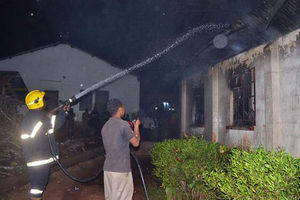
The renewed debate comes as schools across the country continue to experience incidents of unrest and dormitory fires, prompting fresh concern over student safety and learning disruptions.
From left: Elimu Bora Working Group members David Karani, Boaz Waruku, Deputy Executive Director of Kenya Human Rights Commission Cornelius Oduor and Maxwell Magawi address journalists in Nairobi on February 11, 2024.
Photo credit: Billy Ogada | Nation Media Group
Elimu Bora Working Group strategist Boaz Waruku questioned the rationale behind launching another investigation, saying previous commissions had already identified the drivers of school unrest and proposed practical remedies.
He maintained that education stakeholders, including teachers, parents and experts, have for years submitted memoranda outlining both the causes of unrest and possible interventions.
“The country does not have a shortage of reports on school unrest. What we have is a shortage of implementation. The answers are already in government files. Teachers have spoken. Parents have spoken. Education experts have spoken. Their memoranda are sitting in the ministry. What is missing is not information; it’s political will,” he said.
Mr Waruku argued that before appointing another task force, the ministry should revisit landmark reports such as the Chang’ach and Bombolulu reports, which extensively examined indiscipline, school fires and institutional responses.
He warned that repeatedly appointing committees without acting on their findings creates the impression that the government is avoiding the root causes of the problem.
“You cannot keep commissioning new investigations when previous reports have already diagnosed the problem and prescribed the treatment. At some point, you stop gathering evidence and start implementing solutions,” he said.
“This idea of setting up another task force instead of dealing with the root causes tells you that somebody is either not keen on resolving the matter or is completely incompetent and unable to address it,” he added.
Mr Waruku also questioned whether the planned task force could merely be buying time as public anger grows following the latest cases of school fires.
“The government should not be buying time because it wants Kenyans’ anger to cool down. It should not be looking for someone else to blame, whether parents or students, while the ministry absolves itself of responsibility. When a government responds to every school fire by announcing another committee, it begins to look like it is managing public anger rather than solving the problem,” he said.
The National Parents Association (NPA) has cautioned that the proposed task force should review and implement recommendations from previous inquiries instead of duplicating work that has already been done.
“We support the task force because the country needs answers, but it should not start from scratch. It must build on what has already been documented and identify what has not been implemented,” said the association’s chairperson, Silas Obuhatsa.
National Parents Association Chairman David Obuhatsa Silas (centre). Mr Obuhatsa opposed the closure of schools “because parents are also starving at home”.
Photo credit: File | Nation Media Group
He acknowledged that previous commissions had made recommendations on addressing school unrest but noted that different administrations had failed to fully implement them. The parents’ body also said recurring school fires have left families worried and called on the government to act swiftly.
The lobby said the recurring incidents of school fires have left many families anxious and called on the government to move beyond investigations to tangible action that will improve safety in schools.
"Parents are anxious. Learners are anxious. Every new fire raises fresh questions. What parents want now is action that will make schools safer," Mr Obuhatsa said.
The association also called for stronger collaboration between schools and parents, arguing that many student grievances could be resolved before they escalate into unrest.