A curious tradition takes place every year in the morning, before the results of national examinations are announced. It is strictly observed, although it is not a requirement of any law.
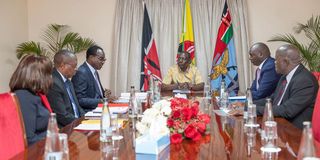
Senior officials from the Ministry of Education, led by the Cabinet Secretary, usually have a sitting with the President at State House or a State Lodge to brief him on the details of the particular examination. Securing an appointment is important and determines the date, place, and time the results are announced.
Reliable sources, who spoke to the Nation in confidence, had earlier indicated that the release of the Kenya Certificate of Secondary Education (KCSE) examinations had been set for Monday or Tuesday next week, but President William Ruto’s diary could not allow for it. It then had to be brought forward.
President William Ruto briefed by the Ministry of Education officials, CS Migos Ogamba and PS Julius Bitok, on the release of the 2025 KCSE exams on January 9, 2025.
Photo credit: PCS
The President was in Uasin Gishu County, and so the officials had to scramble for flights to Eldoret City when they were granted an audience by the Head of State. Some of them flew as late as 7.00 pm on Thursday evening.
It was the second time the results were being announced in Uasin Gishu County, as had happened before in 2024.
The results have also been announced from Mombasa County (2016) at Shimo la Tewa High School.
What exactly is this briefing about, while the rest of the country is consumed with anxiety over the outcome of the national examination?
The chief executive of the Kenya National Examinations Council (Knec), David Njeng’ere, explains that while the practice of briefing the President is not anchored in law, the tradition persists under different administrations. He said examination results provide the most accurate data on learners in school.
“Examinations are usually not primarily about results, but are about giving a scorecard on the education system. Essentially, the President is briefed on access, completion rates, gender parity and finally on performance,” he said.
On the access scorecard, the President is presented with statistics on what proportion of the country’s population, of a given age, is in school.
He notes that while discussions about grades often overshadow the issue of access, it remains among the clearest indicators of where the country is headed.
“That is where it starts because you cannot develop your human capital if they are not in school,” he says, noting that Kenya is doing way better than its counterparts, such as South Africa, Tanzania, and Uganda, where basic education access rates remain low.
On the completion rates scorecard, the President is briefed on statistics about enrolled or registered learners in comparison to those who actually make it to the finish line.
Dr Njeng’ere notes that a lot of countries are struggling with this, including those in the Global North, with Kenya’s figures telling a relatively stronger story.
“If we look at the 2025 KCSE – from registration in January to sitting the exams in November, only about 3,000 candidates dropped out,” he notes.
The third scorecard is on gender parity, and here the President is briefed on the balances attained or missed in keeping boys and girls in school.
Dr Njeng’ere notes that this is one of the most difficult balances for education systems to achieve globally, with even America and Europe struggling to get it right.
“In Kenya, the gender parity is currently at the perfect point where you have slightly more girls than boys and that is the way it should be, because in any normal population there are more girls than boys,” he notes.
It is only after access, completion rates, and gender parity are presented that the performance parameter comes into focus.
Dr Njeng’ere explains that the President is briefed on exam results so they can be viewed through the lens of investment and outcomes. Education, he says, is not just a social service but a major national investment.
Because KNEC’s data is comprehensive and credible, Dr Njeng’ere says it allows the President to reflect beyond grades and rankings.
“KNEC’s data is the most authentic and cannot be manipulated by anybody. With his data, the President can consider whether challenges lie in education itself or in related areas such as health, economics or social conditions,” he says, noting these will inform policy decisions.
As such, briefing the President before the release of national examination results is not about interference or approval. It is about understanding the state of the education system as a whole, using reliable data to guide policy decisions, and ensuring that the conversation goes beyond scores to the future of the country’s human capital.