Teachers can continue expressing themselves on social media without fear of punishment after a court declined to lift orders suspending a disputed policy that sought to control what they post online.
Justice Francis Kyambia found that the directive issued by the Teachers Service Commission (TSC) failed to clearly define what amounted to unprofessional online conduct, raising concerns that teachers could be punished for expressing opinions on public issues.
“What is clear from the circular is that the same does not sufficiently define or particularise the conduct which may expose teachers to disciplinary action," said Justice Kyambia, dismissing TSC's application to lift interim orders dated August 21.
The ruling leaves the TSC decision suspended pending determination of a petition challenging the legality of the social media restrictions imposed on teachers.
The petition centres on a circular dated August 13, 2026 titled “Prohibiting unprofessional conduct on social media platforms and cyberbullying” issued by TSC Acting Secretary and Chief Executive Officer Evaleen Mitei. The circular warned teachers against cyberbullying and unprofessional social media conduct, warning of disciplinary action.
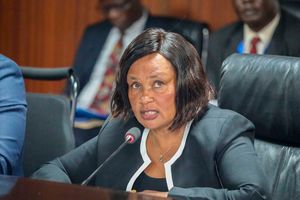
Teachers Service Commission Acting CEO Evaleen Mitei.
Photo credit: File | Nation Media Group
The dispute comes amid the growing use of online platforms such as Facebook, X, TikTok, WhatsApp, Instagram and YouTube in Kenya, where citizens increasingly use them to share information, challenge government decisions, expose wrongdoing, mobilise protests and shape national debates on politics, careers, governance and public policy.
The TSC circular cited the Constitution, Leadership and Integrity Act, Computer Misuse and Cybercrimes Act and Data Protection Act. It directed teachers to Clauses 10, 12 and 24 of the 2015 Code of Conduct and Ethics without reproducing them.
Teacher Fredrick Ochieng’ moved to court, arguing that its vague terms could reach into teachers’ private online expression without explaining what amounted to cyberbullying or behaviour that demeaned the profession.
He said teachers could be deterred from commenting on education policy, governance and working conditions, because the circular did not distinguish official conduct from private speech.
Mr Ochieng’ also complained that TSC had not consulted teachers or other affected stakeholders and said the directive lacked public participation and the fair administrative process required by law.
He filed the case for himself, affected teachers and the public interest. He asked the court to declare the circular unconstitutional, quash it, stop its enforcement and bar the TSC from victimising teachers under it. He also sought general damages, arguing that the directive violated the Constitution.
The TSC opposed the petition and applied on August 26 to have the interim orders lifted. It said the circular relied on the constitutional and statutory framework governing teaching standards and discipline.
It maintained that the directive created no new offence or disciplinary process, but reminded teachers of duties already contained in existing laws and professional rules. It said the suspension interfered with the government’s responsibility to maintain standards in the teaching service.
TSC said concerns about teachers’ social media use had prompted the directive, which was issued in good faith and not to suppress expression.
"The issuance of the circular was the culmination of internal policy and regulatory process arising from increasing cases of misuse of social media platforms by teachers, which concerns the respondent had observed over time," TSC said.
But Mr Ochieng said the suspension had not stopped TSC investigating or disciplining teachers under the existing code, including for online harassment.
He said the government’s proposed comprehensive policy on cyberbullying showed the need for structured development and consultation.
Justice Kyambia found that the petitioner had established a strong case and a real danger that freedom of expression could be violated.
The judge said restrictions on expression must be founded in law and satisfy constitutional requirements of reasonableness and proportionality. “Such a sweeping limitation of the right to freedom of expression must be founded in law,” he said.
The court noted that the respondents did not dispute the lack of consultation. It said TSC should have issued specific guidelines instead of a blanket circular, adding that offending teachers should be handled case by case under existing rules.
"It is not denied by the respondent that there was no consultation with the stakeholders before the formulation and issuance of such circular. All this goes to demonstrate that the petitioner has demonstrated a prima facie case," said Justice Kyambia.
He said the interim orders are intended to preserve the status quo that is being challenged. The case is scheduled for mention on February 3, 2027.