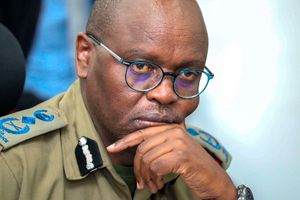
Embattled Deputy Inspector General of Police (DIG) Eliud Lagat has hired a Nairobi-based lawyer, Cecil Miller, to defend him in a court petition that is seeking his removal from office following his alleged involvement in the death of teacher Albert Ojwang.
According to papers filed in court, Mr Lagat has instructed the lawyer to lead his legal team against the petition lodged by activist Eliud Karanja Matindi, a Kenyan living in London United Kingdom.
Mr Lagat wants the lawyer to fight claims that his decision to "step aside was nothing and should be deemed to be a resignation since the move is unknown to the law."
The court was petitioned by Mr Matindi to examine the legality of Mr Lagat's decision to step aside from office.
The petitioner moved to court after Mr Lagat's announcement on June 16, 2025 that he had stepped aside from his role as DIG of the Kenya Police Service, to pave way for investigations into his alleged involvement in the teacher's murder.
In the petition filed at the High Court in Milimani Nairobi, Mr Matindi says by stepping aside Mr Lagat conceded that he was unsuitable to carry out the functions of the office of DIG. He wants court to find that the stepping aside was equal to resignation and the DIG Kenya Police Service position should be declared vacant.
“Mr Lagat is deemed to have resigned as DIG on June 16, 2025 in accordance with Section 12 of the National Police Service Act, having determined, on his own motion, that he could no longer lawfully discharge the functions of DIG. Mr Lagat himself conceded, he was unsuitable to carry out the functions of DIG,” says Mr Matindi.
He accuses the National Police Service Commission of violating the Constitution by standing by and allowing Mr Lagat to “step aside” as DIG, Kenya Police Service.
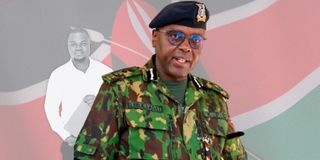
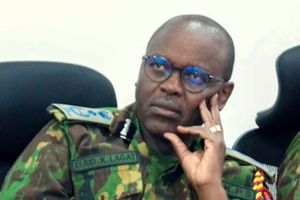
Deputy Inspector-General of Police Eliud Lagat.
Photo credit: Dennis Onsongo | Nation Media Group
He further argues that Mr Lagat’s move to step aside lacks the legal backing because there is no constitutional or statutory provision that allows it to make that decision.
“Under the Constitution, National Police Service Act, or any other provision having the force of law in Kenya, there are no provisions which allow Mr Lagat to “step aside” as DIG, Kenya Police Service, after he determined, on his own motion, that it was untenable for him to discharge his functions as DIG, pending completion of investigations into the death of Ojwang," says the petitioner.
Mr Matindi further argues that the stepping-aside “was solely to serve Mr Lagat's personal and private interests and a complete betrayal of the public or official interests”.
“It offends the principles of good governance, integrity, transparency and accountability. The decision was inconsistent with the purposes and objects of the Constitution, failed to show respect to the people and honour to the nation and the office of DIG. It further failed to uphold the integrity of that office,” argues Mr Matindi in the court papers.
Legality of Mr Lagat’s move
It is his case that the National Police Service Commission (NPSC) was required to carry out a recruitment process, based on fair competition and merit, to identify a suitable person to recommend for appointment as DIG.
The petition also accuses the NPSC of abdicating its constitutional responsibilities and allowing Mr Lagat to determine whether or not he ought to be subject to disciplinary control and what sanctions, if any, he ought to face. This is in relation to circumstances surrounding Ojwang’s murder.
“It was not in Mr Lagat’s place to make that determination. It was, instead, the NPSC’s constitutional duty to make that call, as demanded by Article 246(3)(b) of the Constitution,” argues the petitioner.
Also being challenged is the legality of Mr Lagat’s move to appoint his Principal Assistant, Patrick Tito, to serve as the acting DIG of the Kenya Police Service during his absence.
Mr Matindi claims these decisions caused a constitutional crisis and administrative confusion within the National Police Service.
A man displays a placard with the picture of Deputy Inspector-General of Police Eliud Lagat during protests in Nairobi on June 12, 2025 to demand justice for Albert Ojwang who died in police custody.
Photo credit: Wilfred Nyangaresi | Nation Media Group
He argues that it was unlawful for Mr Lagat to appoint Mr Tito as the acting DIG. He wants the court to declare the move as null and void.
According to the petitioner, the appointment of Mr Tito effectively means the National Police Service has two DIGs for the Kenya police unit, one substantive and the other acting, a scenario that is not contemplated in the Constitution.
“Under the Constitution, there can only be one DIG, Kenya police service at any one time, whether appointed substantively or in an acting capacity. The charade of having a substantive and an acting DIG for the Kenya police service at the same time, is a gross violation of the Constitution by the National Police Service Commission (NPSC) and the Attorney-General as well as Mr Lagat and Mr Tito,” argues the activist.
He sued the NPSC and Attorney-General Dorcas Oduor while Mr Lagat and Mr Tito are named as interested parties in the petition. Other interested parties include the Law Society of Kenya and Katiba Institute.
Mr Lagat announced his absence from office by stepping aside from the DIG position following public pressure over Ojwang’s murder at Nairobi’s Central Police Station.
He was linked to the murder because the arrest of Ojwang and the subsequent killing stemmed from a complaint lodged by him over alleged online defamation.
Ojwang’s death in police custody was subject of extensive public debate and calls for transparency and accountability in determining how and why it happened and who, if anybody, ought to be held culpable.
Mr Matindi argues that "Mr Lagat had no constitutional or statutory powers to appoint any person to act as the DIG during his claimed absence from that office".
"That function is exclusively delegated to the NPSC in accordance with Article 246(3)(a) of the Constitution,” says Mr Matindi.
The petition is pending hearing before Justice Chacha Mwita and is scheduled to be mentioned tomorrow (Monday) for directions.