The language around Somalia is often confusing and sensitive to those it describes. That is why choosing the right term matters, sometimes because it can ensure respect just as much as accuracy.
This is because Somalia’s complex history, from colonial rule to civil war and ongoing reconstruction, has shaped identities and political sympathies that mean words carry different meanings for different people.
Technically, Somalia should be one country. Yet its political history from colonialism to civil war and recent rebuilding has produced political sympathies that do not always mean the same thing to different people.
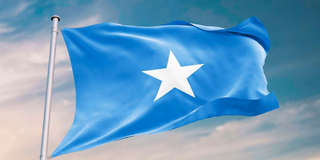
In this picture taken on on May 23, 2022, outgoing Somalia President Mohamed Abdullahi Mohamed (left), also known as Farmaajo, presents the Somali flag to newly-elected President Hassan Sheikh Mohamud during the handover ceremony at the Mogadishu palace.
Photo credit: File | AFP
The country of Somalia denotes the Horn of Africa state east of Kenya, bordering Ethiopia and Djibouti. It currently operates a federal system with six member states: Jubaland, Puntland, Northeast, Southwest, Hirshabelle and Galmudug. Officially, it also includes the Somaliland region, which continues to pursue secession.
Located at the north western tip of Somalia, this region was once a British protectorate, separate from southern Somalia, which was largely under Italian colonial rule. In 1960, British Somaliland and the southern regions voluntarily merged to form the Somali Republic.
A woman holding a flag as soldiers and other military personnel of Somalia's breakaway territory of Somaliland march past during an Independence day celebration parade in the capital, Hargeisa on May 18, 2016.
Photo credit: File | AFP
The union was troubled, however, and civil war in the late 1980s prompted Somaliland to declare independence in 1991. The decision was unilateral, opposed by the rest of Somalia and barely recognised internationally. Only Israel has recognised Somaliland’s independence, a move criticised by the African Union and the Arab League.
Despite contradictory political ambitions, the nationality of all citizens of Somalia is Somali. The term refers both to ethnicity and nationality. It may also describe communities in Kenya, Ethiopia and Djibouti that share the common language, also called Somali. Thus, “Somali” can mean citizens of Somalia, the cross border ethnic group, or the language itself.
In Somaliland, however, the term often provokes sensitivities, as many there consider themselves citizens of a different country. They frequently refer to themselves as Somalilanders.
In some English speaking countries, confusion between ethnic Somalis and Somali nationality has led to the use of “Somalian” to describe citizens of Somalia. The term may also be used to distinguish people with Somali nationality who are not ethnically Somali. Within Somalia, however, “Somalian” is generally considered offensive or an incorrect descriptor of their identity. Most speakers avoid it.