Much was given to her, and much was expected in return.
Faith Odhiambo took over the helm of the Law Society of Kenya (LSK) in March 2024 with a lot on her plate.
When the Nation contacted her and other LSK presidential hopefuls ahead of the election that she eventually won, she wrote something profound about her vision for the law society.
“I believe LSK must remain a politically neutral player, only standing for what is right. We are not mandated to fight the government. Our mandate is to advise it and, where necessary, call it out for preservation of the rule of law. So, when the government needs and is willing to accept our input, we remain prepared to offer it. But where the government violates the Constitution or compromises the rule of law, we are ready, willing and able to stand up to power,” she said then.
Becoming the 51st president of the society and only the second woman to hold the role, she was hardly three months into her role when a wave of anti-government protests started.
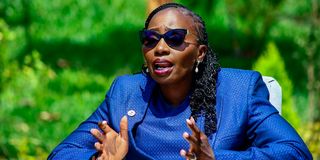
Law Society of Kenya President Faith Odhiambo during an interview at Don Bosco Utume, Karen, on September 16, 2025.
Photo credit: Wilfred Nyangaresi | Nation Media Group
Keen to defend the voices of youth who were opposed to Finance Bill 2024, she went all out to offer support, visiting police stations, standing on the Bar to defend suspects, being the first to reach where abducted youth had been released, among others.
“For over one year, I have known no peace. Since June 18, 2024, my phones have not stopped ringing with phone calls, messages and WhatsApp alerts from Kenyans in distress,” she said in a speech recently during the swearing-in of the Panel of Experts on Compensation of Victims of Demonstrations and Public Protests.
“I have to respond to calls at 3.45am,” she added. “I am called even on Sundays when I am in Church. When they cannot reach me, they will call my husband, my mother or my colleagues in the [LSK] council. Even my friends and former schoolmates aren’t spared either.”
A heroine she became. Many wanted her to join politics and vie for Kenya’s biggest seat. Many praised her. “Wakili simba jike,” a Taifa Leo headline once proclaimed.
The International Commission of Jurists (ICK)-Kenya named her the jurist of the year in 2024. She was named among the “Top 40 under 40” women by Business Daily in 2024. The Commonwealth Lawyers Association gave her the Commonwealth Law Conference Rule of Law Award 2025.
“Faith has become a beacon of hope and inspiration for many, notably during the 2024 Gen Z-inspired anti-tax protests, where she tirelessly advocated for the safety of protesters and demanded the release of those who were arrested and abducted. Her dedication to justice has earned her the admiration and respect of not just her peers but that of the public as well,” said the Commonwealth Lawyers Association.
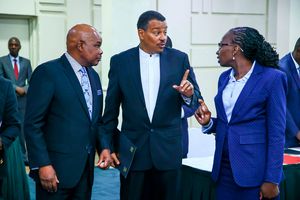
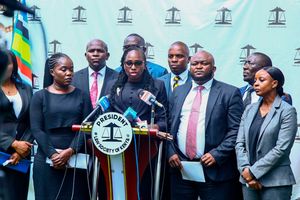
Prof Makau Mutua (left), Vice-Chair Faith Odhiambo(right) and panel member Irungu Houghton (center) during the swearing-in of the Victims Compensation Panel at the KICC in Nairobi on September September 4, 2025.
Photo credit: Wilfred Nyangaresi | Nation Media Group
However, the much that was given to her meant she was continuously under scrutiny. She was not just the LSK president but a woman every Kenyan looked up to.
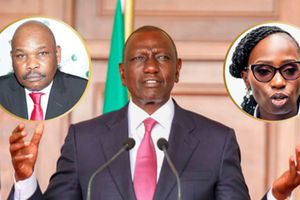
She won many accolades in July 2024 when she turned down an offer by President William Ruto to join a task force to audit Kenya’s debt, saying that was the job of the auditor-general.
And so, when she accepted Dr Ruto’s appointment of her into the Panel of Experts on Compensation of Victims of Demonstrations and Public Protests, as the vice chairperson no less, tongues were set to wag. And tongues wagged.
“I have today chosen a bold but unpopular step, some of my colleagues in the legal profession may not like this move and for sure, thousands of Kenyans have voiced their reservations,” she said on the day of the swearing-in of her team, led by Dr Ruto’s adviser Makau Mutua.
The most pressing question, and which has been put in a case filed before court, is: can’t the Kenya National Commission on Human Rights (KNCHR) do that job?
Another lingering question is: isn’t Mrs Odhiambo speaking from both sides of her mouth when she turned down one presidential appointment and accepted another?
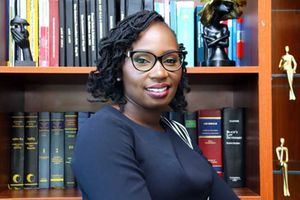
Law Society of Kenya President Faith Odhiambo.
Photo credit: File | Nation Media Group
In an interview with Nation on Tuesday, Mrs Odhiambo responded to those concerns, and below are the excerpts from the interview:
“First of all, I grappled with it a lot because my concern was: what would be our role? And is this just a PR stunt? And I grappled also with the question of what about the victims, the feelings of Kenyans and the scepticism that we all have about this government being able to deliver on any of its promises.
I did a lot of consultations with my seniors. I spoke to my colleagues in the civil society, just to get their opinions.
I listened to quite a number, just trying to process their fears, their scepticism, and some even offering their support to say, ‘You know, we’ll work together, we’ll sit like this, we’ll try and push and analyse what is the government’s commitment on this, and if we feel then it’s not, we’ll advise you this way.’ And so, it’s something that I’ve thought about with others, and what are the best ways, and how can we maximise to ensure that we actually see tangible change or propose actual policies and change to legislation.
Today, we have the Victim Protection Fund that has never been operationalised. So, even after going to the criminal justice system, the Victim Protection Fund should be up and running so that victims who have gone through that entire process can then seek that compensation”.
“KNCHR has a number of limitations. I’ve worked closely with the Kenyan National Commission of Human Rights. I support them wherever I can. I advocate that they should be given more funding to do their work. I’ve seen situations where their cars are literally grounded. They cannot even go to the streets because sometimes we have worked with them to see the situation in protests.
Law Society of Kenya president Faith Odhiambo..
Photo credit: File I Nation Media Group
We have gone around with them in police stations, we have gone around to hotspots to see what’s happening, the mistreatment and how police are behaving against protesters. And [there is the] sheer frustration that that institution goes through to just try and live its mandate. We work with the numbers that they [KNCHR] announce because we work jointly. And there’s that realisation that they give the recommendations, but what happens next?”
This was a personal decision for me. The appointment [to the panel] was in my personal capacity. As a law society, we make decisions as a council and therefore we continue to work together in that direction. We agree on consensus on the work that we do. And so, there is nothing to create a fear that the law society is compromised or the law society has been taken over by the government.
We make decisions as a council and the president is just the mouthpiece of the entire council because we reach decisions jointly before I can make declarations in my position as president.
For me, it was more about the victims than any other thing.
Q: As a member of the panel, what reforms would want to see?
I believe the compensation processes are too slow. We need to have strict timelines in terms of prosecution of cases of police brutality by the police, the abduction cases, the killings. There needs to be timelines. Unless we have timelines, cases can go on and on forever. And we know how our system is. It allows for porousness.
People can get a hold of witnesses under witness protection. And imagine putting your life on hold in hiding for 10 years under witness protection. People even get tired because you’re secluded from your family, your friends, your daily life. Your life totally changes because of a perpetrator. Life should not be difficult for victims; life should be difficult for the perpetrators.
And so, we need to change the system to make it more palatable for those who have been suffering. You should not be made to suffer more because of an individual who violated the law. They ought to be prosecuted timeously. Their case should be heard on a day-to-day basis so that victims can actually see justice.
You see, justice delayed is justice denied. If I have to wait for years and years, I’ll get tired of waiting and move on with my life. And that is the frustration that a lot of people face in the justice system. I’m not blaming the judiciary, but I’m saying there needs to be more done.
Baby Pendo’s case is an example. It is going to its 10th year, and plea-taking was only taken this year after immense pressure.
And you continue to see the frustration even going through plea-taking from the enquiry stage. Rex Masai is still at the [inquest] stage, and you see the tampering of evidence. There’s no bullet connecting that particular police officer to that gun. It took quite a long time to convince the witness who was with Rex to come out and say that they were there and they saw what happened. And it’s because of the frustration that we continue to see.
There’s no adequate victim protection funding to protect these victims. There is no adequate timeline in terms of how fast these cases go, and how much support is given even to the victim’s family to go through the judicial system.
So, if you’re telling someone you’ll see justice in 10 years-plus…imagine Rex Masai 10 years from now. We’ll be having [Generation] Alphas now who will be going to the streets, and no one will be remembering the story of Rex Masai. We’d have forgotten the names of these individuals. You see, reparations is not just about cash. It’s about acknowledgement.
The government must acknowledge that these are the people who were killed by virtue that they filled in their responsibilities. Those names must be put in a hall of fame to remember that these are the individuals who fell while fighting for the rights of their fellow citizens, fighting to protect the constitution, fighting for what they believed in. There needs to be psychosocial support.
I will abide by what the court decides on the experts’ team. We are officers of the court and when the court pronounces itself, we abide by the court orders. I submit myself in all humility to the jurisdiction of the court. So, the court will make its pronouncement and I will, as an officer of the court, abide by the court decision.
Regarding calls for my ouster from the LSK seat, there are people who have not been happy with the work that I’ve been doing. We have faced threats, and we have faced much more. And even council members have gone through a lot this entire period since we started the work that we have been doing as the law society. But we are a member organisation, and I’ll always submit myself to my members.
I’m human, and I can [err], but however, my true north is to serve the people as an institution and also serve the people of Kenya. I serve not to seek praise; I serve not to seek recognition. And I also serve not in fear. I serve in faith that I have in God that will continue to guide me.
It’s never easy; it’s never perfect, but I know my heavenly Father will continue to guide my steps.