The wide gap in the payment of tea bonuses by the 77 factories managed by the Kenya Tea Development Agency (KTDA) has kicked up a storm.
On average, farmers in the 21 tea-growing constituencies recorded a drop of between Sh0.80 and Sh19.10 in earnings, according to the interim report for the financial year ending June 30, 2025, compared with the previous year.
The 680,000 small-scale tea growers across the country have been anxiously awaiting the declaration of the annual bonus rate card per kilogram of green leaf delivered to KTDA over the last one year.
Under KTDA zoning, East of Rift represents counties in the larger Mount Kenya region, while West of Rift covers the Rift Valley and South Nyanza regions.
KTDA is expected, in a few weeks, to release the actual and cumulative payments that farmers will receive for their supplies, in addition to the monthly payments.
Tea growers in the East of Rift region will receive between Sh26 and Sh57 per kilogram of produce, in what is referred to as the “second payment” (bonus), according to documents seen by the Daily Nation and confirmed by KTDA directors.
In contrast, factories in the West of Rift will pay between Sh10 and Sh32 per kilogram — a sharp drop in earnings for small-scale farmers compared to last year. Kiru Tea Factory is the most affected, paying Sh32 per kilogram compared with Sh51.10 last year — a reduction of Sh19.10.
Embu’s Rukuriri Tea Factory leads in payments at Sh57.50 per kilogram, though this marks a drop of Sh4 from Sh61.50 paid last year. Mununga Factory follows with Sh57 per kilogram compared to Sh62.65 last year, reflecting a drop of Sh5.65. Imenti Factory will pay Sh56 per kilogram, down from Sh60.30 last year — a decrease of Sh4.30.
At the other end, farmers supplying Kiamokama/Rianyamwamu will receive Sh10 per kilogram, half of last year’s Sh20. Nyamache/Itumbe will pay Sh11, down Sh9 from Sh20.
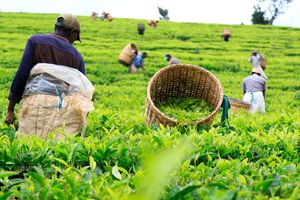
Workers pick tea leaves at a tea plantation.
Photo credit: File | Nation Media Group
Other factories in West of Rift — including Ogembo/Eberege, Sanganyi, Nyansiongo, Mogogosiek, Kobel, and Boito — will each pay Sh12 per kilogram. Gianchore, Kebirigo, Tombe, Kapkoros, Tirgaga, Olenguruone, and Motigo will pay Sh13 per kilogram.
Momul Tea Factory, the highest-paying in the West of Rift at Sh32 per kilogram, still marks a significant drop of Sh18.10 from last year’s Sh50.10.
“The huge differences in payments between factories in the West and East of Rift, which have persisted over the years, must be addressed to end longstanding claims and suspicions of manipulation at the Mombasa Tea Auction,” said Cheruiyot Baliach, a KTDA zonal director representing the Kaptebenget zone in Kapset/Rorok, Bomet County.
Mr Baliach added that neither the government’s tax waiver on packaging materials nor the Sh2.6 billion fertiliser subsidy has been felt in the industry.
“The government should strengthen existing systems rather than disrupt them. We must market Kenyan tea globally and open new outlets, rather than rely on traditional markets that are shrinking,” he said.
Motigo Factory director Simion Mutai cited high electricity costs, the stalled hydroelectric projects in South Rift and the now-suspended reserve auction prices under the Tea Act, 2020, as key reasons for the drop in payments.
Kericho Governor Dr Erick Mutai called for a second tea auction to be set up in South Rift to complement Mombasa, arguing this would address price discrepancies and expand market access.
“Globally, tea from the West of Rift is known for its quality and popularity, but this is not reflected in prices and farmer earnings. That farmers here are the least paid is unacceptable,” Dr Mutai said.
Claims that East of Rift tea is superior have fueled the disparities. But according to Philip Ng’eno, a large-scale tea grower in Bomet East and a university lecturer, this is unfounded.
“The issue of poor quality does not arise, because farmers adhere to the ‘two leaves and a bud’ standard set by the Tea Board of Kenya (TBK). What we must tackle are marketing challenges. Kenya should embrace specialty teas for niche markets, which fetch higher prices,” he said.
KTDA Holdings national chairman Chege Kirundi recently admitted, after a meeting with President William Ruto at State House, that the agency was navigating difficult times that would affect this year’s bonuses.
“This is a very bad year for us. Even with increased volumes sold, the shilling has strengthened from Sh160 to Sh129 against the dollar — a huge loss for farmers,” Mr Kirundi said. “The exchange rate, geopolitics, and currency devaluations have eaten into earnings. KTDA would greatly benefit from forex adjustments.”
He nonetheless praised the government for removing excise duty on packaging materials, supporting value addition through a common-user facility, and injecting Sh300 million to unlock investment in value-added products.
“The government’s strategy has opened new markets in China and the US. But external disruptions beyond our control continue to hurt earnings,” he said.
“Bonus payment will be a challenge due to the shilling’s strengthening. We urgently need government intervention and look forward to President Ruto’s support.”
In the financial year ending June 30, 2024, KTDA paid smallholder farmers a record Sh89.29 billion for green leaf supplies — up Sh21.5 billion from Sh67.7 billion in 2023. Of this, Sh56.68 billion was paid as bonuses, while Sh32.61 billion was disbursed in monthly payments.
KTDA Holdings also distributed Sh1.04 billion in dividends to 54 factories — the highest in its history.
President Ruto, during his meeting with KTDA directors, said agricultural reforms were starting to bear fruit.
“Tea sector earnings rose from Sh138 billion in 2022 to Sh215 billion last year, and we can push this to Sh280 billion by 2027. Prices have climbed from Sh51 to Sh64 per kilogram. With continued value addition, modernization, and branding, we will hit that target within two years,” Dr Ruto said.