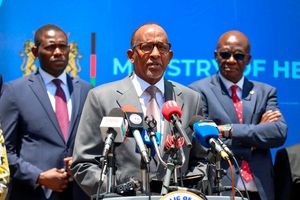
The procurement of technology to be used in next year’s General Election has been challenged before the Public Procurement Administrative Review Board, with a Kenyan company accusing the electoral body of discrimination and issuing a flawed tender.
Independent Electoral and Boundaries Commission (IEBC) floated two major international tenders for election-related goods and services.
One covers the Integrated Elections Management System (IEMS) and associated hardware, which will form part of the technology infrastructure supporting the Kenya Integrated Elections Management System (KIEMS) kits used for biometric voter identification and results transmission.
The commission has also floated a separate tender for ballot papers, tactile ballot folders for voters with visual impairment, the Register of Voters and statutory result-declaration forms.
However, Galadirel Investment Limited has challenged the IEMS procurement, arguing that the tender is flawed, discriminatory and violates Article 227 of the Constitution, which requires public procurement to be conducted in a manner that is fair, equitable, transparent, competitive and cost-effective.
In an application before the Public Procurement Administrative Review Board, the company argued that the tender document does not state the value of the procurement despite IEBC requiring bidders to provide a tender security of Sh30 million.
“The tender document contains vague, incomplete, or undefined technical standards and specifications, including provisions which remain in the nature of instructions to the procuring entity to ‘insert’ or specify the applicable standards, benchmarks and requirements, thereby exposing tenderers to uncertainty and subjective evaluation,” the company stated.
Galadirel said it was apprehensive that the requirements had been formulated in a manner tailored to favour a foreign company to the exclusion of otherwise qualified and technically competent Kenyan firms.
The company further argued that the tender document does not clearly and comprehensively specify the quantities, scope or estimated value of the goods and services being procured.
It said the omissions make it difficult for prospective bidders to determine the precise commercial scope of the procurement and prepare responsive bids.
The firm argued that Sections 58(2) and 70(3) of the Public Procurement and Asset Disposal Act, 2015, require tender documents to contain sufficient information to facilitate fairness, transparency, cost-effectiveness and competition, as well as specific requirements and timelines for delivery or completion.
“The tender fails to adequately disclose the compatibility, interoperability and integration criteria between the existing hardware, including the existing biometric devices, and the hardware and systems proposed to be procured,” Galadirel director Daniel Odhiambo said.
He added that the absence of clear compatibility requirements creates uncertainty over the technical standards against which the proposed information system will be evaluated.
According to Mr Odhiambo, this also creates a risk of unequal interpretation and application of the tender requirements.
The company further challenged what it described as substantial experience and qualification requirements imposed under the international tender.
It said the requirements, including those relating to the value of previous contracts, quantities supplied and international experience, appeared unduly restrictive and disproportionate and could have the effect of limiting competition.
Galadirel Investment Ltd argued that IEBC had not sufficiently explained the justification for the prescribed thresholds.
The company said the material omissions, contradictions, undefined requirements and incomplete provisions in the tender meant that prospective bidders did not have a clear, transparent and uniform basis on which to prepare and submit responsive and comparable tenders.
“The aforesaid omissions, contradictions and ambiguous material have the potential to affect competition, responsiveness, evaluation, comparability of tenders and equal treatment of tenderers, thereby rendering the procurement process procedurally defective,” Odhiambo said.
The company is seeking the intervention of the procurement review board over what it considers defects in the tender and wants the procurement process subjected to the requirements of public procurement law.