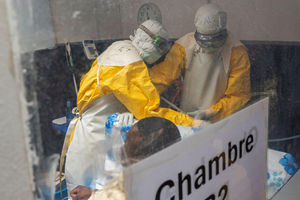
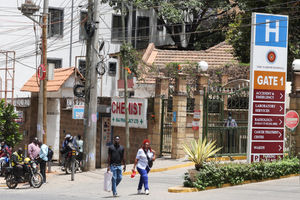
Kenya in race against time to trace contacts after first Ebola case
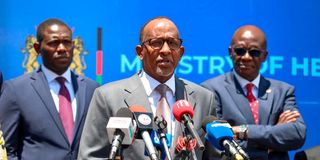
Cabinet Secretary for Health Aden Duale, accompanied by other government officials, addresses journalists during a press briefing at Afya House in Nairobi on October 6, 2026, after Kenya confirmed its first case of the Ebola virus.

What you need to know:
- 10 Kenyans have already been quarantined as health ministry follows up 57 people who had been in contact with the deceased.
- The patient flew with other passengers and after he was admitted, he was visited by family members and friends.
Three days passed between the moment Kenya’s first Ebola patient landed at Jomo Kenyatta International Airport and the moment the country was told he had the disease on Monday.
Before then and within those days, he flew with other passengers, travelled by car to the hospital and was received at the reception by staff who did not know his status. After he was admitted, he was visited by family members and friends.
Now, the Ministry of Health is working around the clock to find everyone who came into contact with him before anyone falls sick and infects other people. The early numbers show how difficult that task will be.
As of Wednesday morning, contact tracing had identified 57 people according to the Ministry of Health and only 10 had been quarantined. The patient landed in Nairobi on Jambojet flight 8523 from Entebbe at 1.10 pm on Saturday, October 3.
He passed through Port Health screening and immigration before a relative and a friend drove him to Nairobi Hospital.
The Ministry said he was initially placed in a separate room in the accident and emergency department before being moved to the East Wing Isolation Facility. Nairobi Hospital said he was admitted to its isolation unit on October 3 and died at about 11.30 pm on Monday, October 5.
Health Cabinet Secretary Aden Duale said 10 Kenyans had already been quarantined as the Ministry followed up the 57 people who had been in contact with the deceased.
“That is more than three days from landing to announcement. The usual aim in an outbreak is to reach contacts within 24 hours. Kenya has already gone past it. It’s actually more than that,” independent consultant pathologist Dr Ahmed Kalebi said.
The World Health Organisation has detailed guidelines for contact tracing during Ebola outbreaks. They are designed to help teams identify and isolate people who may have been exposed so that chains of transmission can be broken.
The process has three main stages: identifying contacts, listing them and following them up. Every potential contact is monitored for 21 days from the last day of exposure. Anyone who develops symptoms is isolated immediately to prevent further transmission.
Kenya’s response follows the same principle. The Ministry has identified contacts, is monitoring them for 21 days and says anyone who develops symptoms will be isolated.
Ebola spreads through contact with the blood or other body fluids of an infected person. The incubation period can be as long as 21 days, meaning an infected person may not show symptoms for weeks.
That makes every hour important in tracing and monitoring contacts.
A doctor noticed bleeding at a needle site and suspected a haemorrhagic fever. That was the first link in what Health CS Aden Duale calls a fast response to Kenya's first Ebola case.
Duale set out the factors the Ministry says made the difference. They run from the laboratory to the hospital, the family and the airport.
He told the Nation that the Ministry was told of a patient with a preliminary positive laboratory result at about 1 pm on Sunday. Its Rapid Response Team, which Duale described as well trained, quickly got in touch with the hospital to arrange collection of a sample.
The laboratory, also well prepared, analysed the sample with a turnaround of about six hours, he said.
Duale credited the hospital for keeping very good records, the Accident and Emergency team for being cooperative, and the Medical Director for being supportive.
He gave the most weight to what the doctors noticed. "The high index of suspicion from the medical team, particularly when there was bleeding from the venipuncture site and the turnaround time made a difference,” Duale said
The hospital, he said, had the necessary Personal Protective Equipment (PPE) to move the patient to the East Wing Isolation facility. It was also able to track the patient's movement and list all the staff who had interacted with him, according to Duale.
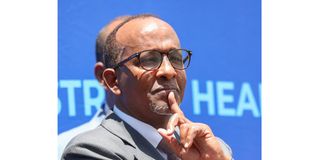
Cabinet Secretary for Health Aden Duale addresses journalists at Afya House in Nairobi on October 6, 2026, following Kenya’s first Ebola death.
Duale said the family was "very supportive and was open about what transpired, including where the patient had been for the last 6 months.” They gave the Ministry a list of all family contacts and their residences. They stayed at the hospital until late in the evening, and plans for the interment were made in consultation with them.
“Information flowed smoothly; we stayed in contact with them throughout. This matters beyond kindness. Contact tracing depends on people being honest about who they met and where they went.” Duale said.
At the Airport, every staff member who interacted with the patient and was on duty on October 3 was listed.
Duale said piecing together information from different sectors has been a challenge
“I am glad we are managing,” he said
According to Dr Kalebi, the incubation period can be as short as two days. A relative who came into contact with the patient on Saturday could already be at day three, he further explained.
“This person could have been infected and today he is infectious,” he said.
Prof Omu Anzala, a virologist and member of the National Task Force for Ebola, said it should be relatively easier to trace people who travelled with the patient on the flight as passenger records are available. His relatives and the people who drove him to hospital are also known.
The more difficult task, he said, will be tracing passengers who have since dispersed to different parts of the country or travelled onwards.
“Someone from that flight may have gone to Nyeri, Nakuru or Kisumu, or taken another flight,” he said.
Foreign passengers could pose an additional challenge because they may have travelled outside Kenya, requiring health authorities to coordinate with teams in other countries.
Prof Anzala suggested that passengers on flight 8523 should be asked to identify themselves and provide their whereabouts so that health teams can trace them.
According to the expert, they should not be asked to travel to health facilities because doing so could create further opportunities for exposure.
“It must be through persuasion and not force,” he said.
Dr Kalebi said the imported case should not cause widespread alarm unless local transmission is detected. He explained even a small chain of undetected contacts could quickly expand.
“I am not worried about one or two imported cases. My fear is local transmission. If the 10 Kenyans already in quarantine met five others each, and each of those met others, then Kenya would be in a dangerous spot. Kenya therefore needs ‘total and absolute contact tracing’ to stop any chain of transmission before it takes hold,” he said.
He also warned that the country’s isolation capacity could come under pressure if more cases emerge.
Ebola has no widely available proven cure, making early diagnosis, isolation and supportive care critical. The Ministry lists 62 isolation beds nationally and 23 isolation and treatment centres. Only five laboratories are authorised to test for Ebola because of the biosafety requirements involved in handling suspected samples.
Dr Kalebi said the government must move quickly to close any gaps before a small lapse triggers wider panic.
He called for a multi-agency response to contact tracing, including the Directorate of Criminal Investigations and intelligence agencies. CCTV footage from the airport and Nairobi Hospital, he said, could help identify people who came into contact with the patient.
“If the system could fail with one patient who is clearly infected, clearly sick, then how many other people could come through the cracks?” he asked.
Kenya has also tightened screening at Jomo Kenyatta International Airport, with travellers from 10 African countries considered at higher risk of Ebola transmission being directed through a designated gate.
Public Health and Professional Standards Principal Secretary Mary Muthoni said Gate 16 at JKIA would serve passengers arriving from the Democratic Republic of Congo, Uganda, Burundi, Rwanda, Ethiopia, South Sudan, Angola, Central African Republic, Zambia and Tanzania.
Ms Muthoni announced the measures after touring JKIA on Thursday to assess preparedness.
In addition to health declaration forms for passengers arriving in Kenya, the country has introduced forms for passengers leaving Kenya to provide information on their health status.
Passengers arriving in Kenya will also be required to provide information on their verified health status and any treatment they have received in the previous month.
The Africa Centres for Disease Control and Prevention has commended Kenya’s response so far while calling for speedy action to prevent further spread of the virus.
The 21-day monitoring period runs from the last exposure. For passengers who were exposed on October 3, the monitoring period ends around October 24. For health workers who treated the patient until Monday, October 5, it runs to about October 26.
If no contact develops symptoms by then, Kenya will have passed the critical window without recording another case linked to the patient.
But before that happens, health authorities must account for every possible contact.
“Right now is the golden chance. We need to do all we can to contain this before we record any other case,” Dr Kalebi said. Yesterday, President William Ruto said the country is adequately prepared to deal with Ebola incidents that may arise.
President said the Government has taken measures to protect the country from any potential risk arising from the case.
“In the coming hours and days, we will continue to inform the country of the necessary steps that the Government has taken and continue to take to ensure that we raise our surveillance to the highest level,” he said,” he said.
He pointed out that those who had travelled with the patient who died, the medical personnel who attended to him at Nairobi Hospital, and family members who came into contact with him have been identified and the necessary public health interventions instituted.
He spoke during the handover and dedication of the Raila Amolo Odinga Mausoleum at Kang’o ka Jaramogi in Bondo, Siaya County, on Wednesday.
Follow ourWhatsApp channel for breaking news updates and more stories like this.