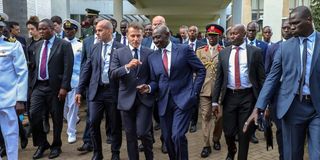
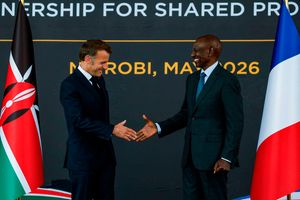
French President Emmanuel Macron yesterday admitted his country’s waning influence in West Africa and said the situation has pushed Paris to strengthen ties with Anglophone nations like Kenya.
At the start of the Africa Forward Summit in Nairobi, Mr Macron said the losses have helped France refocus on other parts of the continent.
It was one of several occasions Mr Macron has talked about France’s legacy on the continent. He said a rapidly shifting geopolitical landscape in West Africa, marked by military coups, made Paris adjust its mindset.
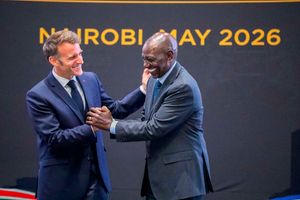
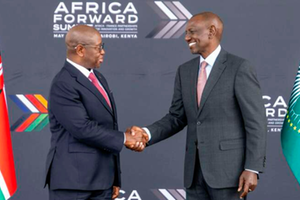
French President Emmanuel Macron and Kenya’s William Ruto after talks focusing on strengthening bilateral ties in Nairobi yesterday.
Photo credit: Reuters
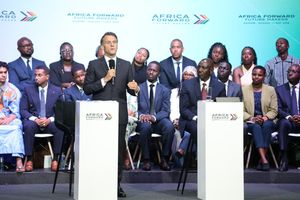
“I have never considered Francophone Africa as a private preserve. That is what I said in my Ouagadougou speech in November 2017,” he said at the University of Nairobi.
“There is the will to say: Africa is a whole. We are the true pan-Africanists. We believe Africa is a continent with much to build. It is the youngest, with an extraordinary demographic dividend.”
Mr Macron was referring to his address at the University of Ouagadougou, Burkina Faso, where he sought to distance himself from the notion of a singular “French policy for Africa”.
Since then, France has cultivated closer ties with English-speaking countries such as Kenya and Nigeria, as well as Egypt and Ethiopia.
“There is a policy we may pursue, there are friends, there are people with whom we agree and others with whom we do not. Above all, there is a continent we must face directly,” he said.
Burkina Faso, Mali and Niger are now run by armies that overthrew elected governments accused of being French puppets.
“Unity of African leaders is the firmest foundation required to secure the future. Leaders must be united in purpose, bold in vision and determined to shape Africa’s destiny through African solutions to African challenges,” President Ruto said when he met his Gabonese colleague Brice Nguema at State House.
Several heads of state are in Nairobi, including those of Comoros, Côte d’Ivoire, Senegal, Burundi and Chad. The summit officially openned on Monday.
Mr Macron, meanwhile, said Africa is no longer a place he wants viewed “as a private preserve where business leaders have contracts guaranteed simply because it is Francophone Africa”.
“Some believed France provided a form of insurance by making and unmaking governments. That era is gone,” he said.
Upon landing in Kenya for the two-day conference on Sunday, Mr Macron said France would no longer discriminate against countries based on language.
Presidents Duma Boko of Botswana (left) and Bassirou Diomaye Faye of Senegal (right) arrive at the University of Nairobi on Monday, May 11, 2026, for the afternoon engagements of the Africa Forward Summit 2026.
Photo credit: Dennis Onsongo | Nation Media Group
He added that those who refuse to work with France would “regret” it, as Paris would focus on English-speaking nations willing to host French companies.
“By being here for the Africa Forward Summit, following the innovative Montpellier summit in 2021, there is no intention to hide anything,” he said.
The inaugural Africa Forward Summit was in 1973. It has been used by France to cement ties with former colonies.
During a joint press conference at State House, Mr Macron said democratic backsliding would affect France’s long-standing relationships with some countries in West Africa.
“It is hard to say Western Africa will not be present. Three countries, regrettably, decided – because of coups and the behaviour of their armies – to set themselves apart. That does not mean West Africa is absent,” he said.
“The biggest leaders of the region are here. Beyond that, we will remain vigilant to ensure even Sahel states are represented.”
He added that disagreement with leaders does not mean France opposes the citizens of those countries. “We love the people of Mali, Burkina Faso and Niger. Their intellectuals, academics, artists and entrepreneurs are involved in this summit.”
President Macron added that his administration is moving quickly to engage all countries in Africa, citing the continent’s fast-growing economy and young population.
French companies and multinationals have lost a chunk of their market share in West Africa since 2017, deepening the need for new solutions.