The High Court has rejected a petition challenging alleged recruitment of “ghost workers” and relatives at the Nairobi County Assembly.
Justice Patricia Nyaundi dismissed the case after finding that the petitioner, Francis Awino, had failed to first use the statutory mechanism for challenging county government recruitment decisions.
“The petitioner bore the duty to demonstrate, with clarity and precision, that this court possessed jurisdiction notwithstanding the doctrine of exhaustion,” Justice Nyaundi said.
The petition centred on hiring of 12 staffs for Speaker's Office, alleged employment of MCAs' relatives and five purported ghost workers.
Mr Awino filed the petition on May 22, 2023, challenging the fitness of Speaker Kennedy Ng’ondi to serve as Speaker and chairperson of the County Assembly Service Board.
He alleged that 12 employees were irregularly hired into the Speaker’s office, contrary to a 2023 Salaries and Remuneration Commission circular which, he said, allowed five staff members.
The disputed employees listed in his petition included three personal drivers, three secretaries and one communications officer. He alleged five other workers were unidentified ghost employees.
Mr Awino also alleged that relatives of three MCAs were employed without advertised vacancies or competitive recruitment. He claimed the relatives were placed in the administration, legal and finance departments.
The petitioner wanted the Public Service Commission to conduct fresh interviews and appointments. He also asked the Ethics and Anti-Corruption Commission (EACC) to investigate the Speaker and, where culpable, recommend prosecution by the Director of Public Prosecutions.
The Speaker opposed the case, saying he did not personally recruit the Assembly employees. He said that responsibility belonged to the County Assembly Service Board.
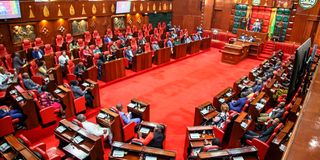
Speaker of the Nairobi City County Assembly Ken Ngondi during proceedings at the County Assembly in Nairobi on August 25, 2026.
Photo credit: Wilfred Nyangaresi | Nation Media Group
He argued that the Board had not been joined to the case and that the employees whose jobs were being challenged had also not been made parties to the petition. He described the petition as incompetent.
The Speaker further argued that employment disputes belonged before the Employment and Labour Relations Court and that the petition lacked sufficient detail.
The EACC also opposed the petition, saying Mr Awino had not shown that he had lodged a corruption complaint with the Commission or another investigative agency.
EACC said the petition was premature, the orders sought were untenable and that its continued participation served no identifiable purpose.
The court upheld the Speaker’s preliminary objection, holding that Section 77 of the County Governments Act provides a mechanism for challenging county-government recruitment decisions and that the petitioner had failed to demonstrate an exception to the exhaustion doctrine.
Justice Nyaundi found that the preliminary objection raised a pure question of jurisdiction and therefore met the legal test.
She then examined Section 77 of the County Governments Act, which provides a mechanism for challenging county public-service employment decisions.
The provision gives the Public Service Commission authority to hear appeals involving recruitment, selection, appointment and qualifications attached to county government offices.
Justice Nyaundi said the exhaustion rule requires litigants to use a prescribed administrative process before seeking judicial intervention, unless an established exception applies.
The court found Mr Awino failed to demonstrate that his case fell within an exception to that rule. The judge therefore upheld the preliminary objection and ended the petition without considering the substance of the hiring allegations.
“The Petition collapses at this threshold stage, leaving no room for the court to venture into the remaining issues,” Justice Nyaundi ruled.
The judgment made no finding on whether the 12 employees were unlawfully hired, whether relatives of MCAs were recruited improperly or whether the alleged ghost workers existed.