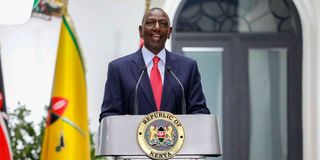
President William Ruto's proposal to launch a new long-term national development blueprint beyond Vision 2030 has triggered sharply divided reactions, with opposition leaders dismissing the initiative as an attempt to divert attention from governance failures, corruption and the high cost of living, while Kenya Kwanza allies defended it as a bold and necessary roadmap to secure Kenya's economic future.
Former Deputy President Rigathi Gachagua, former Chief Justice David Maraga and Jubilee presidential hopeful Fred Matiang'i led critics in questioning the President's credibility to champion another national vision before fulfilling existing promises, even as senior government officials and Kenya Kwanza leaders urged Kenyans to embrace the planned national conversation, arguing that the country's next phase of development requires broad public participation.
Mr Gachagua dismissed the proposal as an economic distraction designed to rescue what he termed a struggling political administration.
"It is not even a matter worth discussing that a president who has sunk the nation into a debt crisis, who advises his economic advisers on how to advise him, one who is selling state assets at throw-away prices, has captured the nation can tell us he is now taking us into 2060," Mr Gachagua said.
Former deputy president Rigathi Gachagua.
Photo credit: File I Nation Media Group
Former Chief Justice and presidential aspirant David Maraga also rejected the President's address, accusing him of deliberately avoiding the country's biggest governance challenge.
“Not once did he mention the word corruption. Not once did he denounce corruption. We know it as a fact that Kenya loses about three billion shillings a day. The more than one trillion shillings we are losing to corruption every year would do wonders to this country," Mr Maraga said.
Linda Mwananchi leader and Nairobi Senator Edwin Sifuna argued that the President had attempted to place economic development above the constitutional principles that underpin the country.
President Ruto announces new Economic blueprint to succeed Vision 2030
"Kenyans, please trust me when I tell you there is a reason the Preamble comes before Article 43. You don't get to the development clauses until and unless you have considered the reasons we passed this Constitution in the first place- democracy, human rights, freedom, equality, rule of law and social justice."
Jubilee Deputy Party Leader and presidential hopeful Dr Fred Matiang'i also questioned the timing of the proposed national dialogue, describing it as a diversion from pressing governance failures.
Dr Matiang'i argued that the administration had failed to implement existing reform proposals, including recommendations contained in the National Dialogue Committee (NADCO) report, and therefore lacked the credibility to launch another national conversation.
"It is a contradiction that Ruto has the temerity to lecture us about human rights and the patriotic clauses of our Constitution when he has failed to address cases of rampant thuggery and the wanton breakdown of law and order in our country," Dr Matiang'i said.
Democratic Party leader Justin Muturi said the President should first account for the performance of his Bottom-Up Economic Transformation Agenda before proposing another long-term economic blueprint.
"William Ruto, you can't call for a national conversation beyond 2030 when many Kenyans are still asking, 'Can we first finish the conversation about your 2022 BETA and Hustlers Economics?'" Mr Muturi said.
ODM National Treasurer Timothy Bosire echoed similar sentiments, saying corruption remained the country's biggest obstacle to development.
"The shameless display of the culture of corruption by the government and the political class is extremely embarrassing. Even God is unhappy with our country," Mr Bosire said.
The criticism came less than 24 hours after President Ruto used a special State of the Nation Address to unveil what he described as a national conversation that will shape Kenya's development agenda for the next three decades.
The President announced that beginning August 12, the government would convene experts, leaders and stakeholders to formulate a successor to Kenya Vision 2030, arguing that the country needed a fresh economic and development roadmap capable of transforming Kenya into a high-income, industrialised nation by 2060.
The Head of State framed the initiative as a non-partisan national project, saying it would build on the gains made under Vision 2030 while responding to emerging global economic realities and technological changes.
A section of Kenya Kwanza leaders has, however, rallied behind President William Ruto's proposed post-Vision 2030 development agenda, urging Kenyans to embrace the planned national conversation instead of dismissing it along political lines.
Cabinet Secretary for Interior and National Administration Kipchumba Murkomen speaks during a service at AIC Plainsview Church service in South B, Nairobi on June 14, 2026.
Photo credit: Billy Ogada | Nation Media Group
Interior Cabinet Secretary Kipchumba Murkomen dismissed the criticism, insisting the initiative would secure "a brighter and more dignified future" for Kenyans.
Mr Murkomen said the President was right to place development at the centre of his agenda, arguing that the country's long-term prosperity could not be divorced from the Constitution.
"The President is placing development at the centre of his agenda and securing a dignified future for Kenyans. That is why he unveiled the Beyond Vision 2030 agenda yesterday," he said in Embu County on Friday.
Mr Murkomen further defended the Kenya Kwanza administration's development record, particularly in the Mt Kenya region, saying the government's performance would ultimately be judged by its achievements.
During an interdenominational choir fundraising event at Nyambaria Boys High School in Nyamira County, Senate Majority Leader Aaron Cheruiyot said the President's proposal was intended to give Kenyans an opportunity to shape the country's long-term future, arguing that nations that have achieved rapid economic growth did so by pursuing a shared national vision.
"The president spoke about Kenya's vision. He said if you look at developed countries, it's because they had a plan, a vision. People sat down and, as a country, they agreed they had to move forward. That's why you hear about Singapore and other countries," Mr Cheruiyot said.
"The national conversation brings together Kenyans of goodwill who want to see their country move forward, and these are the people who should join in the conversation to share their views on what we should do."
Nyaribari Chache MP Zaheer Jhanda also backed the President's proposal, saying the national conversation offered Kenyans an opportunity to chart the country's economic future.
He argued that the opposition's criticism stemmed from a lack of alternative ideas, insisting the Kenya Kwanza administration had already laid the foundation for sustained growth through investments in infrastructure, electricity connectivity and healthcare reforms.
UDA Secretary General Hassan Omar also defended the President's address, accusing the opposition of politicising a development agenda that he said was aimed at sustaining Kenya's economic recovery and laying the foundation for long-term transformation.
Mr Omar argued that President Ruto had first stabilised the economy before embarking on a new national vision, citing the Affordable Housing Programme, reforms in the healthcare sector and expanding access to credit as some of the administration's achievements.
"The opposition have minimal understanding of the economy and transformation. The President started by stabilising the economy through affordable housing and the transformation in healthcare. We won the presidency because of economic reforms, and he has now set out a vision that reflects the new realities and the progress we have made as a country," Mr Omar said.
He maintained that the proposed post-Vision 2030 blueprint would build on gains already made rather than replace previous development plans.
- Reporting By Ndubi Moturi, Mwangi Muiruri, Ruth Mbula, George Munene