'Don't hang your child's clothes near ours': The mothers fighting disability stigma every day

Edna Kiplagat (left), with her daughter who suffers from delayed milestone and trauma, and Carolyne Adhiambo, with her son who suffers from cerebral palsy, at the Mathare Care Centre, Nairobi, on July 25, 2025.

What you need to know:
- When husbands leave and communities judge, mothers like Carolyne and Edna continue to carry love and hope.
They raise disabled children alone, face stigma and are the unseen heroes of Kenya’s care crisis.
The sound of silence can be deafening. Twelve years ago, when Carolyne Adhiambo walked into Pumwani Maternity Hospital, she expected to hear her newborn's first cry—that universal announcement of life beginning. Instead, she was met with a silence that would change everything.
Her baby boy had suffered oxygen deprivation during birth, resulting in cerebral palsy, a permanent neurological disorder that affects movement, muscle tone, and posture. Today, he cannot talk or walk.
"My life changed completely," Carolyne says quietly.

What followed was a cascade of abandonment that too many Kenyan women know all too well. Her husband, rather than offering support, turned accuser. He blamed her use of family planning for their son's condition and made a devastating declaration: he couldn't live with her anymore.
"It hurt then, and it still does," she reflects.
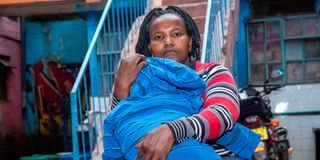
Carolyne Adhiambo carries her son, who suffers from cerebral palsy.
Left to raise three children alone, including one with special needs, Carolyne cobbles together a living as a tailor, sometimes earning just Sh400 a day. The income barely covers basic needs, let alone the special diet, medications, and weekly physiotherapy her son requires.
But perhaps the cruellest burden is the social stigma that follows her everywhere.
"Where I live, women don't want me to hang my son's clothes near theirs," she says, her voice cracking. "They think I'll infect their children with his condition. It makes me cry, but what can I do?"
Despite these overwhelming challenges, Carolyne takes her son for therapy three times a week. Slowly, painstakingly, he has learned to stand and even take a few steps, though balance remains elusive.
Her story echoes in households across Kenya, where mothers like Edna Kiplagat face similar struggles. Edna's second child, now one and a half years old, was diagnosed with delayed developmental milestones and trauma shortly after birth. The diagnosis forced Edna, a trained salonist, to abandon her dreams of returning to work.
"I had to stop working. She needs my full attention every hour of the day," Edna explains. "Sometimes, when I see other children developing normally, I ask—why my child?"
Despite the emotional toll, Edna clings to hope. After months of consistent physiotherapy, her daughter can now crawl, turn her neck, and hold it up firmly.
"I believe she will one day stand and walk," she says with quiet determination.
But hope doesn't shield her from public scrutiny. Strangers regularly stop her with invasive questions: "What's wrong with your child? Why isn't she growing?"
"I never know what to say," Edna admits. "I just tell them, 'She'll be fine.'"
While caring for her daughter consumes her days, Edna dreams of saving enough to open a small salon—a path back to financial independence and dignity.
Invisible burden
Carolyne and Edna's experiences represent countless untold stories of mothers raising children with disabilities in Kenya. These women exist at the harsh intersection of caregiving and survival, ignored by systems and judged by communities, yet somehow finding the strength to give their children dignity and love.
Their daily reality involves round-the-clock feeding, cleaning, monitoring, lifting, soothing, and emotional labour that remains largely invisible and unacknowledged. For mothers of children with disabilities, this unpaid care work extends far beyond typical household chores.
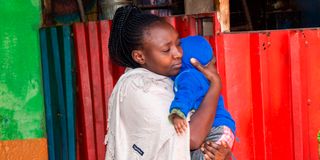
Edna Kiplagat with her daughter.
The economic impact is severe. Caring for a child with a disability often limits a mother's ability to work, reduces her income, and leads to long-term economic insecurity. Studies show that the more severe the disability, the more likely a mother is to stop working entirely.
According to the Kenya National Bureau of Statistics, women already spend 3 hours and 36 minutes more than men each day on unpaid care and domestic work. Among working women, this unpaid labour still exceeds that of men by over 3 hours daily.
Amidst this struggle, both women have found refuge at the Mathare Care Centre, a community-based initiative dedicated to supporting children with disabilities and their caregivers. Founded in 2018, the centre offers free physiotherapy sessions, psychosocial support, and a day-care facility where mothers can stay with their children.
The centre has served more than 280 children from Mathare and Dandora, most diagnosed with conditions like cerebral palsy, autism, and delayed developmental milestones.
"The stigma mostly affects the mothers," explains Nelson Otieno, the centre’s manager. "People don't understand disability. Many parents, especially mothers, are isolated and overburdened."
The day-care, limited to 20 children, plays a crucial role in easing the unpaid care burden these women carry. It represents something revolutionary: recognition that care work has value and that caregivers deserve support.
This recognition has gained momentum at the national level. In May 2025, UN Women Kenya, in collaboration with the State Department for Gender and Affirmative Action, launched the Evidence to Policy for Kenya Care Economy initiative. Backed by the Bill and Melinda Gates Foundation, the initiative seeks to recognize, reduce, redistribute, reward, and represent care work—especially the kind that women like Carolyne and Edna shoulder silently every day.
"This is not just a social issue," says Dan Bazira, UN Women's Deputy Country Representative. "It's an economic issue. When unpaid care work is overlooked, so is development. We need robust investment in the care economy."
The Mathare Care Centre stands as one of the pilot sites demonstrating what such investment looks like in practice: dignity for caregivers, mobility for children, and hope for families long abandoned by both policy and community.
Nelson Otieno remains optimistic about changing attitudes. He urges parents not to hide children with disabilities but to seek help and support.
"I want to see a future where people with disabilities are respected, and their parents empowered economically," he says.
For Carolyne and Edna, their hopes remain beautifully simple yet profound.
"I just want him to be happy and treated like any other child," Carolyne says. "He didn't choose this."
"I want to work again one day," Edna adds. "But until then, I'll keep fighting for her."
Their stories may not be rare, but their resilience is remarkable. In a society where the burden of care still falls unequally on women's shoulders, mothers like Carolyne and Edna continue to hold up not just their families, but a nation's conscience.