'How can I call my wife 'sweetie' at this age'? Inside Kenya's marriage revolution
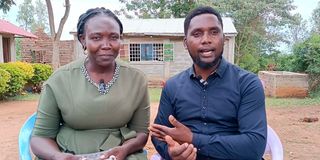
Pastors Stellar Asio and Daniel Sina during the interview on December 15, 2025 outside Jesus Celebration Center Church in Kavunyu, Machakos County. They are among the facilitators of ‘Becoming One’, a 14-session group counselling programme designed to strengthen marriages and prevent intimate partner violence.

What you need to know:
- According to the 2022 Kenya Demographic and Health Survey, 41 per cent of women who have ever had a husband or intimate partner have experienced economic, psychological, emotional, physical, or sexual violence from their current or most recent partner.
- Among men, 36 per cent have experienced similar forms of violence in their lifetime.
In a small church in Kavunyu, Machakos County, Pastor Stella Asio stands before the congregation, leading worship, delivering the sermon, making key ministry decisions. Her husband, Pastor Daniel Sina, sits in the front row, fully supportive.
"I step back and let my wife take the lead in church matters, and I'm completely comfortable with it," he says. "I'm proud of her."
This wasn't always their reality. Just a few years ago, the idea would have seemed impossible. The Sinas, like countless Kenyan couples, had inherited rigid ideas about marriage — who leads, who submits, who controls the money, who makes decisions.


According to the 2022 Kenya Demographic and Health Survey (KDHS), 41 per cent of women who have ever had a husband or intimate partner have experienced economic, psychological, emotional, physical, or sexual violence from their current or most recent partner. In the 12 months before the survey, 29 per cent of women experienced at least one form of such violence. Among men, 36 per cent have experienced similar forms of violence in their lifetime, with 28 per cent reporting incidents in the preceding year.
Yet in Makueni's Kalawa Ward and Machakos County's Mwala Ward, something remarkable is happening. On a Tuesday evening at the Jesus Celebration Centre church hall at the foot of Kavunyu Hills in Machakos, 10 couples sit side by side, illustrated workbooks in hand. They are not here for a sermon. They are here to talk about money, intimacy, respect, and how they speak to each other when anger flares. For many, it is the first time such conversations are happening openly, guided not by counsellors in white coats, but by their own faith leaders.
"What do you do when you wrong each other and start shouting?" Asks Pastor Stella, leading the opening session, while her husband sits beside her, waiting to take over the next session.
"You calm down and only discuss the problem once you're both calm," a couple responds, completing each other's sentences.
After Pastor Stella, her husband takes the stage to talk about intimacy. He asks in Kamba language: "When was the last time you called your wife or husband 'my sweetie'?"
The couples, whose ages range from their 30s to 60s, look at each other with surprised grins.
"How can I call my wife 'sweetie' at this age?" One husband, visibly in his 50s, responds, his tone betraying his discomfort with the idea.
Pastor Daniel reminds the audience that love and intimacy are ageless and can be expressed in many ways, including using endearing language.
"When you pass by a shop and see something nice, buy it for your husband or wife, bring it home, and tell them, 'I have brought you a gift, and you know, I'm always thinking of you,'" he advises. "When you do this, you build healthier, happier families. Your children feel that happiness too, and it helps them grow into well-adjusted, joyful individuals."
What pastors Stella and Daniel are facilitating is ‘Becoming One’, a 14-session group counselling programme designed to bring couples closer and prevent intimate partner violence. Delivered through churches, the initiative is reshaping relationships, one household at a time.
Here, the Sinas and two other couples share their stories; honest, sometimes painful, ultimately hopeful and how Becoming One changed their marriages.
'I step back and let my wife take the lead in church matters'
Pastors Stella Asio and Daniel Sina
We pastor at Jesus Celebration Centre in Kavunyu, Machakos County. We started this church in July 2016.
Our story began much earlier. My dear wife is from Uganda. I met her in 2009 when we were doing missionary work. She had just finished university with a degree in business administration, and I had completed diplomas in Christian ministry and early childhood education. At the moment, I'm also pursuing a diploma in Electrical and Electronics Engineering.
We met as friends, sharing stories and encouraging each other in Christ. By December 2012, I proposed, and after prayer and counsel, she said yes. We wasted no time planning our marriage in 2013—from the introduction in April, to dowry negotiations in August, to our pre-wedding and wedding in October.
Before joining the Becoming One programme, our understanding of marriage was limited. We had knowledge, yes, but it was basic, and often we felt like we were "hitting a rock" when counselling other couples. We wanted to help, but our tools were insufficient. What we knew was shaped by how we were raised—ideas such as "a wife should respect her husband" and "a husband should love his wife," without examining the dynamics behind those expectations. You cannot beat a wife into respecting you under the pretext that a punch here or there is a sign of love. Love and respect go hand in hand, but in the generations we were raised in, those ideas were sometimes distorted to justify violence.
Then the programme came and it transformed everything. It gave us practical guidance on communication, finances, love, and mutual respect. It taught us that marriage is about partnership—not one person dominating, but both moving toward shared ground.
Through this programme, we learned to communicate effectively, resolve conflicts, and support one another. Before, there were times when money, work, or simple misunderstandings caused tension. For instance, Stella had always kept a "secret" emergency fund. When I discovered it, I realised we needed to trust each other fully with our finances. Now, we manage everything together. We plan, budget, and support each other.
We also learned that household chores and responsibilities are shared. It's not only my job or hers; it's ours. Now, we farm together, manage the home, cook, and care for our children. The programme taught us that submission and headship are not about control, but about love and respect. Submission flows from love, and leadership is shared.
For instance, traditionally within church structures, the husband is positioned as the chief pastor, while the wife takes a subordinate role. But the programme changed my perspective—there is no hierarchy like that. Now, I step back and let my wife take the lead in church matters, and I'm completely comfortable with it. I'm proud of her and fully support her.
And because we are among the faith leaders facilitating this programme, we now teach other couples from experience. We were taught, we applied it in our own marriage, and now we pass it on.
'Our marriage is now sweet, joyful, and heavenly'
Samson Wambua and Priscilla Wambua
We got married in 1988. We were young, and we related to each other the way society had taught us. A man was not expected to listen to his wife's advice or accept her ideas for development. Even when it came to investments, decisions were supposed to come from the husband, not the wife.
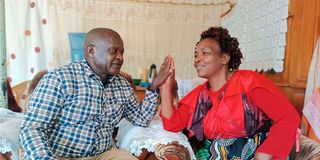
Samson Wambua and Priscilla Wambua during the interview at their home on December 16, 2025, in Kangondi village, Machakos County. The couple say their intimacy has greatly improved following their participation in 'Becoming One'.
That was difficult, because I made all the financial decisions. I am a videographer, while my wife runs small businesses, including an eatery in a nearby shopping centre.
There were times I would go out to work and come back with nothing. Money became a hostile subject.
Our children are now grown, and there were moments when I could not manage to pay school fees. My wife would secretly take loans from chamas and clear the fees. If I asked how she had managed, she would tell me I should not ask where the money came from. That was painful. As a man, I was raised to believe that I must be the provider and take care of my family. It made me feel diminished, as though she was looking down on me, and it became a source of bitter quarrels.
We are now past those challenges.
We have learned how to listen, not just to speak. Now, when my partner talks, I wait, I listen carefully, and then I respond. We were taught that careless words can hurt deeply, and that has stayed with us. Before, my husband often silenced me. Now, my voice is heard. My husband listens to me, and I feel respected.
The love between us has grown, and even our children notice it. They tell us that when we are together, we are happier and friendlier. We know we are now role models, not only to our children, but to others around us. Through this programme, we learned the importance of conversation, listening, encouragement, and mutual respect. Today, we are not just husband and wife—we are friends in our home.
Financially, we have also grown tremendously. Before, money could easily cause conflict. Now, whatever we earn, we share openly with each other. We plan together, agree together, and even do business as partners. We combine ideas, explore opportunities, and support each other. I have learned that finances are not one person's responsibility; they belong to both of us.
Our intimacy has also changed for the better. Before, we did not understand it deeply; it felt rushed and unplanned. Through the programme, we learned that intimacy requires preparation, patience, and equality. We learned that both partners deserve equal time, pleasure, and respect. That understanding has strengthened our bond.
This programme has also earned us respect, not just in our home, but in our community. People listen to us now because they see us working together. Before, we were doing things, but without depth. Now, everything we do has meaning.
Even before the programme, we helped each other. We fetched water together from far places, worked in the fields together, and supported one another. But this programme became a catalyst. It motivated us to do even better, with humility and understanding.
For us, our marriage feels like it has just begun. It is sweet, joyful, and heavenly. I only wish this programme had come earlier. Our happiness could have started sooner.
'Our marriage is no longer a home of an angry husband and a frustrated wife'
John Mutunga and Purity Mwende
This is our fourth year of marriage. Life after marriage was challenging. Things were not easy, and we had to struggle to make ends meet. We started attending church and our pastor introduced us to the programme. At first, it was very difficult to follow. Some lessons were hard, like discussions on intimacy. We wondered, "How will we manage this?" But we didn't give up. We continued learning, and slowly we started to see changes in ourselves.
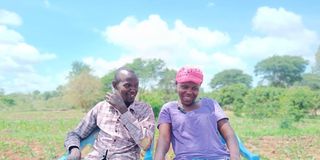
John Mutunga and Purity Mwende during the interview at their home in Kingatwani village, Makueni County, on December 17, 2025. They say they have become a team in household chores and farm work after learning about partnership through 'Becoming One'.
We have learned that no task is solely for women or men. We now support each other with chores like fetching water and cooking. Before, my wife had no control over the money I brought home; I decided how it was spent. Now, we budget, plan, and save together. Money is no longer a source of fear; we see it as a tool for stability and independence.
We have also learned the value of farming. Before, my husband used to be frustrated with me because I never tended the goats or cows. I couldn't feed them or give them water, and this caused major conflicts between us. Now, however, we wake up early together, make tea, go out to the farm, and work side by side. I help with the goats and cows, too.
We have learned that marriage is about partnership, equality, and understanding. Our marriage is no longer a home of an angry husband and a wife frustrated by constant reminders about feeding the goats. We understand each other better and are now a happy couple.
Why faith leaders?
The origins of Becoming One can be traced back to Liberia, where researchers sought to understand who communities trusted most to help resolve conflict within families.
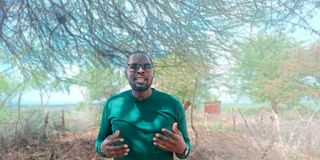
Lyndon Aduda, a field research manager at Innovations for Poverty Action, a global research and policy organisation. He says faith leaders were trained as facilitators of the 'Becoming One' programme because they are among the most trusted figures in the community.
"The answer came back again and again: faith leaders—the pastors. They were deeply local, accessible to both women and men, and incredibly influential in setting norms about what was acceptable in the home," explains Lyndon Aduda, a field research manager at Innovations for Poverty Action (IPA), a global research and policy organisation.
Yet many pastors admitted they felt ill-equipped to deal with persistent conflict and violence in marriages. That gap inspired an interdisciplinary team—experts in violence prevention, researchers familiar with religious institutions, and community insiders—to co-create a programme rooted in faith but grounded in evidence.
The result was a curriculum built around illustrated workbooks, making it accessible even to faith leaders with varying literacy levels, with sessions focusing on communication, emotional regulation, shared control over finances, healthy sexual relations, and mutual respect—issues repeatedly identified as flashpoints in domestic conflict.
Evidence from Uganda
In 2017, IPA partnered with World Vision and International Care Ministries to pilot the intervention with 35 faith leaders in Northern Uganda. Early lessons shaped its design: sessions were reduced from twice a week to once weekly to make attendance realistic, and materials were made more visual.
Then, in 2018, IPA conducted a large-scale randomised controlled trial involving 1,680 couples and 140 faith leaders across three districts in Western Uganda. Half the couples received the programme immediately, while the rest formed a comparison group.

Andrew Muganda, World Vision Kenya’s spiritual nurture coordinator, during the interview on December 18, 2025, in Mbavani village, Makueni County. He says the organisation hopes to mobilise resources to expand the 'Becoming One' programme beyond Machakos and Makueni counties.
The findings were striking. Twelve per cent fewer women in participating households experienced violence. Put differently, for every 20 couples that went through the programme, violence against at least one woman was prevented.
Equally important was why it worked. "The strongest predictors of impact were the faith leaders' own views on gender equality and how closely they adhered to the curriculum," Lyndon notes. "Who delivers the programme, and how, really matters."
Piloting in Kenya
In Kenya, the intervention is being piloted by World Vision in partnership with IPA, targeting churches in Kalawa Ward, Makueni County, and Mwala Ward, Machakos County.
"We chose these areas because we already had strong relationships with churches there," says Andrew Muganda, World Vision Kenya's spiritual nurture coordinator. "Faith leaders are among the most trusted individuals in community settings, which makes them powerful agents of change."
The process begins by engaging senior church leaders and securing buy-in. They, in turn, nominate trusted faith leaders, who are then trained alongside their spouses for a full week. Each trained leader recruits cohorts of 10 couples from their congregation, guiding them through the 14-week curriculum.
The programme addresses four core areas: communication, finances, sexual intimacy, and respect. Crucially, faith leaders teach the programme together with their spouses, modelling the values they promote.
Since the pilot began in August 2024, 86 faith leaders have been trained across the two regions, reaching 914 couples. The pilot concluded in December 2024.
Beyond the couple: children at the centre
Andrew says the programme's ripple effects on children are just as important as its impact on couples.
"When marriages are strengthened, children notice," Andrew says. "We are hearing children say their parents communicate better, argue less, and make decisions together. Homes are becoming places of peace."
Various studies show that in households where violence and constant conflict once prevailed, children often absorb trauma silently, affecting their emotional wellbeing, school performance, and sense of safety. By helping couples build healthier relationships, *Becoming One* creates what Andrew calls "a thriving environment where children can grow extremely well."
Scaling what works
One of the programme's strengths lies in its sustainability. "This is a church-led initiative," Andrew emphasises. "Once faith leaders are trained, they can continue supporting couples long after World Vision's programmes end."
The next step is scaling up. Andrew hopes to mobilise resources to expand the programme to other counties.
As couples leave the church hall after another session, some holding hands, others deep in conversation, the name of the programme feels less like an aspiration and more like a lived reality: becoming one, together.
Government efforts
Meanwhile, the Kenyan government has made efforts to tackle domestic violence.
In December 2024, the government launched a national three-year initiative called 'Safe Homes, Safe Spaces,' specifically intended to address femicide. During the official launch in Kakamega, the Prime Cabinet Secretary Musalia Mudavadi who was also the acting CS for Gender, indicated that training would include relevant stakeholders, such as boda boda operators. A month earlier, President William Ruto had committed Sh100 million to the campaign.
Before the year closed, Mudavadi reminded Kenyans that femicide was an "elephant in the room," having claimed the lives of 100 women in just four months, from August to November of the same year. He also informed the nation that the Inspector General of Police had formed a specialised missing persons unit within the Directorate of Criminal Investigations' homicide unit to address cases of femicide. However, these actions were taken only after anti-femicide campaigners marched in January and December, calling for an "End Femicide Now."
While these interventions are not explicitly aimed at domestic violence, which encompasses violence against women and men, their outcomes directly impact its prevalence. UN Women describes femicide as an extreme outcome of domestic violence.
President William Ruto also established a taskforce to examine gender-based violence, including femicide, although its findings and recommendations have yet to be made public.
The government, through the State Department of Gender and with support from non-state actors, operates the national hotline 1195, where those at risk of abuse or violence can call for help and receive guidance on accessing the necessary support.
However, experts say that addressing domestic violence requires more than just reactive interventions.
"What we address mostly is the symptomatic effects of domestic violence. For us to aggressively address its prevalence, we must address the root causes. And the root causes are from how we are socialised as women and girls, prevailing stereotypes, realities of the economy," Anne Ireri, former executive director at Federation of Women Lawyers in Kenya, said in an earlier interview.
Yet men need to be helped to do away with toxic masculinity, the radical sermon preached to them throughout their childhood by fathers and mothers who went through the conservative tradition.
"Men have continuously been left behind from being supported to understand their proper role and to fit in the present-day life where we are talking about human rights and gender equality," stated Kennedy Odhiambo Otina, executive director of Masculinity Institute, in an earlier interview. The national organisation was started in 2012 to promote the welfare of boys and men in Kenya.


