'Politics is the home of liars': The SDA believer who redefined politics in Makueni
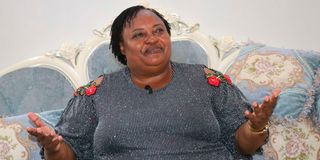
Makueni Woman Representative Rose Museo during the interview in Kibwezi township, Makueni County, on September 22, 2025.

What you need to know:
- From fighting hunger in Masongaleni to championing women’s empowerment, Rose Museo’s journey shows how faith-driven leadership can change lives – one water tank, one woman at a time.
Rose never planned to join politics, but a broken leg, a persistent governor, and a community in need transformed her into one of Makueni’s longest-serving and most impactful leaders.
Two months before the 2013 General Election, Rose Museo was certain of one thing: she would never join politics. A staunch Seventh-Day Adventist, she believed politics was a world tainted by deceit and moral compromise—the opposite of her faith’s teachings.
“To me, politics was dirty. It was the home of liars,” she reflects in an interview with the Nation.


At the time, Rose was also recovering from a road accident that had left her with a broken leg and a wounded sense of self-worth. It took the persuasion of then Makueni Governor Prof Kivutha Kibwana to change her mind.
Prof Kibwana was among those who had recognised leadership potential in Rose. Her years of women empowerment work through the SDA women’s ministry and her experience at ActionAid, where she improved lives in the drought-prone Masongaleni Settlement Scheme, made her stand out.
“One day, Prof Kibwana brought a team of around 600 delegates to my home to convince me to join politics,” Rose recalls. “When I told him I couldn’t campaign because of my leg, he said, ‘There is no problem. We shall ask for that seat. People know you.’ And I was persuaded.”
From activism to politics
Rose’s first taste of activism came long before she considered elective politics. In the early 1990s, the government evicted hundreds of families from the eastern slopes of Chyulu Hills in an environmental conservation drive, resettling them in Masongaleni. When relief food failed to arrive, hunger hit hard.
Working with ActionAid, Rose took a bold stance. She threatened to resign unless the NGO added a food aid component to its programme—a radical demand given the organisation’s strict policy against distributing food. Her determination won. ActionAid eventually introduced food support for the displaced families.
That moment, she says, taught her that leadership means taking risks to serve others. When ActionAid ended the programme in 2005, Rose transitioned to become the Director of the Children and Women Ministry at the SDA Church, deepening her passion for community work.
Inspired by female trailblazers
Rose drew inspiration from formidable women leaders like Agnes Ndetei, the former Kibwezi MP, and Charity Ngilu, the first woman to run for Kenya’s presidency. “From the two, I learned that voters expect their representative to be a fighter—someone who moves things or speaks for them. They don’t like polite leaders,” she says.
She has often lamented the dominance of retired men in community leadership in Makueni, observing that few women are encouraged or supported to take up such roles.
“Men say allowing women to lead is dangerous—that they’ll become radicals. This is unfortunate. When women are excluded from development, the whole community lags behind,” she insists.
Championing water, empowerment, and equality
With her background in sustainable development, Rose has made her mark through tangible projects. Her signature initiative—the plastic water tank programme—has transformed households across Makueni.
“For over 10 years, I’ve promoted rainwater harvesting through affordable plastic tanks. We created a friendly payment plan, making ownership possible for every home. A random check shows a blue tank in every three to four homesteads,” she says.
Beyond easing women’s burden of fetching water, the programme has helped combat waterborne diseases such as amoeba, bilharzia, and typhoid.
Read: Timeline: The rise and fall of women's representation in Kenya’s political leadership since 2022
Rose also takes pride in steering women away from predatory microfinance loans. She helped establish 75 community-based organisations, now managing over Sh100 million in revolving empowerment funds under the National Government Affirmative Action Fund.
“Women are no longer losing their assets to banks. They borrow from their own groups under friendly terms,” she explains.
Her empowerment model has even extended to boda boda operators in Wote town. “She helped us buy motorcycles through cooperatives instead of expensive loans. We now pay back at fair rates,” says Urbanus Mutisya, a local riders’ association chairperson.
Criticism and legacy
Still, not everyone agrees with her leadership style. Some residents say she could do more to clarify how she selects beneficiaries of her teenage mother education support programme.
“We know she helps some girls return to school, but many others are left behind,” says Dorcas Muthui, a peasant farmer.
Rose defends her record, saying that the woman representative position has been crucial in amplifying women’s voices in Parliament.
“Before 2010, only a few exceptional women made it to Parliament. The position has created space for more voices and better leadership,” she says.
However, she believes Kenya is still far from achieving gender equality.
“There’s nothing to smile about regarding the two-thirds gender rule. Look at Rwanda — over half of its leaders are women. We must be serious,” she says, urging President William Ruto to fast-track full implementation of the rule.
A loyal Wiper Party member and skilled orator known for her storytelling and marriage counselling sessions, Rose remains coy about her political future.
“We are still weighing options,” she says with a smile, declining to comment on rumours of a 2027 gubernatorial bid against Governor Mutula Kilonzo Jnr.