'We are losing them': Why male teachers in Kenya are reaching breaking point
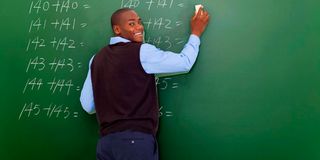
A male teacher during a lesson. Male principals are grappling with challenges that make their work unusually difficult.

What you need to know:
- Male teachers in Kenya face mounting pressures from finances, stigma, and workplace challenges affecting their performance.
- Studies reveal male educators struggle silently, even as male students rely on them for mentorship and guidance.
In Kisii Central, male high school principals are grappling with challenges that make their work unusually difficult.
When they took part in a study on the influence of gender on job satisfaction among secondary school teachers in Kenya, published in the International Journal of Advanced and Multidisciplinary Social Science in 2017, they spoke candidly. One principal described the pressure of dealing with widows who sought to pay school fees “in kind”.
“In our society today, we have more widows than widowers. When they come to the office, they expect favours by virtue of being female and widows, saying, ‘I am single; where do you expect me to get money?’”


Another highlighted the difficulty of disciplining female teachers. “Sometimes you want to discipline a female teacher, and she goes out saying you wanted her, and because she refused, you are retaliating. We are looked at as hunters and the female as our prey. It makes us cautious when dealing with female teachers,” he said.
Women principals did not report similar challenges.
Meanwhile, in Kieni West, Nyeri, another study, published in 2025 in the Research Journal of Education, Teaching and Curriculum Studies, found that male teachers underperform compared to their female peers. The main reason: inadequate pay and meagre allowances. It established that motivation was difficult to sustain under such conditions.
From school heads to classroom instructors, men working with students at critical stages of their education are facing burdens that cannot be ignored. Yet studies show boys look up to them as role models and mentors when choosing careers.
In Nakuru, a study on secondary schools explored how teachers’ gender influences the educational aspirations of the male learners.
Published in the European Journal of Education Studies, it found that they lacked male figures to guide and counsel them, unlike girls, who benefitted from female teachers’ support. Teachers reported that 70 per cent of the time, female teachers encouraged girls in class, compared to just 30 per cent when male teachers encouraged boys. The study recommended male teachers be encouraged to act as role models.
But for the Kenya Union of Post‑Primary Education Teachers (Kuppet), this is asking too much of men already weighed down by institutional and personal burdens. Martin Koikai, a Kuppet member and Kajiado branch executive secretary, says the most affected gender in high schools today is male teachers.
Drugs, meagre salaries and relationships
“We are losing them,” he says. “Some through inappropriate relationships, others to drugs. Some look at salary, see it is too small, and walk away from duty to end up addicted.”
He is concerned that these struggles are eroding their effectiveness and productivity. To address this, he calls for the rollout of well‑funded, effective mental health interventions. “Families expect men to shoulder costs and responsibilities, yet government salaries remain small. All burdens are heaped on them,” he says.
In Kitui, Juliet Mwikali Kimotho—recently elected Kuppet national secretary for gender, a position she had held at the branch for the past five years—recalls a loss that cannot be brushed off. Within five years, 20 teachers died by suicide, 19 of them men, a toll equivalent to nearly five households, going by the current average household size of 3.9.
Shaped by this reality, she says her mentorship will be tailored to address the specific challenges male teachers face. She links many of those struggles to economic pressures. “Our main source of mental health problems is poor pay,” she says. “When you have money, your problems are almost solved.”