Abused? Know the laws that can help you get justice
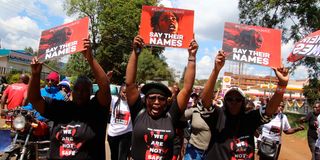
Activists during the #EndFemicide march in Nyeri town on December 10, 2024, where they called for harsher penalties for perpetrators and urged survivors to report abuse. Kenya has several laws that protect survivors, and many are unaware of them.

What you need to know:
- Kenya has laws that protect survivors of SGBV.
- These laws provide avenues for justice, protection orders, medical and psychosocial support, compensation, and safeguards for survivors' dignity and privacy.
- However, many survivors remain unaware of these protections.
Kenya has laws to protect survivors of sexual and gender-based violence (SGBV), but many of the people who need them do not know they exist. Women and girls carry most of the burden of this violence.
The laws cover rape, defilement, sexual assault, domestic violence, sexual harassment, forced marriage, female genital mutilation (FGM), human trafficking and psychological abuse. They allow survivors to seek justice, get medical and psychosocial help, be protected from further abuse, and keep their dignity and privacy. Yet many survivors do not know what protection they are entitled to, or what legal steps they can take.
With the annual 16 Days of Activism against Gender-Based Violence starting on November 25, here are the key laws every survivor should know.


The Constitution of Kenya, 2010
The Constitution is where protection against violence, discrimination and abuse begins.
Article 27 says everyone is equal before the law and bans discrimination on grounds that include sex, pregnancy and marital status. It also requires the State to act on historical discrimination and inequalities.
Article 28 gives every person the right to inherent human dignity, and says that dignity must be respected and protected.
Article 29 protects the right to freedom and security of the person. It bans all forms of violence, whether by public or private actors. It also bans torture, cruel, inhuman or degrading treatment, and physical or psychological punishment.
Under Article 21, the State must respect, protect, promote and fulfil the rights and freedoms in the Bill of Rights, paying particular attention to vulnerable groups, including women and children.
Together, these articles give survivors a basis to seek protection and to challenge violations of their fundamental rights.
The Sexual Offences Act, 2006
This is Kenya's main law on sexual crimes. It defines and criminalises rape, attempted rape, sexual assault, gang rape, defilement, incest and sexual harassment.
It protects both male and female victims. It also adds safeguards for children, persons with disabilities and people sexually exploited by those in positions of authority or trust.
Sentences range from several years in prison to life imprisonment, depending on the nature and circumstances of the offence. For rape and sexual assault, the minimum sentence on conviction is 10 years, and it can go up to life imprisonment.
The Act also protects survivors in court. It has provisions for vulnerable witnesses, allows proceedings to be held in camera where appropriate, and restricts publication of information that could reveal a victim's identity. It also sets up a Sex Offenders Register and a DNA Data Bank to help identify and track offenders.
But the law is now under pressure to catch up with new forms of sexual exploitation, especially those driven by technology.
The National Council on the Administration of Justice (NCAJ) has adopted the Sexual Offences (Amendment) Bill, 2026, which is now before Parliament's Justice and Legal Affairs Committee. It seeks to criminalise technology-facilitated sexual abuse, including AI-generated intimate images and videos, non-consensual sharing of intimate content, sextortion, stalking and online grooming. It also proposes a ban on informal out-of-court settlements in sexual offence cases, and stronger protection for survivors.
AI-generated images and videos are a growing worry because perpetrators can use technology to create realistic but fabricated sexual content. They can then use it to shame, threaten, blackmail or extort victims.
Desire Njamwea, an assistant director at the National Gender and Equality Commission, backs the proposed changes. He argues that the law must keep pace with changing forms of abuse.
“Modernising the law to address technology-facilitated sexual offences is increasingly recognised as essential to protecting privacy, safeguarding human dignity and ensuring that survivors can access timely, effective and meaningful justice in an increasingly digital society,” he says.
He notes that mobile technology has made it easier to record and share images and videos, but has also opened the door to serious privacy violations. These can have lasting psychological, social and economic consequences.
The Protection Against Domestic Violence Act, 2015
Under this Act, domestic violence is not only physical assault. The law lists several forms of abuse that can happen within families and domestic relationships.
Section 3 says domestic violence includes physical and sexual abuse, emotional and psychological abuse, verbal and economic abuse, and stalking. The law also treats harmful cultural practices as domestic violence. These include FGM, child marriage, forced marriage, forced wife inheritance, virginity testing and widow cleansing.
Protection covers spouses, former spouses, children and other dependents in domestic relationships, regardless of gender.
A survivor can apply to a Resident Magistrate's Court for a protection order. Someone else can apply on behalf of a child, or of a person who cannot apply alone. The order can stop an alleged abuser from committing further violence, harassing the survivor or entering the family home. Where immediate action is needed, courts may issue an interim protection order.
Disobeying a protection order is a crime, punishable by a fine of up to Sh100,000, imprisonment for up to 12 months, or both. Police can arrest a person without a warrant if they have reasonable grounds to suspect that an order has been breached, or that a breach is about to happen.
Courts can also order counselling and compensation for injuries, losses or damage caused by domestic violence. The Act also allows third-party reporting, so other people can report abuse for victims who cannot seek help themselves.
The Prohibition of Female Genital Mutilation Act, 2011
Kenya's Prohibition of Female Genital Mutilation Act, which came into force on October 4, 2011, makes FGM and the acts that support it a crime.
It is an offence to perform FGM, to help or encourage someone to undergo it, to arrange for it, or to hire someone to carry it out. Medicalised FGM, including cutting done by health professionals or trainees, is also banned. Consent from the person undergoing the procedure is not a defence.
Other offences include using premises for FGM, possessing equipment meant for it, taking someone out of Kenya to undergo it, and failing to report an FGM incident. The Act also criminalises abusive or derogatory language against women and girls who have not undergone FGM, and against people who support efforts to end it.
A person convicted of general offences under the Act faces at least three years in prison, a fine of not less than Sh200,000, or both. If FGM leads to death, the offender may be jailed for life.
This law is also up for amendment to strengthen enforcement while ensuring survivors are not treated as offenders.
The Prohibition of Female Genital Mutilation (Amendment) Bill, 2026, sponsored by nominated Senator Catherine Mumma, is before the Senate. One of its proposals is to make failure to report an FGM incident an offence, punishable by up to three years in prison or a fine of Sh200,000.
The Bill also responds to concerns that survivors have sometimes been treated as perpetrators under the reporting provisions. It would separate those who carry out or facilitate FGM from those who have undergone it, so that survivors get support and protection instead of further punishment. It also seeks to prevent re-victimisation and psychological trauma during investigations and court proceedings.
Anti-FGM Board Acting Chief Executive Officer Nyerere Kutwa has called the proposed law timely, saying it will speed up the fight against FGM in the country. He says it will close loopholes perpetrators have been using to evade justice.
“As the Anti-FGM Board, we fully support the proposed amendment of the FGM Act 2011. It is good to note that the proposed law is imposing sweeping penalties against the perpetrators,” says Kutwa.
He adds that he is optimistic the new law will unlock the prosecution of FGM perpetrators, which he notes has been low.
“With the new law, the cross-border FGM and medicalisation of FGM will be able to be dealt with appropriately,” he adds.
The Children Act, 2022
The Children Act, 2022, offers wide protection against the abuse, exploitation and neglect of children. It builds on Article 53 of the Constitution, which guarantees every child protection from abuse, neglect, harmful cultural practices, inhuman treatment and all forms of violence.
The Act deals directly with physical, psychological and sexual abuse, and with practices such as FGM, child marriage and forced circumcision. It also covers new threats linked to technology, including online child sexual exploitation, harassment and violations of children's digital privacy.
To make justice easier to reach, it creates specialised Children's Courts that are child-friendly and protect minors’privacy in legal proceedings. Judicial officers who handle children's cases are to receive specialised training to reduce the risk of exposing young survivors to further trauma.
The Act also provides for county rescue centres for children affected by violence, and Child Protection Units at police stations, which operate under the oversight of the Inspector-General of Police.
For children below 16 who are complainants in legal proceedings, the State Legal Aid Fund meets the cost of legal representation. This is so that lack of money does not keep vulnerable children from accessing justice.
The Victim Protection Act, 2014
The Victim Protection Act starts from the view that justice should not end once an offender has been prosecuted and punished. Survivors also need protection, information, medical and psychological support, and help to rebuild their lives.
It sets out how the rights and welfare of victims and witnesses of crime should be safeguarded, including survivors of SGBV. One of its key aims is to protect survivors from further trauma during investigations, prosecutions and other interactions with the justice system.
Section 32 makes the Victim Protection Board responsible for putting in place measures to reduce re-victimisation.
The Act also provides for shelter and temporary safe accommodation for vulnerable victims, along with psychosocial support and trauma counselling. It recognises mental health care as part of recovery, noting that survivors may need more than physical treatment to overcome the effects of abuse.
Survivors have a right to timely information about their cases, including developments on the arrest, release or bail of an accused person.
Victims can also seek reparation and compensation for losses arising from criminal acts. These may include medical expenses, lost income and other damages caused by the violence.
The Act further requires crime data to be collected and compiled every year, broken down by age, gender and county. The information is meant to help authorities identify areas with high levels of violence, plan targeted prevention programmes, and allocate resources to support survivors and recovery services.
The law offers a range of protections, but survivors must be able to reach them. It recognises that awareness, effective enforcement and survivor-centred support remain essential if victims of abuse are to get justice and rebuild their lives.
Where to get help
Survivors can get help through these toll-free helplines:
- 1195: National GBV Toll-Free Helpline, open 24 hours a day and operated by Healthcare Assistance Kenya and the Government of Kenya
- 1196: Helpline for male survivors of gender-based violence
- 1190: Counselling and sexual and reproductive health/GBV hotline run by LVCT Health
- 116: National Child Helpline, for child protection, abuse and exploitation
- 0800 720 501: Fida-Kenya SGBV toll-free line, for legal and GBV support