Backlash as Treasury cuts Ngaaf budget by Sh500 million
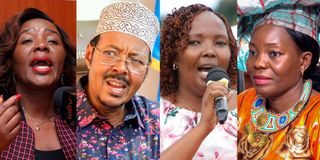
From left: Kiambu Woman Rep Ann Wamuratha, Eldas MP Adan Keynan, Laikipia Woman Rep Jane Kagiri and Busia Woman Rep Catherine Omanyo.

What you need to know:
- The government's Sh500 million cut to the Ngaaf has sparked outrage among woman reps, who plan to protest at the Treasury.
- The budget reduction from Sh3.2 billion to Sh2.7 billion, contradicts President Ruto's 2023 promise to increase the fund by Sh1 billion.
Jane Njeri's face still lights up when she recalls that hopeful January day in 2023. Standing among a thousand fellow students from across her county, she felt a rare moment of relief as she received her Sh10,000 bursary through the National Government Affirmative Action Fund (Ngaaf).
"The high cost of living has taken a heavy toll on many families, making them unable to pay school fees for their children," Jane reflects, her voice softening as she remembers how the bursary rescued her education at Thika Training Technical Institute when her parents couldn't afford the fees.
"The government should ensure they help students whose parents don't have the strength to pay school fees."


But that lifeline for Jane and thousands like her now hangs in the balance. Treasury Cabinet Secretary John Mbadi recently announced a slash in the Ngaaf budget from Sh3.2 billion to Sh2.7 billion—a Sh500 million reduction that has ignited a firestorm among the country's 47 woman representatives.
The woman representatives, custodians of this crucial fund designed to support women, youth, and vulnerable populations, have not taken the cut lying down. Their response has been swift and unified: this is not just a budget adjustment but a direct attack on grassroots development initiatives across Kenya.
"This is deeply disheartening. The 47 woman reps are bleeding right now," declares Busia Woman Rep Catherine Omanyo, her frustration palpable in every word.
"The money itself is meagre, too little to begin with. We demand that the Sh500 million find its way back to the Ngaaf kitty. How do I go to Busia and tell them I am representing them, if the money was taken while I sat in Parliament pretending to be sober?"
The irony isn't lost on anyone. Just last year, in 2023, President William Ruto stood before these very women representatives at State House and made a solemn promise to increase the fund by Sh1 billion—from Sh2 billion to Sh3 billion.
"We will enhance the women's kitty for Ngaaf from Sh2 billion to Sh3 billion," the President had declared.
"I hope you will support me and the government in making sure everybody pays tax. We have also agreed that we will avoid any cuts that will affect your delivery of that agenda as woman representatives."
Now, instead of the promised increase, they face a devastating reduction.
Laikipia's Jane Kagiri, who leads the Woman Representatives Caucus, is preparing for battle. A protest march to the National Treasury is in the works, with a powerful symbolic element—the women representatives will wear black to "mourn the decision."
"We will be wearing black to mourn this deduction, which is an injustice not only to us but to the people of Kenya," Kagiri states firmly.
"We will march to both the Ngaaf offices and the National Treasury to demand accountability."
The significance of this fund extends far beyond political posturing. For many Kenyans, Ngaaf represents a crucial stepping stone toward economic independence. Kiambu Woman Rep Ann Muratha has witnessed this transformation first-hand.
"The fund has enabled individuals to realise their potential, generate income, and support their families with dignity," Muratha explains.
"By providing tools and resources, we give our people a chance to build businesses, create employment, and contribute meaningfully to the economy."
She lists the tangible tools that have changed lives: tents, chairs, hair dryers, blow dryers, welding machines, chafing dishes, shaving machines, juicers, business umbrellas, and 'beba beba' trolleys—each representing a family's path out of poverty.
Irene Wanjiku from Juja stands as living proof of this impact.
"As a beneficiary of Ngaaf, I have received a hair dryer and blow dryers, which have helped me to expand my salon business and increase my income," she says.
"When individuals and communities are economically empowered, dignity is restored and progress becomes inevitable. Reducing the budget only means fewer people will benefit."
The budget cut has drawn criticism beyond the women representatives themselves. Eldas MP Adan Keynan views it as a regressive step that undermines hard-won progress for women in political leadership.
"I find it unfair to deny woman reps a right already granted," Keynan asserts.
"I want to appeal to the mandarins at the Treasury to show consideration when making such decisions. Women are the majority of voters. Denying them Sh500 million is not just unfair; it is politically and morally wrong."
Eva Komba, a gender and development expert, delivers perhaps the most scathing assessment: "This fund is at the heart of economic development and social protection. It is a terrible move, ill-informed and not well thought out. In the wake of global resourcing changes, we further target this fund? A fund that is desperately needed to augment deficit and combat household poverty. This government doesn't mean well for women and girls."
The cuts to Ngaaf are part of broader austerity measures announced during a Cabinet meeting chaired by President Ruto at State House last week. The government aims to reduce the fiscal deficit from 5.3 per cent of GDP in 2023/24 to 4.5 percent in 2025/26, requiring revisions to the original Sh4.3 trillion budget estimates.
"The changes are part of broader austerity measures designed to strengthen fiscal discipline, reduce public debt vulnerabilities, and create the fiscal space necessary to deliver essential public goods and services," reads a Cabinet communique.
But for Jane Njeri and thousands of others whose lives have been transformed by Ngaaf, these technical explanations offer little comfort. They can only hope that the woman representatives' fight will succeed—restoring not just funds, but faith in promises made.