Beijing’s promise, Kenya’s reality: The Gen Z reimagining power and possibility
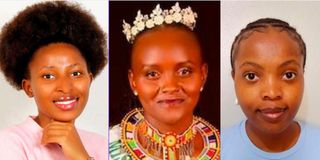
From left: Hellen Muthoni, Dorcas Naishorua and Wamucii Muriithi. The Gen Z fulfilling the Beijing promise.

What you need to know:
- Thirty years after the Beijing Declaration, three young Kenyan women—aged 21, 23 and 25—are transforming the sectors the world once vowed women would shape: cybersecurity, internet governance, and climate resilience.
- A cybersecurity guardian inspired by her mother’s online fraud trauma, a tech-policy advocate bridging Africa to global governance, and a pastoralist climate champion planting 50,000 trees—these three young Kenyan women exemplify how personal experiences fuel public leadership and systemic change.
They were not yet born when 189 governments gathered in Beijing in 1995 to make a revolutionary promise: that women would share equally in shaping the world's technology, environment, and security.
Thirty years later, three young Kenyan women—aged 21, 23, and 25—are delivering on that promise in ways the architects of the Beijing Declaration could scarcely have imagined. One guards our digital lives, turning her mother's encounter with online fraud into a mission to protect millions.
Another ensures Africa's voice resonates in the corridors where the Internet's future is decided. The third plants trees where drought once killed her family's livestock, transforming grief into 50,000 seedlings of hope. Their stories reveal something profound: when women claim space in the rooms where the future is built, they do not merely participate—they transform.


The Fourth World Conference on Women in 1995 produced the Beijing Declaration and Platform for Action, a blueprint adopted by 189 governments to advance women's rights. This was not merely about equality in theory; it laid out specific, bold ambitions. It called for women's full and equal participation in environmental decision-making, recognising their pivotal role in ecosystem management and sustainable development.
It demanded their active involvement in science and technology, urging the removal of barriers to education and careers in these fields. Crucially, it envisioned women as central architects of the emerging digital age, shaping its policies and security. It was a promise of shared power in building the future.
Three decades on, the scorecard is mixed. But look beyond the official reports and slow-moving institutions. The most compelling answer to Beijing's call is rising from a generation that was not even born when that promise was made. They are 25 years old and under, and they are not waiting for an invitation to a table set by others. They are building new tables, in new rooms, with a new blueprint for impact.
Meet Hellen Muthoni, the 21-year-old cybersecurity guardian translating digital threats into human stories. Meet Wamucii Muriithi, the 25-year-old tech-governance bridge-builder ensuring Africa's voice shapes the global internet. Meet Dorcas Naishorua Umaka, the 23-year-old climate warrior turning pastoralist wisdom into frontline action. Their fields—cybersecurity, internet governance, and climate justice—are the very arenas Beijing highlighted. Yet their stories are threaded by common fabric: a profound sense of purpose born from personal experience, resilience forged against stereotype, and a leadership style that is collaborative, empathetic, and fiercely inclusive.
These young women are already excelling, already leading, already reshaping their corners of the world. They are the living, breathing answer to Beijing's call, demonstrating that when women are given—or when they claim—the space to contribute, they do not just participate; they transform. They are the architects of the next decade, and they are building from the ground up.
Hellen Muthoni
For her, cybersecurity is not about anonymous hackers in dark rooms. It is about her mother. "Everything changed when my mum was scammed," Hellen recounts, her journey pivoting from academic interest to profound personal mission. "That incident made cybersecurity personal. It wasn't just a course anymore; it was a way to protect people like her."
This human-centric view defines her approach in a field often obsessed with technical binaries of ones and zeros. Her greatest achievement, she says, is not a certificate but "learning to care for my own mental wellness while remaining agile and gentle with myself." This self-awareness is the bedrock of her leadership, which she describes as simplifying complex security concepts into "cute, understandable bits."

Hellen Muthoni, a 21-year-old cybersecurity guardian translating digital threats into human stories.
Hellen's path was not linear. She disliked computer studies in school and initially resisted her university placement in cybersecurity. Curiosity brought her in, but her mother's experience grounded her. From messy, self-taught beginnings with Kali Linux and YouTube tutorials, she found structure and community through the CyberGirls Fellowship. Now, having graduated last month from KCA University with a degree in Information Security, she is stepping onto panels, mentoring others, and specialising in Threat Intelligence and Digital Forensics.
Her mentor, Adonijah Kiptanui, who instructed her in cloud and network security at CyberShujaa, attests to her drive. "She's been quite a good student... an outgoing lady," says Kiptanui. "She's taken on programmes like CyberGirls and graduated, even being featured on their LinkedIn as a top student. She's very active in hackathons and CTF competitions. In campus, she was a lead for the Google Developer Group on cybersecurity, organising meetings to get fellow students to improve their skills." This external voice confirms the trajectory Hellen herself describes: one of proactive learning and community building.
The challenges have been profound. She navigated the loss of her father, her biggest supporter, which forced a "crash course in independence and resilience." As a young woman in a male-dominated field, she also faces the subtle, exhausting work of constantly proving herself. "Seeing other young ladies hesitate to enter this field has fuelled my passion to mentor them," she states. Her goal is to dismantle the antisocial "lone hacker" stereotype, arguing that cybersecurity "isn't just about systems or code but mostly about people, how we communicate with them, and the trust we build."
On the Beijing Declaration's promise for women in tech, Hellen points to a recent month-long industry challenge featuring 18 creators, not one of them a woman. "This highlights how skilled women are often overlooked," she notes. However, she finds hope in programmes like CyberGirls and SheLeadsTech, which prove that with support, women do not just belong—they thrive and drive impact. For her, true inclusion is "recognising talent and ensuring everyone has a chance to contribute meaningfully," moving far beyond tokenism.
Looking ahead, Hellen sees Artificial Intelligence as the next great, unprepared-for threat—not just technically, but ethically. Her trajectory is clear: to blend deep technical expertise in intelligence-driven defence with unwavering advocacy for mental wellness and mentorship, building a digital world that is not only secure but also humane.
Wamucii Muriithi
Her work exists in the critical, often invisible space between lightning-fast technological innovation and the slow, deliberate work of governance—a direct engagement with the systemic change called for in Beijing.
"Technology moves fast, and governance is always trying to catch up," she explains. "I work in the space between those two worlds, trying to reduce the gap." Her single biggest mission? To combat the "silent chaos" of online insecurity and mis-governance, making the internet safer, fairer, and more predictable.

Wamucii Muriithi, a 25-year-old tech-governance bridge-builder ensuring Africa's voice shapes the global internet.
Her entry into tech is a story of beautiful accidents. A high school agriculture student who did not know how to properly turn a computer on or off, she was placed by Kuccps into Computer Technology. In a pivotal moment, she tried to switch to Electrical Engineering, but a gut feeling made her rush back and retract the request. "Something about it just felt right," she recalls.
That feeling was validated in her second year when she heard the word "hacking." Curiosity ignited, she borrowed a friend's laptop—since she did not have one of her own—and a path unfolded towards cybersecurity and, later, the perfect nexus of her interests: Internet Governance.
Wamucii's greatest achievements are milestones of representation. Being selected as a Pan-African Youth Ambassador for Internet Governance and then representing young African women at the 19th Global Internet Governance Forum in Riyadh last December were turning points.
"Being part of those conversations... was a turning point," she says. Equally profound is her work in translating complex internet governance concepts into Swahili, "reaching people who are usually excluded from 'global tech discussions' simply because of language."
David Kinyua, Director of Mjenzi Cloud and one of her mentors, vouches for the qualities that enabled these feats. "Wamucii quickly grasps complex technical concepts and applies her learning with precision," Kinyua notes. "Beyond her skills, what makes her exceptional is her integrity, professionalism, and the positive energy she brings... Her ability to communicate complex ideas clearly through her writing demonstrates both her expertise and her creativity."
This endorsement from the industry underscores the substance behind her rising profile. She has walked into rooms that were not built for her. "The space is brilliant, yes, but also intimidating, heavily male, and structured in ways that don't always consider you as a young woman," she describes.
The challenge was constant: to prove she deserved her seat. Her solution was unwavering persistence: "Voice is earned through contribution, not permission." This experience has shaped a leadership style that consciously breaks from the old CEO archetype of authority and gatekeeping. "I lead with curiosity, collaboration, and accessibility... I'm interested in building rooms where more people get to participate in the conversation."
On the Beijing vision of technology as a great equaliser for women, Wamucii offers a nuanced assessment. "Technology has opened doors for women... But calling it the 'great equaliser'? We're not there yet." She highlights how offline inequalities—economic, social, cultural—replicate themselves online. "Real equality requires more than tools. It requires structural change," she asserts, pointing to the work still to be done.
Her ethical line is non-negotiable: never compromise user trust. "If a project, partner, or idea requires me to sacrifice my ethics for efficiency, profit, or political convenience—I'm out." For her, ethics is a compass, not a talking point.
The future for Wamucii is one of deeper influence: more policy work, global engagement, and community-focused education, all while continuing to bridge the digital divide with Swahili content. She aims to stand firmly at "the intersection where security, governance, and public education meet," ensuring Africa's footprint in the digital future is bold, informed, and self-determined.
Dorcas Naishorua Umaka
For Dorcas from Kajiado County, the climate crisis has a face, a smell, and a devastating, intimate cost. It became personal not through a report, but through ruinous drought between 2020 and 2022.
"Our livestock, our pride and our entire livelihood began to die one by one," she shares. The crisis forced her to pause her education, a sacrifice that crystallised her resolve. "I realised climate change wasn't a distant headline. It was shaping our days, our future and our dignity." This is the lived reality of the environmental challenges the Beijing Declaration urged women to lead in solving.
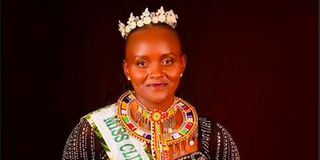
Dorcas Naishorua, a 23-year-old climate warrior turning pastoralist wisdom into frontline action.
From that pain grew actionable hope. Her most concrete victory is a testament to community power: leading the planting of over 50,000 tree seedlings, reviving landscapes and community spirit. Esther Anki, a medical social worker who coordinates projects with Dorcas, provides grassroots testimony to this impact.
"We have grown trees in Olokole, and in Kajiado at large... in schools, in churches, in public spaces," Anki states, listing locations like Baraka Worship Ministry churches, several schools in Amboseli, and Oldonyo Roto Secondary School in Kitengela.
"When you bring the trees to the community, everybody will be scrambling for them and this means that people are embracing a greener community."
Dorcas's work through Isilan CBO, founded in 2019, has blossomed into a holistic model of resilience that supports women's beadwork collectives, introduces beekeeping (apiculture), and uses music to teach conservation. "She has been impactful," Anki emphasises.
"She has taught the community about climate change. Besides that, she also educates the community and advocates against early child marriages and FGM. We are at a better place comparing to 2019, courtesy of her." This corroboration paints a picture of a leader whose environmental action is inextricably linked to social justice and community health.
Dorcas speaks a language of tangible connection. Her most effective message is stark and relatable: "Climate change is already inside our homes."
By linking action to immediate realities such as empty granaries and the price of water, she makes the solution feel possible. She fiercely refuses the stereotype of the environmentalist as a distant, privileged activist. "I refuse to hide behind a polished image. I want people to see that an environmentalist can be a girl who walked barefoot to school, herded goats, fetched water and still found her voice."
Her assessment of women's leadership since Beijing is clear-eyed. "Women's voices are louder than before, but they still struggle to fit into decision-making rooms. We are often invited to speak but not always invited to shape policy." She calls for a move beyond "symbolic inclusion," especially for young and Indigenous women like herself.
Justice is the core of her mission. Her work ensures the green transition is fair by centring those most affected: "the people who feel climate change the most, women, youth and Indigenous communities, are part of the solutions."
Her vision for 2045 is of a Kenya where renewable energy powers villages, climate literacy is standard in schools, and environmental care is "not a special project, but a way of life."
The challenges are familiar yet deeply personal: battling credibility based on her age, gender, and background. "But these challenges have pushed me to work harder, learn more and create space for other girls who will come after me," she states. On her horizon is an expansion into Sustainable Aviation Fuel (SAF) and clean energy, connecting local community wisdom to global platforms and alliances. Her goal is elegantly simple: "to make climate action something everyone can understand, join and benefit from."
Building new rooms
Individually, Hellen, Wamucii, and Dorcas—and many others in their age group—are formidable. Together, they represent a seismic shift in what leadership looks like for the generation shaped by the 21st century's greatest challenges. They embody the principles of the Beijing Declaration not because they are adhering to a 30-year-old document, but because they are living its unmet aspirations as modern necessities.
Their leadership is resilient and redefining. They have all entered spaces not designed for them—the server room, the global policy forum, the pastoralist ranch turned boardroom. They have faced down stereotypes, grief, and systemic doubt not by adopting the armour of the status quo, but by softening and strengthening it with their authenticity. They mentor, they translate, they include.
Their leadership is ethically uncompromising. Whether it is Hellen's focus on mental wellness, Wamucii's vow never to betray user trust, or Dorcas's commitment to a just transition, their moral compass is their most critical tool. They understand that innovation without integrity is a threat in itself.
The Beijing Declaration envisioned a world where women share power and influence equally in shaping policy, technology, and environmental sustainability. Hellen, Wamucii, and Dorcas are the embodiment of that vision in action. They are not just participating in tech, security, and climate action; they are re-engineering these fields from the inside out, insisting that systems be secure, inclusive, and just.
They are the architects. The blueprints are theirs. And the world they are building—one of secure connections, fair governance, and restored land—is a future worth watching, supporting, and celebrating. The promise of Beijing is being realised, one line of code, one policy brief, and one tree seedling at a time, in the capable hands of these young women who are not just shaping the next decade, but reclaiming it.