Unfinished revolution: How Kenya's unsung heroes are living Beijing's promise
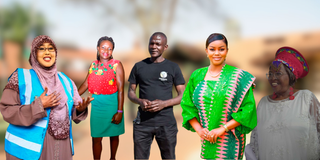
From a 78-year-old legal pioneer who coordinated Kenya's Beijing journey to a male flower farm worker championing against GBV, five voices reveal how political exclusion, educational discrimination, and cultural resistance persist alongside inspiring resilience.

What you need to know:
- Thirty years after the Beijing Platform for Action, Kenyans continue fighting the same gender barriers the global declaration sought to eliminate.
- From a 78-year-old legal pioneer who coordinated Kenya's Beijing journey to a male flower farm worker championing against GBV, five voices reveal how political exclusion, educational discrimination, and cultural resistance persist alongside inspiring resilience.
From Kenya's corridors of power to rural classrooms and urban streets, a quiet revolution unfolds. Thirty years after the Beijing Platform for Action promised gender equality, it's written in the determined steps of women defying patriarchal systems, in men championing gender equality despite backlash, and in the resilience of those transforming wounds into bridges for others.
These are stories of unfulfilled visions and unhealed scars, but more importantly, testimonies of unbreakable spirit that echo Beijing's enduring call for change. Many Kenyans, particularly women, have had their voices silenced based on gender—the very barriers the Platform for Action sought to dismantle. Yet from their narratives emerges not bitterness, but inspiring resilience that proves Beijing's vision lives on. Their collective motto remains unwavering: "Forward ever, backward never."
The pioneer's perspective


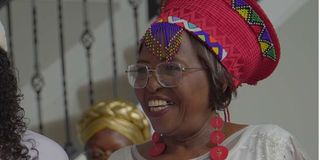
Lilian Wakiiya Mwaura, 77, who attended the landmark Beijing Conference in 1995, says that three decades later, gender under-representation in elective positions and GBv cases remain part of Beijing's unfinished agenda.
In Nairobi, the Voice meets Lilian Wakiiya Mwaura. She wears a beautiful headgear made from beads that match her long red earrings hanging above her shoulders, also made from beads. This attire reminds her of the journey prior to Beijing, China in 1985, when she organised a mini-Beijing at the University of Nairobi grounds to enable grassroots women to "taste Beijing."
"Women came from the rural areas—4,000 of them—and other women from the world were 14,000," she recalls. "I tell you, the streets of Nairobi were full of women, colourful with the aroma of different perfumes, and men felt their patriarchal system was being threatened."
Her role in the Beijing declaration was pivotal as the national coordinator for the process. During that time, she was chairperson of the National Council of Women of Kenya, an umbrella organisation for women NGOs, a role she held between 1987 and 1996.
"The 1985 declaration in Nairobi was the Nairobi Forward Looking Strategies by the year 2000 and beyond," explains the founder of Fida Kenya Chapter. "When the UN organises these meetings to see whether they have been implemented, if they are not implemented, then the challenges and strategies adopted to achieve them must be reported."
Although she marks her 78th birthday this year, the Senior Counsel maintains crystal clarity about the journey to achieving gender equality in Kenya.
"Gender equality is a global problem, and the journey to achieve gender equality did not start with Beijing," she emphasises. "It started in 1975 through to 1985 when the UN organised that meeting in Mexico City, and women from Kenya participated. That is the year when the women's decade was declared, and they emphasised equality."
Thirty years later, the pioneer in private legal practice in Kenya through K Mwaura and Company Advocates expresses sadness about the rise in violence against women, especially during wars like the post-election clashes and the Covid-19 lockdowns.
"Since 1985, violence has escalated not only in Kenya," she observes. "When we have wars, women are raped, and we have had a number of wars in this region."
She adds, "Recently, a lot of femicides have been happening until the president formed a tribunal to look at the causes. The government should establish shelter homes for victims of gender violence. They should also ensure that when these cases are taken to court, they are not delayed because when they delay, the victims feel desperate about it. The National Bureau of Standards should collect data so that we know how many women have been raped, killed—femicide."
Despite the constitution and bill of rights being gender-sensitive, Lilian notes that of the 12 Beijing recommendations, the country has made progress, but there is still no gender equality, whether in elective seats or presidential appointments.
"Since 2010, there has been no effort to enact the law which can enable equal participation of women in decision-making at the national assembly and the senate," she points out. "Of course, the majority of people in parliament are men; they don't have that goodwill, so we have not achieved that."
She stresses that gender equality involves both men and women.
"Unless we achieve gender equality between men and women and not discriminate against women, that is when we will have total development," she concludes. "Without that, our pace will be slow. We also need peace."
The male champion's journey
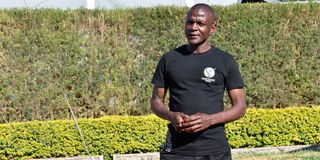
Ronald Munyite Makanda when he spoke to Nation.Africa at Wildfire Flowers Limited in Naivasha on November 8, 2024. Working in an environment with both men and women intrigued him to become a gender champion within the flower farms.
In Nakuru County's Naivasha, we meet Ronald Munyite. The presence of blossoming beautiful roses at the flower farm brightens his face but cannot hide the struggles of denied access to education that shaped his advocacy.
After sitting his Kenya Certificate of Primary Education examinations in 2000, Ronald faced a school fees problem. He settled for a day high school, which would have been more affordable for his parents. However, when he reached Form Two, things worsened, forcing him to drop out.
"My dad did not have the heart for educating boys; he leaned more toward the girls," he recalls. "At the time when I was joining high school, we were four—myself, my sister, my stepbrother, and my stepsister. My two elder brothers had already dropped out of school due to lack of school fees."
Coming from a polygamous family where his mother and stepmother had 11 and eight children respectively, Ronald faced significant challenges. His father was the only breadwinner, but the large family size and his father's bias toward daughters and stepdaughters disadvantaged Ronald, his brothers, and stepbrothers.
A friend's advice to join the Uganda curriculum offered temporary hope. Ronald enrolled in Form Three, but financial constraints persisted.
"Things did not work out even in Uganda—I was not able to pay school fees," he says. "From there, I dropped again and came back to Kenya."
His job-searching journey took him from his Bungoma home county to Nakuru, where he landed an opportunity at a security company. However, the pay wasn't enough to help him achieve his dream of completing high school, even after working for close to five years. He resigned and found another job at a flower farm, where he has worked since 2014.
"I have gone through different departments: maintenance, production, and now I am in the irrigation department at the greenhouse irrigation counter," he explains.
Working in an environment with both men and women intrigued Ronald to become a gender champion within the flower farms, promoting gender equity at workplaces and within communities.
"I got the zeal to do this job because there was a girl who was defiled, but nobody was there to stand with her," Ronald says. "Her mother, who is illiterate and also has a disability, faced barriers that made it impossible to find justice for her daughter."
The family eventually received justice when the accused was prosecuted and is currently serving a 14-year jail term, thanks to Ronald's intervention. He attributes the success to his knowledge of human rights issues.
"I took the girl to Naivasha Level 5 Hospital a few hours after she was defiled, then we also called a police officer who came and recorded the statement," he explains. "The girl identified the perpetrator, who was arrested."
Being a man championing against gender-based violence draws criticism, especially from male counterparts.
"I do face backlash in the community as some men ask me if I will feel okay if I were arrested," says the father of four. “I normally tell myself that we can keep quiet today, but tomorrow, the same thing can happen to our children."
While he works at the flower farms, most people recognise him as a gender champion, thanks to support from the County gender-based violence coordinator.
"Since we have a GBV cluster within Naivasha, getting reports about these cases is easy now, and through that, the cases have reduced," he notes. "Through the cluster, I am recognised, and when I go to the police station, the officers recognise me as a GBV champion."
The politician's painful lesson

Anita Nyawira Mbae, who contested for the Woman Representative position in Tharaka Nithi County during the 2022 General Election, but stepped down three months before polling day in favour of her party's preferred candidate.
Anita Nyawira Mbae's voice still carries the weight of that devastating phone call. Three months before the polls, her political dream was shattered not by voters, but by the very party she had loyally served for two years.
"We were called to Nairobi for the negotiation process that was led by a team of senior politicians," recalls the Daystar University graduate with a bachelor's degree in Communication and a minor in International Relations. "Leaving that meeting knowing that my name would not be on the ballot box was the nastiest thing in the world. I honestly wished that a car would hit me because I had spent so much of my time and money convincing people over the years."
Anita's vision was clear and urgent: to represent the needs of rural women in Tharaka Nithi by implementing policies that would end gender-based violence and female genital mutilation—vices she says still hinder girls and women in the area from enjoying quality education like their male counterparts. Her commitment had seen her walk with the political party for two years, building relationships and trust within her community.
The pain of being subjected to what she describes as a "party negotiated democracy"—a lengthy process that buried all her efforts, work, and invested resources at the final stretch—was overwhelming.
"I even got depression. It was one of my lowest moments in life," she admits. "Imagining my years of work from 2020 just culminated on a table because probably I am not a suitable candidate on the basis of me being younger and without resources the party was looking at."
This wasn't Anita's first brush with leadership. At Daystar University, she had made history as the first female secretary-general of the university's student association, winning the traditionally male-dominated position with a landslide. Her successful tenure earned her a scholarship to study at the University of North Carolina in the United States for being an outstanding student leader.
"My being elected also coincided with the 2017 general election politics where politicians were looking for influential student leaders to pull youth votes in Nairobi County's top seat, and I was among them," she explains. "We could sit in the same forum with the politicians, and that gave me a good perspective on how national politics looks like beyond what I was doing on campus."
Young, visionary, educated, and globally exposed beyond her hometown in Maara Constituency, Anita believed she had everything that would earn her the majority of electorates' votes. She was wrong.
"It was also bad for my political career because there were people who were ready to vote for me on the ground," she reflects. "When I told them that I stepped down, they thought that I was taking them for a ride and that I had chickened out. I could not fight the system because I was loyal to it due to some privileges that come from belonging to a party. I could not also run as an independent candidate because I did not have resources."
The timing couldn't have been crueller. Months before she was asked to step down, Anita had buried her father, who had been suffering from cancer. He had been her strongest supporter, helping her campaign among older men who needed convincing that a young university graduate like Anita had leadership ability.
"When I was told to drop from the race, I was carrying a lot of pain in my heart because I used to remember all the sacrifices that my dad made, and now he is dead," she says. "I was not seeing the future of what was going to happen to me. Dealing with emotional baggage and getting discouraged, especially when he succumbed to cancer, was so much."
A compromise appointment at the Ministry of Agriculture offered brief respite, though she worked there for only a few months before a new government came in. Gradually, she found hope by remembering her work championing gender equality and empowerment programs as a communications and democratic governance consultant at UN Women.
Today, she sees opportunity in the 2027 general election, particularly in the Tharaka Nithi woman representative seat. Some of the women she had equipped with tools to compete fairly in previous elections have won top county seats, giving her renewed optimism.
"I am currently advocating for systemic change and creating pathways for others to thrive," says the founder of Mbae Anita Foundation, a non-profit organisation dedicated to empowering women and supporting brilliant children through scholarships, mentorships, and entrepreneurial training. "Seeing girls still using blankets when they are on their menses, and girls not continuing with their education because of FGM which is still going on in Tharaka Nithi County in 2025 is a sad state of affairs."
Rising above body shaming

Everlyne Bowa founded Agape Woman and Child Empowerment Foundation that supports women and girls to thrive in their areas of specialisation.
In Nairobi's Kibera, Everlyne Bowa walks with her head held high, knowing that graduating with a bachelor's degree in Community Development from Daystar University was no mean feat. But there was a time at Olympic Primary School when she couldn't have imagined this future.
"I was facing body shaming because of having a big body and big breasts," she recalls with painful clarity. "Those days our parents would buy uniforms that would take us for three to five years. So you would find the clothes I used to wear made me look much older than my classmates."
The relentless teasing affected her academic performance, trapping her in a cycle of low self-esteem and poor grades.
"I grew up with challenges around low self-esteem; I was in the bottom 10," she narrates. "Imagine my image back then—having big boobs and you are performing poorly, you have a big body... it was a lot of body shaming and stigmatisation."
Despite choosing not to give up, the psychological burden was immense. Looking back, she still finds it hard to believe that she actually completed her studies and is now in the process of enrolling for her master's degree at a local university.
Having lacked someone to hold her hand as a young girl, and seeing other girls subjected to discrimination that hindered their academic performance, Everlyne founded Agape Woman and Child Empowerment Foundation that supports women and girls to thrive in their areas of specialisation. They are currently supporting about 3,000 in Nairobi and Bungoma counties by offering them platforms to understand reproductive health, maternal health, menstrual hygiene, and family planning.
"I am giving adolescent girls what I did not get," she tells the Voice. "You might be bullied, abused, your body might look how it is, but when you look around and see me there for you, then you don't lose hope but feel loved."
Despite this work, Everlyne believes girls are not yet safe and calls for more support to achieve gender equality in education.
"We still have schools where sanitary facilities are not meeting the needs of girls," she observes. "There is a need to make education affordable or create a mechanism to waive school fees for needy students. I believe that will support vulnerable girls to continue accessing their education."
The multilingual champion
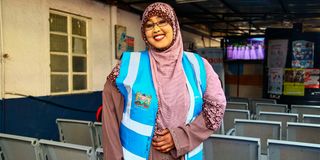
Fatuma Mohamed Ahmed, a community health promoter and gender-based violence champion, during an interview in Eastleigh, Nairobi, on October 12, 2024. Her mother helped her escape marriage to a man her father deemed suitable—a decision that enabled her to continue her studies.
In Eastleigh, Nairobi, Fatuma Mohamed Ahmed, carries out her duties with unmistakable passion. At only 28, she already wears several hats: champion against gender-based violence, community leader, and community health advocate. These roles have made her a valuable member of the Eastleigh community, helping individuals overcome health challenges.
"I have come across women who have had complications conceiving, and through connecting them with reproductive health service doctors, some have conceived and they come back to me happy when they become mothers," she shares. "Some mothers have invited me to go carry their babies immediately after they deliver, saying they previously had three miscarriages, but when I advised them to go to hospital and receive medical treatment, they became mothers."
Her satisfaction comes from helping fellow women access information they might otherwise miss due to communication barriers, as she is multilingual. Every local language she speaks reminds her of a crucial conversation with her mother when she was a young girl in class seven in her home county, Mandera.
Her mother helped her escape marriage to a man her father deemed suitable—a decision that enabled her to continue her studies after excelling in her Kenya Certificate of Primary Education examination, allowing her to join Moi Girls in Mandera.
"My father gave me out for marriage, and that affected me because he hid my Form One admission letter and threatened me that I would never get married in my life," she remembers. "My mum saved me so that I could continue with my education. She is very proud of me today and uses me as a role model."
This experience taught Fatuma that everyone needs someone as friendly as a mother to help them overcome challenges requiring third-party intervention. For over seven years, she has found pride in helping her community overcome various challenges.
"I feel very happy when I teach women about hygiene, malnutrition, adhering to exclusive breastfeeding for six months by mothers who have given birth, and also how to feed their babies once they introduce them to other foods," she explains. "I also advise parents to allow their children to get vaccines against diseases like measles and polio."