Beyond GBV taskforce report: The path towards ending the 'national crisis'
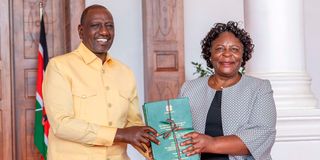
President William Ruto receives the Report of the Technical Working Group on Gender-Based Violence, including Femicide, from the chairperson, Dr Nancy Baraza, at State House, Nairobi.

What you need to know:
- Report recommends the establishment of a survivor fund to ensure that victims of GBV, including femicide, receive compensation.
- It adds that where appropriate, survivors should access reparations that would help them sustain their livelihoods beyond the violations they have endured.
When Mama Joy* heard on a local radio station that a taskforce had recommended compensation for victims of gender-based violence (GBV), she turned up the volume.
“When did they say they are starting?” she asked her mother, who was seated beside the radio.
Mama Joy is a struggling mother caring for her daughter, who was defiled in 2024 when she was just three years old. Her daughter’s life was upended when a man who had recently moved into their neighbourhood—after being displaced by floods on a nearby island—attacked her.


The assault left the child with fistula-related injuries. She now requires Sh400 every two days for specialised medication to ease painful bowel movements.
“I wish they would hasten that compensation. My daughter has really suffered, and that money could help both her and me,” Mama Joy says.
The taskforce she refers to is the Presidential Taskforce on GBV, including Femicide, which submitted its report to President William Ruto at State House on January 26.
Among its key recommendations is the establishment of a survivor fund to ensure that victims of GBV, including femicide, receive compensation and, where appropriate, access to reparations that would help them sustain their livelihoods beyond the violations they have endured.
Other far-reaching recommendations include proposed amendments to the Sexual Offences Act, 2006, to have chemical castration for child defilers and defilers of persons with disabilities, as well as strict minimum sentences for aggravated sexual offences and repeat offenders.
President Ruto, while receiving the report, emphasised that the document is more than just a technical report. “It is a reflection of voices, fears and hopes of Kenyan people, especially survivors of gender-based violence,” he said.
He added that he had received and taken note of its contents, including the wide-ranging findings and recommendations on GBV, including femicide.
“The report lays bare the scale, complexity and evolving nature of GBV in our country, affecting women, men, girls and boys, with women and girls bearing a disproportionate burden,” President Ruto stated.
He described the findings on femicide, domestic violence, harmful cultural practices, and technology-facilitated abuse as deeply troubling, calling for “collective national reflection and action”.
The President highlighted that the recommendations emphasise the need for institutional coordination, adequate resourcing, and a comprehensive “whole-of-government and whole-of-society response”. He assured Kenyans that all recommendations would be carefully considered and subjected to due process in line with the Constitution and the law.
“The report will be reviewed through the appropriate government mechanisms, including the Cabinet, relevant ministries, departments, and agencies, to determine policy, legislative and administrative action,” he said.
Where legislative reforms are proposed, they will be processed through established constitutional and parliamentary procedures, he added.
Even as the government considers the report, President Ruto stressed that ending GBV is not the work of government alone. “Parents, families, and communities must nurture respect and non-violence from every home,” he said.
“Religious institutions must uphold the sanctity of life and dignity. Community leaders and elders must reject harmful practices and the culture of silence around abuse.”
He further urged citizens to take responsibility, noting that every Kenyan has a role to play in ensuring that GBV is prevented, reported, and punished. “Speak out, report abuse, and stand with survivors,” he said.
On the next steps, President Ruto directed that the Cabinet Secretary responsible for this sector, together with relevant colleagues, process the report through Cabinet within one month, after which appropriate actions would be taken as recommended by the taskforce.
Meanwhile, anti-GBV stakeholders welcome the move with cautious optimism. An expert with more than 20 years’ experience in GBV work, who has previously consulted for the government and requested anonymity, warned against celebrating President Ruto’s acknowledgement of the taskforce’s recommendations without sustained follow-through.
“From my experience, GBV work is often viewed as donor-driven,” the expert said. “Now that donors are tightening their belts and governments have priorities elsewhere, Kenyans must be the ones to push the President and county governors to prioritise GBV. In any case, the taskforce would not have been formed without two rounds of national protests. We all have a stake in the implementation of these recommendations.”
His view was reaffirmed by Tony Mwebia, the founder and executive director of Men End FGM Foundation. Female Genital Mutilation (FGM) is one form of GBV. He observed that the growing calls for the Kenyan government to “reprioritise” FGM and GBV prevention require deeper reflection.
He argues that public pressure is essential for political prioritisation, yet conversations on FGM remain largely absent from public discourse, particularly among young people.
“When people say the government needs to reprioritise, I’m left wondering, who is the government?” he asks. “For me, the government begins with you and me.”
*Name changed to safeguard the privacy of her child.