Beyond the 16 days: For survivors, the nightmare does not always end with assault
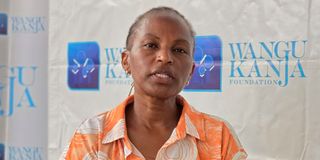
Wangu Kanja, founder of the Wangu Kanja Foundation, offers a perspective shaped by 21 years of working with survivors of sexual violence on whether the 16 Days of Activism against Gender-Based Violence delivers any impact, during the interview at her office in Nairobi on November 9, 2026.

What you need to know:
- Wangu Kanja has spent 21 years supporting survivors of sexual violence through medical care, counselling and access to justice.
- She says Kenya has adequate laws but lacks the funding and systems to protect survivors and enforce them.
- She calls for sustained investment and action beyond the annual 16 Days of Activism.
Post-rape care is an emergency service. Yet survivors seeking help at public hospitals are, in some cases, being asked to register with the Social Health Authority (SHA) before receiving treatment.
For those unable to afford registration, this can mean leaving hospital without the urgent medical interventions they need to prevent HIV infection, other sexually transmitted infections and unintended pregnancy.
For 21 years, Wangu Kanja has helped survivors of sexual violence navigate medical care, psychological support and the justice system. Having survived rape herself, she founded the Wangu Kanja Foundation in 2005 to help others facing the challenges she encountered.


The foundation has since handled more than 50,000 cases, receiving between two and 10 cases daily. But after two decades of working with survivors, Wangu says Kenya's biggest problem is no longer a shortage of laws. It is the failure to invest in the systems and services needed to enforce them.
Donor funding is shrinking, forensic services remain inadequate, mental health support is limited, and the foundation has had to suspend some medical services after exhausting the grants that supported them.
As Kenya marks another 16 Days of Activism against Gender-Based Violence, Wangu is questioning whether the annual campaign is delivering meaningful change or simply recycling familiar conversations. In this interview, she explains what is failing survivors and what must change beyond the 16 days.
What are survivors experiencing when they seek emergency medical care under SHA?
Previously, survivors could walk into a private or public health facility and receive medical attention because post-rape care is an emergency service.
Now, survivors are being asked to register with the Social Health Authority (SHA) before they can access those services. They arrive at a public health facility in need of emergency care, and they are told to register first.
Many do not have the money to register. They have to go back home to look for it, or find an institution that can help. That creates a barrier to timely medical and mental health support.
The consequences can be serious. If a survivor goes home without the necessary treatment, there is a risk of contracting HIV or other sexually transmitted infections, or of an unplanned pregnancy.
That is why we encourage survivors to seek medical attention within 72 hours. They need timely interventions, including post-exposure prophylaxis, to reduce the risk of HIV, sexually transmitted infections and pregnancy.
Emergency services are emergency services. You cannot tell someone who needs urgent treatment to go and register first. Provide the service, then deal with the administrative requirements afterwards.
Has the withdrawal of international funding affected services available to survivors?
Funding for women's rights organisations and civil society organisations has fallen by about 80 per cent. Some support services will inevitably be affected.
With the limited resources available, we are prioritising direct services to survivors, including medical, mental health and legal support. Where we cannot provide a service, we reach out to partners who may be able to bridge the gap.
At the foundation, we have had to pause medical services because the grants supporting them have run out. We are still fundraising to see how we can resume that support.
This is not happening to the Wangu Kanja Foundation alone. Other women's rights and civil society organisations are affected too.
Kenyans need to hold the government accountable. If donor support is reducing, what measures are being put in place to make sure survivors do not lose access to essential services? The government has a responsibility to ensure that people can access medical, legal and other support.
Do the annual 16 Days campaigns still carry meaning after 21 years in this sector?
We need to change how we do things. You cannot keep repeating interventions that are not working.
During the 16 Days of Activism, people look for survivors to interview, invite government institutions to speak or organise big events. There is a lot of hype, but after that, what happens?
You spend a lot of money hosting dinners and bringing speakers together, but what changes afterwards? We need to think differently and come up with interventions that can be transformative.
What kind of change are you looking for?
We need to invest in behaviour change and find innovative ways of communicating about sexual violence. We are using the cases we have handled over the years to help reshape how people think about the issue.
Change does not happen overnight. It may take five, 10 or 20 years to see the impact of interventions on sexual and gender-based violence.
Advocacy itself can take five or 10 years before a conversation reaches its conclusion. It requires patience and multi-year funding. Many institutions want quick results, but you cannot invest in rehabilitating someone and expect immediate change.
I have had individuals who have worked with me for 12 years as they learn to integrate their experiences into their daily lives. How many people are willing to make that kind of long-term investment?
We need to work on prevention while also supporting those who have already experienced violence. The two must happen together.
Over 21 years, what has changed in Kenya's response to sexual violence, and where does the country still fall short?
We have made remarkable progress. We now have laws and legal frameworks that allow us to hold people accountable. They include the Sexual Offences Act, the Protection Against Domestic Violence Act and the Prohibition of Female Genital Mutilation Act. Other laws also address issues such as technology-facilitated gender-based violence.
We cannot say we are short of laws. We have them.
That is where the rubber meets the road. It is about investing in the implementation and enforcement of the laws, and in the infrastructure that makes justice accessible.
How much money are we setting aside to address gender-based violence? How much have we allocated for medical support, mental health services, forensic evidence collection and police services?
For example, when DNA is collected from a crime scene, we have no DNA databank to cross-reference the samples. Do we have an independent forensic institution to ensure accountability in forensic services?
A lot goes into protecting a crime scene. Evidence must be identified, collected and packaged. The chain of custody must be maintained. The samples must reach a forensic laboratory, and they must be preserved so that they can be retrieved in future.
The infrastructure is not always survivor-centred or trauma-informed. We need to ask whether the investment is enough to protect survivors, treat them with dignity and help them access justice.
Beyond funding and medical care, what other gaps affect survivors?
How many shelters do we have, and has the government allocated operational funds for them? Do we have buildings that have been constructed but are not operational?
We also have a Mental Health Act that has not been fully operationalised to support survivors. We need to look at how national and county governments support survivors through protection, medical services and mental health care.
There is also a shortage of psychologists. The professionals available cannot meet the demand.
We must also look at the people providing services. Are they trained to handle survivors with dignity? What language do they use? Are they attentive and respectful?
If a survivor goes to a health facility and meets someone aggressive or dismissive, or who uses inappropriate language, that survivor will not keep seeking help. They will lose trust in the system and decide not to pursue the matter.
That affects access to care, the collection of evidence and the chance of justice.
How many of the foundation's 50,000 cases proceed through the justice system?
The attrition rate is very high because of distrust in the system.
Many adults who come to us want medical and mental health support, but they fear what their families, communities and society will think of them. Sexual violence carries a lot of shame and stigma.
Some survivors face threats and intimidation. Others withdraw because they do not want their partners to know what happened. Survivors are often made to explain what they were wearing, where they were or whether they contributed to the violation. That is wrong.
A crime is a crime. Survivors should not have to justify what happened to them.
We encourage both men and women to report sexual violence. Men can also be raped, including by other men and by women. But stigma can make it hard for male survivors to speak about their experiences.
What happens when a survivor wants medical care but does not want to pursue a case?
We give them information so that they understand the process and can make an informed decision.
For example, we explain that they will need to go to hospital for a medical report, report to the police and obtain an occurrence book number. The police then investigate and prepare a file for the Office of the Director of Public Prosecutions (ODPP), which decides whether the matter should go to court.
It is not a one-day affair. It may take a month, six months, a year or even two years. When survivors understand the process and what is expected of them, it helps manage expectations and build trust. If you do not give them information, you create distrust.
We also remind people that sexual offences should not be settled through alternative dispute resolution. The ODPP decides whether a case proceeds or is terminated.
Does reporting after 72 hours mean someone cannot seek justice?
No. There is no statute of limitations for sexual offences. A person can report a sexual offence at any time in their life.
We encourage early reporting because it helps in the collection and documentation of evidence, which will support the case in court. It also allows survivors to receive timely medical care.
What support does the foundation provide?
We provide medical services through private and public health facilities. We have psychologists in the office whom survivors can call or visit. We also offer legal advice and assistance to survivors and their families.
Our toll-free line, 1519, is free on both Airtel and Safaricom. When survivors call, we assess their immediate needs and how they would like to be supported.
We also run economic empowerment programmes for people who are vulnerable to sexual exploitation and abuse. Our focus is to make sure that interventions are survivor-centred, trauma-informed and always in the best interest of the survivor.
The foundation has also built a network of survivors who support others who have gone through similar experiences. We have 47 county networks. Cases reach us through the network, partners, other women's rights organisations, civil society organisations and government agencies.
What does the foundation hope to do next?
We want to scale up our services by expanding our team and partnering with institutions such as the Law Society of Kenya and the Association of Psychiatrists and Psychologists.
We also want to use technology and innovation because too many people need support, and the number of psychologists cannot meet the demand.
Everyone needs to bring their expertise. We need concerted efforts to address the challenges facing survivors and to build a society where people can get support and live free from sexual violence.
Ultimately, we need to stop treating the 16 Days of Activism as an annual event. We should ask what has changed, what has not and what we are doing so that survivors are not left to navigate these systems on their own.
Need emergency care? SHA says it's free
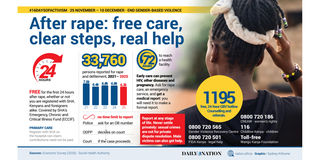
Emergency care is free for the first 24 hours, whether or not a patient is registered with SHA. The cost is covered by SHA’s Emergency, Chronic and Critical Illness Fund. This applies to both Kenyans and foreigners in Kenya. No one should be asked to pay for emergency treatment during this period.
Primary healthcare works differently. A rape survivor, for example, must be registered with SHA for the hospital to record the services provided and claim reimbursement. However, patients do not need to have paid their SHA contributions to access primary healthcare, which is free. These services are available at level one facilities and some level four hospitals that do not offer surgical services.
“Kenyans need to know the services they are entitled to at each facility,” says a SHA official.
If you or someone you know has been raped
- Within 72 hours, visit a health facility. Early intervention can prevent HIV and other diseases and also avoid pregnancy.
- Emergency care is free for the first 24 hours, whether or not you are registered with SHA.
- Request rape care - This is an emergency service and will be able to assist you.
- Obtain a medical report- This is essential if you choose to make a formal report.
- Report to the police- Request an OB number. Police then investigate and forward a report to the ODPP, who will determine whether or not to bring the case to court.
- There is no time limit. Individuals can report sexual crimes at any stage in their lives.
- Avoid private settlement - Sexual crimes should not be dealt with by private dispute resolution.
- Male rape victims can also receive assistance.
Where survivors can get help
• 1195 - National GBV hotline: 24-hour counselling and referrals
• 0800 720 565 - Gender Violence Recovery Centre · Medical and psychosocial support
• 0800 720 501 - Fida Kenya · Legal assistance
• 0800 720 186 - CREAW · Women's rights and GBV support
• 116 - Childline Kenya: Child abuse and protection support
• Wangu Kanja Foundation toll-free helpline