Catherine Umija's unapologetic fight: Include women's housework in Kenya's GDP
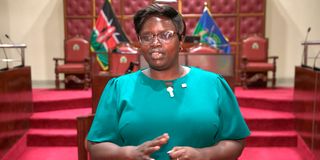
Nominated MCA Catherine Umija speaking in this photo taken on June 30, 2025 at the Laikipia County Assembly where she serves. Catherine is a strong proponent of the National Care Policy that is currently at the cabinet level. She is supporting the monetization of unpaid care work.

What you need to know:
- A Laikipia County MCA, is championing Kenya's Draft National Care Policy to monetise unpaid care work.
- She advocates including care work in Kenya's GDP whilst also pushing for immediate infrastructure solutions like water connections and road repairs to reduce women's burden.
Catherine Umija's unassuming presence at the Laikipia County Assembly belies her determined advocacy for one of society's most overlooked issues. The nominated Member of County Assembly (MCA) greets visitors with a warmth that makes it difficult to immediately discern her status, yet behind her humility lies an unwavering commitment to transforming how Kenya values the unpaid labour that keeps families and communities functioning.
As chair of the Women MCAs Caucus in the assembly, Catherine has become a vocal champion for recognising and monetising unpaid care work—a burden that disproportionately falls on women and girls across Kenya and globally. Her passion for addressing this inequality becomes immediately evident in conversation, as she speaks with conviction about the need for systemic change.
"It is my hope that the Cabinet will find it fit to approve the National Care Policy so that as a country, care work can be recognised by the national and county governments and put in Kenya's gross domestic product (GDP). It's the high time that unpaid care work is recognised and appreciated," Catherine tells the Nation in an interview.


The statistics paint a stark picture of gender inequality in domestic responsibilities. According to the Kenya National Bureau of Statistics, women spend three hours 36 minutes more on unpaid care and domestic work than men. For working women, the disparity remains significant—they dedicate three hours 18 minutes per day more to unpaid care and domestic work than their male counterparts.
This pattern reflects a global trend where women typically spend two to three times more hours per day on unpaid work than men, often juggling these responsibilities alongside formal employment or other income-generating activities.
Catherine is unapologetic in her calls for the country to embrace monetising unpaid care work. She believes that government recognition and compensation could fundamentally shift the burden women currently shoulder.
"By the government monetising care work, it will help to alleviate the burden that women shoulder bordering on care work as they can use the money to employ a person to do the work for them," she explains. "Monetising care work will help to have unpaid care work—most of it normally done by women—be understood and appreciated."
Whilst she acknowledges the financial challenges that monetising care work might pose for the government, she emphasises that there are immediate, practical steps that could significantly reduce women's unpaid care burden.
"The government may fail to pay for the care work but there are things that it can do to lessen the unpaid care burden that women currently grapple with by ensuring that water is connected and roads are fixed," she adds.
Infrastructure development, Catherine argues, plays a crucial role in alleviating the daily challenges women face.
"The government needs to ensure that roads are good and water is readily available to Kenyans so that to ease the care work burden for women who are the ones who normally go looking for water."
Her frustration with the current situation is palpable. "It's sad that care work has never been recognised in a way that every woman feels assisted even after women normally spend a lot of their time in the kitchen, doing laundry, fetching water and collecting firewood among other duties."
As an MCA in Laikipia County Assembly, Catherine has been steadfast in lobbying for women's needs to be prioritised in the Laikipia County Integrated Development Plan meetings. She works to ensure that pressing needs like water, roads, and health services are incorporated into the devolved unit's development plans.
Daycare facility
The Assembly has set a pioneering example by establishing a day-care facility—one of the first assemblies in Kenya to offer such support. The facility, which can accommodate six babies at a time, provides a safe space where female MCAs and staff with young children can leave them whilst attending to assembly business and their jobs.
Complete with a kitchen, beds, playing area, toys, a slide, and a television set for children to watch cartoons, the facility is staffed by a full-time day-care assistant who looks after the babies throughout the day.
"The day-care facility has given the MCAs and staff a piece of mind as they work in the assembly. It has also come to reduce the care work that they do," Catherine notes.
Caroline Kiricho, who works in the assembly, has witnessed first-hand the positive impact of this initiative.
"Many of my colleagues have really benefited from the facility. I must say that it has been of much help to them," Caroline tells the Nation.
Catherine's advocacy aligns with international frameworks that recognise the importance of unpaid care work. The Beijing Declaration and Platform for Action (1995) stressed the importance of unpaid work and aimed to support policies focused on unpaid care. Similarly, Sustainable Development Goal (SDG) 5 aims at recognising and valuing unpaid care work, with the achievement of gender equality being cross-cutting and inseparable from the rest of the Agenda's 17 goals.
Laikipia County is one of three counties benefiting from a significant pilot project on unpaid care work. In May 2025, UN Women Kenya, in collaboration with the State Department of Gender and Affirmative Action, launched the Evidence to Policy for Kenya Care Economy project being implemented in Kitui, Laikipia, and West Pokot counties. Laikipia implementing partner is Hand in Hand Eastern Africa.
This initiative, supported by the Gates Foundation, aims to recognise, reduce, redistribute, reward, and represent care and domestic work—most of which is carried out by women and remains unpaid and invisible. The project is setting the stage for a more gender-equitable society where care is valued as essential to economic and social well-being.
Dan Bazira, the UN Women Deputy Country Representative, emphasises that the care economy extends beyond social issues. "It is an economic issue. And where there is social and economic, there is development. Under looking unpaid care work, means the economic development is being affected. Women should be engaged, who are at the forefront of the family and society's development," Bazira says in an interview.
He advocates robust investments in the care ecosystem, with development partners being integral to this agenda.
"The government machinery needs to allocate resources to the county to ensure there are ECDEs (Early Childhood Development and Education) centres, there support structures for markets that are being constructed and other provisions. Once this is done, you will see a change where a woman has more options to select other economic livelihood options. The moment we provide that platform, caregivers will thrive."
Unpaid care work is articulated in SDG 5 targets, which commit member states to recognise and value unpaid care and domestic work through the provision of public services, infrastructure, and social protection policies.
Whilst no country has fully "monetised" unpaid care work by incorporating it directly into GDP calculations, some nations are making significant strides in recognising and valuing its economic contribution.
Statistics Canada has found that unpaid care work, such as childcare and eldercare, has a significant economic value, equivalent to a substantial portion of GDP in some regions. Several countries, like Australia, have conducted studies to estimate the monetary value of unpaid care work. In Latin America, some countries have implemented policies to support families and caregivers, recognising the economic impact of unpaid care work.
Last week marked a significant milestone for Kenya's care economy. The State Department of Gender presided over an event where different stakeholders validated the Draft National Care Policy—the very policy Catherine has been advocating for.
"Kenya's care economy has achieved a major milestone today following the landmark validation of the Draft National Care Policy spearheaded by the state department of gender. This now sets the stage for onward processes leading to its adoption by the Cabinet," the department posted on social media.
Among the key institutional frameworks of the policy are proposals to establish well-equipped childcare centres, elderly care facilities, and training programmes for caregivers, focusing on compensating tasks like cleaning, domestic work, and caring for the elderly, sick, or children.