Why Tharaka Nithi is a model county in promoting women’s welfare through preschool care
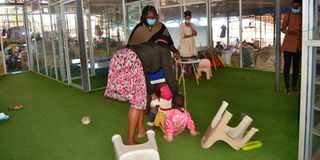
A caretaker at a creche at Chuka open-air market plays with children on August 2, 2021. The facility offers lactating mothers doing business in the town a safe and friendly place to breastfeed their babies.

What you need to know:
- Tharaka Nithi County allowed three-year-olds into pre-primary school, freeing mothers from childcare duties.
- Mothers with unemployed husbands saw 90 per cent income increases, whilst those with additional young children gained 95 per cent more income.
- Other Kenyan counties are now clamouring to replicate this transformative childcare model.
In December 2019, something happened in Chuka Market, Tharaka Nithi County. A public crèche was opened by the county government, a move that marked a powerful shift in how women’s care responsibilities are acknowledged and supported.
Inspired by the success of this single intervention, the county, together with Kenyatta University Women Economic Empowerment (KU-WEE) Hub, Yale Economic Growth Centre (EGC), Bangor University, the University of the West Indies (UWI) and with funding from the Gates Foundation embarked on a study to understand the broader impact of childcare on women’s livelihoods and economic participation.
Casual labour


Then they established that crop farming was the main source of income for 85 per cent of the women, followed by animal husbandry (54 per cent), casual labour (42 per cent), and small business (16 per cent). And on average, women spent 6.14 hours per day on casual labour, earning around Sh 5,460 per month, compared to up to Sh 9,492 from livestock and small businesses, which often require more time, focus, and mobility.
But time was not something these women had. The survey found that unpaid care work consumed between 5 and 19 hours a day, with child care alone taking up to 8 hours daily for many mothers.
To address this, in January 2024, KU-WEE Hub and its partners-Tharaka Nithi County, Yale EGC, and Bangor University and the University of the West Indies, launched a randomised controlled trial in 118 public pre-primary schools across the county.
The innovation? Admitting three-year-olds, a year earlier than the government’s standard entry age of four years into pre-primary one classrooms.
Each participating school admitted five such children, with trained caregivers supporting the regular teachers in delivering an age-appropriate curriculum.
The results, though preliminary, are already telling a powerful story.
“Married mothers with unemployed husbands saw their weekly wages increase by 90 per cent,” said Dr Simon Onywere, co-principal investigator from KU-WEE Hub.
He was presenting these findings during a research and policy dialogue in Nairobi on June 30, 2025, convened by Yale Economic Growth Center and Inclusion Economics at Yale University.
“And mothers with an additional child under three experienced a 95 per cent increase in income. These are life-changing shifts” he said.
But the benefits weren’t only financial.
“We also observed a 16 per cent increase in mothers helping other children under six with learning activities like reading and games,” Dr Onywere added.
“So, it’s not just economic empowerment. It’s also deepening their engagement.”
The model is now drawing national attention.
“Other counties are interested in the programme and want it expanded across Kenya,” said Prof Judith Waudo, Hub Leader at KU-WEE.
“We are open to more partnerships to replicate this model because it works. The interest is growing, and we’re excited about scaling it.”