Conservative bishops push back as a woman takes Anglicanism’s top seat
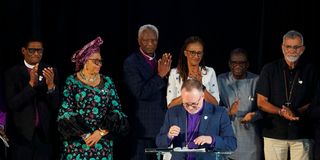
The Global Anglican Future Conference in Abuja, Nigeria, on March 5, 2026. The meeting comes amid ongoing global discussions on leadership and authority in the Church.

What you need to know:
- The appointment of Sarah Mullaly as the first woman to lead the Anglican Church has ignited resistance from conservative bishops, exposing deep ideological and gender tensions.
- A leadership dispute involving Global Anglican Future Conference and its recognition of Laurent Mbanda signals possible schism as debates over doctrine, authority and gender intensify.
When Dame Sarah Mullaly was appointed the next Archbishop of Canterbury on October 3 last year, this marked the first time in the Anglican Church’s 14 centuries of existence for a woman to be at the helm. Gender equality enthusiasts celebrated this achievement and its implied message: that the Anglican Church does not consider sex as a determinant of leadership and that women can dream of occupying any position in the institution.
Perhaps the Anglican Church would be expected to blaze such a trail given its protestant, and, presumably, democratic character. Moreover, the church has several women in senior positions, albeit they are still a small minority.
Globally, the church currently has only two female archbishops, namely Kay Goldsworthy of Australia and Anne Germond of Canada. It also has over 40 female bishops, against a total of some 883 prelates. The women are concentrated in the United States of America, Canada, England and Australia. Africa has seven bishops, namely Elizabeth Awut Ngor (South Sudan); Emily Onyango and Rose Okeno (Kenya); Filomena Tete Estevão (Mozambique and Angola),Vicentia Kgabe (Lesotho); and Dalcy Badeli Dlamini (Eswatini). Thus, power in the church still has a male face.


That the church has women leaders is a healthy profile. However, this seems to be under siege, going by recent reports that a cabal of conservative Anglican bishops, under the aegis of the Global Anglican Future Conference (Gafcon), convened in Abuja, Nigeria, in early March to elect a parallel global leader to Archbishop Mullaly.
Perhaps bitten by the potential backlash and criticism, the group restrained from declaring the parallel leader, only announcing that Archbishop Laurent Mbanda of Rwanda was its head. An article by the British Broadcasting Corporation on March 5 noted that “electing another person with the same title would have been seen by many as an open challenge to the leadership of the first female Archbishop of Canterbury just weeks before she formally begins the job.” It would be a palace coup.
But as William Shakespeare would say, a rose by any other name still smells sweet. The failure to directly answer “yes” or “no” when asked if they still recognised Archbishop Mullaly’s authority, only retorting that "The Global Anglican Council recognises Archbishop Laurent Mbanda as its leader", means that the group is unwilling to subject itself to the authority of Archbishop Mullaly.
Read: 'God has no gender’: Clergy, leaders and rights advocates on Kenya’s gender equality test in 2026
So what are the drivers of this defiance? Gafcon insisted that “doctrine was at the heart of their differences with the Church of England, not gender or sexuality.” It cited concerns about Mullaly’s promotion of “unbiblical and revisionist teachings regarding marriage and sexual morality”. It also preferred that “the majority of the Anglican Communion still believes that the Bible requires a male-only episcopalism.” Gafcon, which has membership from Africa, Asia, the Americas and Australasia, claims that it speaks “for the majority of the Global South”.
This is pure unadulterated patriarchy fighting back. The fluff about doctrinal differences is a smokescreen for reluctance to be led by a woman. The idea of an exclusive male episcopalism is often supported by the argument that Jesus had only male disciples.
But did He ever declare women persona non-grata? Did the bishops inspect his brain to establish that he did not think much of women? Do these renegades know that no biological man was involved in the conception of Jesus? How do they interpret this or don’t they have the intellectual capacity to do so? The simplistic argument is akin to saying that since Jesus wore sandals, that is the prescribed footwear for Christians. It would also mean that every Christian communicant must eat only the type of bread Jesus served on the last supper and drink similar wine. Just how mediocre can people get to defend chauvinism?
Established in 2018, Gafcon has indicated that it will not attend the Anglican Communion slated for June in Belfast to discuss the contentious issues in the Church, because they “no longer recognise the body”. This must be related to the fact that it has established its Global Anglican Communion. Is refusing to come to the table not the clearest indication of a preconceived position and precursor of the declaration of a splinter?
Archbishop Mullaly will be installed in Canterbury on March 25. If Gafcon bishops do not attend the ceremony as threatened, it will be clear that the Anglican Church is on an irreversible path towards a major schism, shamefully based on male chauvinism. The double speak by the rebels does not wash. The sooner Gafcon realises that the train of gender equality has left the station, and that leadership inheres in intellect and skill, not biology, the better.
The writer is a lecturer in Gender and Development Studies at South Eastern Kenya University ([email protected]).


