Curable yet neglected: Why should genital schistosomiasis burden communities?

What you need to know:
- A lakeside woman’s story reveals how genital schistosomiasis silently destroys lives amid neglect, stigma, and broken systems.
- Despite available treatment, thousands suffer in silence—misdiagnosed, misunderstood, and ignored by Kenya’s health system.
This is the second and last instalment of the FGS story.
The morning air is thick with the scent of damp earth after a night of heavy rain. It’s 8am and the sun remains hidden behind reluctant clouds.


But Loza*, a 23-year-old mother of three with no regular source of income, makes one decision clear: she must go out for casual farm work that will earn her Sh200 upon completion at 4pm.
In this village in Homa Bay Town Sub-county, Homa Bay County, this is the kind of work Loza, who only completed Class Eight, can find. Wearing torn black rubbers and carrying a jembe in her left hand, she sets off for the farm, a 20-minute trek.
Step one, then another, and just before the third footfall touches the ground, something happens that makes her scream. A wave of twisting pain wrings through her lower abdomen. Just like that, March 2025 has become a dreadful month for her. It has been months since she last felt this. Something is wrong. “When I had my last-born in April last year, I suffered from severe abdominal pains,” she recalls.
“I would also urinate frequently, and my urine was blood-stained. The blood would come after I had finished urinating. I had a smelly, whitish vaginal discharge that stank so badly that I couldn’t stand or sit next to anyone. Even when walking or working in a group, I would keep a distance to avoid the scornful or questioning eyes.”
For six months, this was her reality, one that she and her hustler husband assumed was a normal part of postpartum recovery and would fade with time. And faded it did, only to return months later with a vengeance. The symptoms Loza describes align with those recognised by the World Health Organization (WHO) as signs of female genital schistosomiasis (FGS).
In the first instalment, we examined what FGS is and how it affects women, especially those with little or no access to clean water and adequate sanitation. WHO says FGS thrives among the poor, like Loza.
More than a woman’s issue
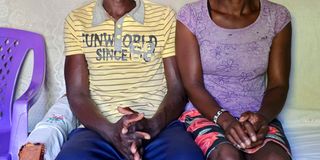
Loza* and her husband Axy* at their home in a village in Homa Bay County on April 15, 2025. They shared how FGS strained their marriage following its complications.
FGS is not only a reproductive health issue; it also reveals a broader failure of the government to connect households, both rural and urban, to safe water sources. This failure compounds the challenges women face.
For a woman planning to have more children, the effects of FGS can compromise that possibility, as outlined in our previous article. For married women, the consequences can trigger domestic violence, outlawed by law but exacerbated by health crises, disrupting the stability of family life, a unit the government claims to protect under its family promotion and protection policy.
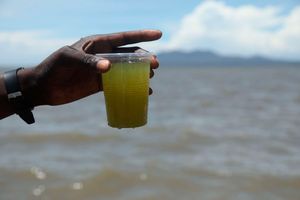
Loza primarily fetches water from a communal pond; at times from a swamp, or she buys piped borehole water, used only for cooking, at Sh5 per 20-litre jerrycan. Ponds and swamps, due to their freshwater nature, are ideal habitats for the snails that host schistosomes –the parasites that enter the body and cause the havoc Loza is experiencing.
This neglected tropical disease has burdened Loza in every way, from loss of self-esteem that leads her to isolate herself, to emotional and psychological distress. She battled with it silently, fearing the worst. In doing so, she left behind a trail of untold pain for herself and her husband.
“When the symptoms returned, my greatest fear was that I had cancer,” she says.
Treatment
Despite the pain, Loza still went to the farm. It was only by chance, meeting a well-known laboratory technologist at a local public health centre, that she was finally convinced to seek medical help. He met her on her way back from the farm and he, after hours of discussion and persuasion, helped her understand the urgency of the situation. “I was afraid of being told I had cancer,” she emphasises.
At home, however, things were far from well. She could no longer enjoy intimacy with her husband because the pain was unbearable. She avoided talking to him about it. She says it made her feel ashamed and unworthy. Her husband, Axy*, confirms this. “The first time I noticed how much pain she was in, I tried to ask what was wrong, but her response was not welcoming,” he says. “From then on, I stopped asking to avoid conflict. I wanted her to go to hospital, but how could I insist when she didn’t even want me to mention it? I kept my distance to maintain peace in the home.”
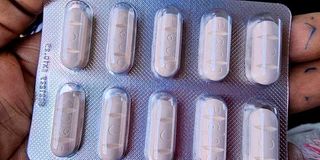
Praziquantel tablets, the cure for genital schistosomiasis.
The laboratory technologist saved the day. At the health centre, a nurse performed a pelvic examination on Loza using a speculum, which confirmed she had FGS. She was prescribed a one-time dose of three Praziquantel tablets, administered based on her weight. Concerned that she might not take the medication, especially after the lengthy effort it took to convince her to seek treatment, the technologist ensured she took all the tablets on the spot to guarantee full adherence. “The symptoms are gone; now I’m okay and happy,” Loza says.
Her husband, Axy, is equally relieved. “I was so worried about her health, especially because she was easily irritated and growing weak. I felt great relief when she finally told me what the problem was and that it had been treated,” he says.
He later admitted to her that he had also experienced similar symptoms – pelvic pain, discomfort during sexual intercourse, and blood in his urine, especially at the end of urination, all of which are signs of male genital schistosomiasis (MGS). He has not yet gone for a check-up but says he intends to do so soon.
Economic vulnerability
Meanwhile, ending FGS and MGS without addressing the economic vulnerability of those most at risk is as complex as the diseases themselves. Loza was advised by the laboratory technologist to stop using water from the pond and swamp. But she and Axy ask, “What options do we have? Can we afford to buy water every day? No, we can’t. I don’t have a job. I take up whatever work I can find to feed our children, and financially, I’m in the same situation as my wife.”
People resorting to herbal remedies for undiagnosed illnesses is not uncommon in Kenya, and neither are the accompanying myths. When it comes to FGS and MGS, a myth can easily arise that one can kill the adult worms by drinking vinegar, lemon juice, or salty water. It stems from the fact that the snails that host the parasites causing FGS and MGS do not survive in acidic or salty water. According to the WHO, the Bulinus snail is associated with urogenital schistosomiasis and FGS, while the Biomphalaria snail is linked to intestinal schistosomiasis.
“First of all, you cannot get FGS by drinking dirty or contaminated water,” points out Millicent Ouma, senior research officer in the FGS study at LVCT Health. “Secondly, drinking acidic products like vinegar will not kill schistosoma eggs. The only effective treatment is through medication. If acidic food worked, no one would have FGS.”
Low-cost strategies
Given that FGS disproportionately affects the poor, who rely on infested freshwater sources like lakes, rivers, swamps, water pans, and ponds, there are a few low-cost strategies to reduce the risk of infection through the skin when collecting water, swimming, bathing, washing clothes, or fishing. She adds that collected water can be made safer with basic household practices: “Once the water is fetched, store it in closed containers or jerrycans for at least 72 hours in direct sunlight. The parasites won’t survive that long when exposed to sunlight and will die naturally.”
Another method is boiling the water before use. The heat will kill the worms, making the water safe for bathing, washing clothes, or cleaning utensils. But beyond these actions, much more needs to be done at the levels of community sensitisation, health service delivery, and professional training.
A groundbreaking study by LVCT Health, in collaboration with the Ministry of Health, the Bridges to Development, and Frontline Aids, has demonstrated the possibility of integrating FGS and MGS services with HIV care, cervical cancer screening, and family planning. However, the success of such integration hinges on awareness at the community level, delivered by trained community health promoters, and capacity-building for healthcare workers to diagnose and treat these diseases accurately.

Stephen Ochieng’, a community health promoter assigned to a community health unit in Homa Bay Township.
Stephen Ochieng’, a community health promoter assigned to a community health unit in Homa Bay Township, has been in the field since 2022. Yet, he only learned about FGS after attending training in 2024. Since then, he has referred 40 women and five men to Homa Bay County Referral and Teaching Hospital for diagnosis and treatment. “I followed up, and 30 of the women who underwent visual examination for FGS were confirmed to have it. Out of the five men, three were given medication,” he says.
Rose Olumo, a nurse from the maternal and child health and family planning clinic at the referral hospital, also points out the awareness gap. “We usually learn about schistosomiasis in school, but not FGS,” she says. “I was trained by LVCT Health and now I understand what it is and how to diagnose it.”
Now she understands the language of the women referred by sensitised community health promoters, who say they want to be checked for FGS while seeking sexual and reproductive health services, including cervical cancer screening and family planning. “We now have walk-ins of women in the reproductive age group, 15 to 49 years, who know what they want and will say they want to be checked for FGS, unlike before. Out of every 10 we screen, three test positive for FGS,” she says.
Investments and progress
All these preventive, curative, and promotive efforts require investments, and progress is being made. The Kenya National Master Plan for the Elimination of Neglected Tropical Diseases 2023–27 by the Division of Vector Borne and Neglected Tropical Diseases in the Ministry of Health identifies FGS as one of the diseases targeted for case management, meaning now there is institutional attention to the problem in endemic regions.
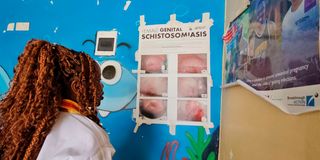
Millicent Ouma, senior research officer in the FGS study at LVCT Health, explains the diagnostic indicators of FGS on a chart at Miniambo Health Centre in Homa Bay County, on April 16, 2025.
The government is working to develop an FGS and urogenital schistosomiasis training manual and guidelines, train healthcare workers on accurate diagnosis, and sensitise community health promoters to FGS.
Already, the master plan indicates that health education forums on FGS have been held in Homa Bay, an FGS-endemic area, reaching 1,700 people through focus group discussions, 70 through advocacy meetings, and 14 through in-depth interviews.
In Kwale, community dialogues have reached 1,586 people, 171 through advocacy meetings, and eight through focus group discussions.
At the same time, 600 healthcare workers were trained in FGS in 2023, another 600 in 2024, and 700 are targeted for 2025, totalling 1,900. This is a drop in the ocean, considering Kenya has over 190,000 active health workers, according to the Ministry of Health’s 2023 Health Labour Market Analysis. However, non-state actors such as LVCT Health continue to supplement the government’s health efforts.
Through its two-year study (2023–25) to establish the feasibility, acceptability and cost of integrating FGS with sexual and reproductive health services, it has also trained and sensitised health managers, healthcare workers, community health promoters, women of reproductive age (15–49), and community gatekeepers.
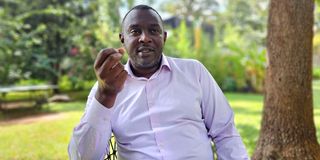
Dr Robinson Karuga, a research scientist at LVCT Health and principal investigator in the FGS study.
“The study aimed to develop and test a model that not only addresses the biomedical aspects of FGS but also embraces a human rights and person-centred approach,” explains Dr Robinson Karuga, a research scientist at LVCT Health and principal investigator in the FGS study. “The rationale is that interventions targeting neglected conditions often fail by focusing solely on the disease, rather than the client and the broader social impacts such as stigma and gender-based violence.”
Human rights
Stephen, a community health promoter, upholds this human rights and person-centred approach during health talks with women and men. “Wives become victims of domestic violence. Their husbands accuse them of cheating because they are not engaging in consensual sexual relations, yet the women are in serious pain from the effects of FGS,” he says. “So, we tell them that before you accuse your wife, find out what the problem is. Take her to hospital. Understand her and help her find a solution, do not torment her further.”
At the start of the study, a literature review found no existing integrated models. This finding prompted consultations with experts in academia, policy, and research, leading to the development of a minimum service package for FGS integration.
The package includes four key components. The first is health literacy, which involves creating awareness among healthcare workers and community members. The second is screening and diagnosis, done using a simple double checklist to assess risk, followed by a speculum examination when necessary. The third is care and treatment, which focus primarily on administering Praziquantel to kill adult worms and reduce inflammation, with referrals made for further treatment in cases where lesions are present. The final component is social inclusion and equity, which acknowledges that men can also suffer from genital schistosomiasis and ensures that women experiencing stigma or gender-based violence due to the disease receive appropriate counselling and support.
“We found that integration was highly acceptable among clients and healthcare workers. It proved feasible, as health workers could screen for FGS during routine visits for antenatal care, family planning, or cervical cancer screening,” Dr Karuga says.
Another major finding was the alarmingly low awareness of FGS in communities. Though improved through training and sensitisation, one key challenge remains: no indicators for FGS in routine health registers. “Without indicators, it’s difficult to track disease burden or allocate resources at national or county levels, perpetuating neglect of this tropical disease. The research team is now advocating the inclusion of FGS indicators in service delivery records and health information systems,” he notes.
The study also highlighted the need to integrate FGS training into both pre-service and in-service training programmes for health workers, especially in endemic areas. This would ensure consistent and informed responses to cases. Additionally, the team found that the cost of integrating FGS into SRH services is cost-effective, estimated at under Sh1,950 ($15) per person in the first year of implementation.
The principal investigator, a trained biomedical scientist who has built a career in public health research, believes the findings can influence curriculum restructuring to include robust training in FGS and MGS, strengthen clinical guidelines, and inform policy. He views this as a pivotal moment to raise awareness, improve diagnosis and treatment, and advocate a more inclusive, evidence-based response to FGS in Kenya and beyond.
Financial input
While integration is possible, it requires financial input.
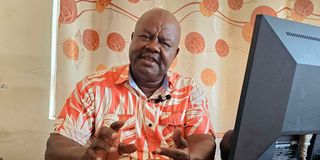
Justus Ochola, deputy county research and innovations coordinator in the Directorate of Public Health Services under the Homa Bay County Department of Health. He says killing snails that serve as hosts of the schistosoma parasite would violate Kenya’s wildlife protection laws. He spoke during an interview in his office on April 17, 2025.
Justus Ochola, deputy county research and innovations coordinator in the directorate of public health services under the Homa Bay County department of health, puts this into perspective, “The drug used for treatment, Praziquantel, is expensive. A 600mg tablet goes for Sh600. And one person may need six tablets, depending on their weight. Do the maths, that’s Sh3,600. That’s too high for most of our people affected to afford.
“During this research period, we did about 8,000 speculum examinations and identified around 1,000 women positive for FGS. This means one in every eight women in Homa Bay County could be presumed to have FGS.”
If each of those 1,000 women required six tablets, the county faces a financial burden of Sh3.6 million for just one dose. Since FGS patients return for a follow-up dose after three months to kill newly matured worms, the financial pressure doubles. Continuous re-exposure to infested water and open defaecation and urination further strains the county’s health budget. Recently, Governor Gladys Wanga flagged off drugs worth Sh50 million. This means that in the first quarter alone, Sh7.2 million will go to treating 1,000 women with FGS, equivalent to 14.4 per cent of the drugs budget.
If women are forced to buy the drugs, this translates into Sh7,200 over four months. From interviews, affected women often rely on husbands who earn Sh500 irregularly from casual work, or on their labour for Sh200 a day. They would need to save all their income for 15 to 36 days to afford treatment, which is impossible when basic needs like food are a priority. This clearly illustrates the burden FGS and MGS place on individuals, households, and the county government. “Most of our facilities lack the infrastructure to examine these women. They require privacy, gloves, specula, light sources to aid visibility; this is a major investment for a county,” Justus adds.
Furthermore, according to MFI Medical, a colposcope can cost as much as $22,532.33 (Sh2,909,599.77), which is more than Homa Bay County’s own-source revenue of Sh2,378,948,918 in the 2023/2024 budget.
Men too are affected
The county has also recorded cases of MGS. Austin Ouma, a medical laboratory officer at Miniambo Health Centre in Homa Bay Town, reported that one in four previously tested cases had MGS.
“MGS occurs when schistosome eggs are trapped in semen and male reproductive organs, causing pelvic pain, painful or bleeding intercourse, erectile dysfunction, infertility, genital swelling, and increased risk of HIV infection,” Millicent states.
FGS examination differs from standard bilharzia diagnosis. FGS is detected visually or physically, unlike bilharzia, which requires microscopic examination. As outlined by the WHO, effective diagnosis requires good lighting to inspect the vulva, and a speculum inserted similarly to cervical cancer screening, to give a clear view of the cervix, vagina and fornices. A colposcope or camera can enhance visualisation, especially in subtle cases.
“Typically, a person is only diagnosed with bilharzia. FGS is recognised later, when reproductive complications emerge. A woman might present with rubbery papules on the cervix or raised lesions,” Millicent says. “She may also have yellow sandy patches scattered, grainy lesions on the vaginal wall or cervix. These may appear as uniform yellow areas.”
She adds that abnormal, engorged blood vessels may be visible. But MGS is only diagnosed by examining semen samples for eggs under a microscope, she says.
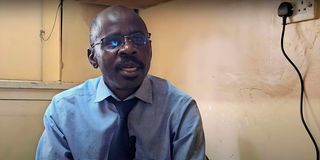
Nickson Mugoha, deputy county coordinator for Neglected Tropical Diseases in Homa Bay County, explains female genital schistosomiasis during an interview in his office on April 17, 2025.
In Homa Bay, proximity to Lake Victoria increases the risk of intestinal schistosomiasis, with prevalence as high as 60 per cent in some wards, explains Nickson Mugoha, the deputy county coordinator for Neglected Tropical Diseases in the county. Conversely, inland areas show higher rates of urogenital schistosomiasis, with prevalence reaching up to 20 per cent.
He lists Homa Bay Central, Homa Bay Arujo, Homa Bay East, Kanyadoto, Kabuoch North, and Kanyamwa, as well as South, Central, and West Kasipul, as areas affected by urogenital schistosomiasis. “Although we lack prevalence data on FGS and MGS, we have bilharzia data, since this region is endemic. Treatment for FGS and MGS is the same as for bilharzia. So we should prioritise and allocate resources to procure necessary commodities and medication for both,” Nickson says. “The numbers we have are significant and are serious.”
Serious are the effects of FGS and MGS that the communities at risk are worried about their future. “Will this happen to my daughters and son? What if there were a vaccine to protect my children from the disease?” Axy asks.