Dad's death led to my love for combat sports
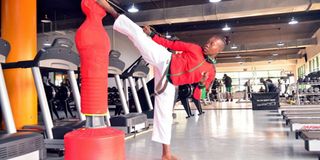
Lorna Abiero, a combat sports specialist in Karate demonstrates a spinning kick during a training session at Smart Gym on August 4, 2020.

What you need to know:
- Lona Abiero needed some distraction after her father's death and decided to give Karate a try; little did she know she would get hooked to it.
- In 2018, she secured a three-month scholarship from the International Centre for Martial Arts, under Unesco, to join the World Martial Arts Academy in South Korea.
- Last year, she participated in a tournament co-hosted by the World Martial Arts Masterships Committee in Korea and won three gold medals and one silver.
- She has partnered with four friends and founded a group called the Power Girls that trains women on how to defend themselves in case of a sexual assault.
If, ten years ago, someone had told Lona Abiero that she would win several gold medals representing Kenya in martial arts, she would have shaken her head in disbelief.
Ms Abiero, 29, was once a student at Masinde Muliro University where pursuing a bachelor’s degree in journalism and mass communication. The young girl who was in the self-sponsored program, had a dream of becoming a TV anchor.
She is wearing a blue top, work track suit, and white sneakers when I meet her. Her forehead is sweaty; she is from offering personal gym training to a client at a gym in one of the upmarket malls in Nairobi.


We take a seat at the reception where she takes us on a trip down memory lane on the twists and turns of her life.
When she was in her second year in campus, tragedy struck - her father, the family sole breadwinner, died.
“His death hurt so badly; I needed some distraction. I no longer had someone to provide for me or pay my school fees, or even a place to call home. I dropped out of school, and my journey to combat sports started,” she says.
Defensive techniques
One day, while walking around Kisumu Polytechnic, an institution in her neighbourhood then, she came across karate students practicing. Out of interest, she decided to give it a try. Little did she know she would get hooked to the sport.
Karate is a ‘weapon-less’ means of self-defence that consists of dynamic offensive and defensive techniques using all parts of the body for maximum advantage. The practice is divided into Kihon (drilling of stances, blocks, punches, strikes and kicks), Kata (pre-arranged forms simulating combat situations) and Kumite (sparring).
‘Karate helped with my mental health. I realised that each time I kicked and punched during training, my mind drifted away as I focused all my energy on it. It was therapeutic,” she says.
With a trainer who kept her on her toes, she got better by the day. She eventually shifted to Tong-il Moo-do in 2017. This is a sport that combines karate, taekwondo, judo and jujitsu techniques.
Gold medal
In 2018, she secured a three-month full scholarship from the International Centre for Martial Arts, under Unesco, to join the World Martial Arts Academy in South Korea. The program, known as Marie (Martial Arts Research Initiative for Experts), had seven participants from different countries including her.
When she got back to the country, she participated in the Mombasa Open International Tong-il moo-do championships, female sparring under 60 kilogrammes. She won a gold medal against a worthy Nigerian opponent.
The next year, she participated in the championships again, and won another gold medal. This time, playing under the Tong-il moo-do Jasiri national team. She won three gold medals, one in the special forms, another one in the team form, and one in female sparring under 65 kilogrammes. A form is a demonstration, which combines kicks, punches and blocks in a sequential movement.
Last year, she went to Korea for a second time, where she participated in a tournament co-hosted by the World Martial Arts Masterships Committee. She competed in the female sparring category of under 65 kilograms. Her first opponent was from Japan (7- 4), followed by Philippines (7 - 0), and finally Thailand (5 - 4). She won three gold medals and one silver. Jasiri national team under the leadership of Master Clarence and Master Hillary, was ranked second after the Philippines in this championship, globally.
Covid-19 lockdown
Just like any other sport, Ms Abiero needs to practice constantly. Her daily routine during the Covid-19 lockdown involves a five kilometre run. She then does basic training, which involves working on punches, kicks, blocks and forms, referred to as katas.
“After the training, I walk back home. However, on days when I do long distance run, I omit the training as it overworks the body, which in turn takes longer to recover,” she says.
“I am also on a diet that requires me to avoid junk food and hydrate well, while keeping off supplements. I must manage my weight lest I slip into a fight category I am not comfortable in. This requires a lot of discipline,” she explains.
Weight plays a big role in the sport, so much that one is disqualified immediately they don’t make the required weight. Besides that, you are in for a tough road fighting in a category you are not used to.
Normally, people weighing more than 65 kilograms are heavyweights. They are slow, she says, but throw heavy punches that leave you sprawled on the floor. Those below 55 kilograms, on the other hand, are lightweights, who make up for their lesser strength with magnificent speed.
Reducing weight
“A disciplined fighter must make the weight. I fight under the 65 kilogrammes category, so there is no single day I will go above it. I am currently sitting at 58 kilogrammes and cannot go below 55. What I do is just food portion control to avoid adding, and sustainably to avoid reducing weight,” she notes.
“I am always trying to improve my speed and power, which I achieve by doing strength and agility training. I lift moderate weights at the gym to improve my strength and power, and then I work on my speed to ensure I incorporate all these,” says Ms Abiero.
As an industry dominated by men since time immemorial, she says she is glad women are slowly warming up to the sport. She attributes the lack of female presence in the sport to the perception that women lose their femininity when they train in martial arts.
“However, the most beautiful thing about combat sport, especially for women and for me in particular is that I understand that I am not training to be like men. I am not competing or trying to equate myself to them, but I am training to be free as a woman,” she states.
So what challenges has she faced?
“Society will judge you for venturing into a male dominated sport. They will tell you that you will never have a boyfriend or a partner,” Ms Abiero says.
The second challenge, she notes, is the female reproductive health system.
“An average female sports person loses at least two days a month in their sports calendar because of menstruation. While most experience some level of discomfort, some get extreme pains, a stumbling block to training,” she says.
Power Girls
She observes that most gyms do not have special classes for women, and coaches train women the same way they train men without considering that the two genders have different anatomies. This makes women slack in training, which is discouraging and some end up quitting altogether.
The exercises are also tough, yet she has to keep going.
“I know most people have taken the Covid-19 season as a chance to rest, but I continue training. As we speak, my abs hurt so bad I cannot even laugh because I did a major workout yesterday,” she remarks with a smile. “The gym has also reopened, so I am back at work.”
Passionate about women, she has partnered with four friends and founded a group called the Power Girls. The group brings together women doing martial arts to train together. Besides that, they train other women on self-defence tactics, which gives them a voice to speak up as well as boost their confidence and esteem.
“We try to create awareness that a woman’s beauty and femininity does not decrease when they practice combat sports, which is mostly associated with the male gender. We are also trying to teach our society that martial arts is mainly taught to improve or instil discipline, to improve focus and self-awareness, and lastly, for self-defence,” she says.
Sexual harassment
She has, therefore, taken up the role of training newbies from scratch, ensuring they are imparted with skills well enough that they can protect themselves in case of danger.
“Women are victims of rape, sexual harassment and are termed weak, which is why we need to stand up for ourselves. Every time I read about someone who has been raped, I feel my intestines knot. It makes me think that if the victim knew how to punch or kick to choke someone, she would have been safer, somehow,” she says.
Sexual violence aimed at women also irks her because most victims do not speak out. This is another reason they started the Power Girls group - as a form of intervention on sexual assault women face.
“We were supposed to start our females’ only martial arts training then Covid-19 happened. We will resume when things go back to normal,” she says.
Being in the world of combat sports has changed her immensely, she remarks.
“I have earned respect, I am physically fit and I earn a living from it. My mental health has also improved,” she says.
With the children home during this global pandemic, she urges parents to enrol them for self-defence classes to keep them busy, physically fit and focused. She also urges women to learn martial arts for self-defence and for society to adapt to the fact that women are fully embracing the same.


