Doctors, pilots, archaeologists: The new faces of Bajuni womanhood
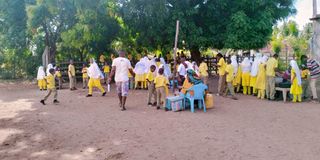
Pupils at Pate Comprehensive School compound in Lamu East Sub-County in this photo taken on March 5, 2025. The institution is changing the Bajuni girls' fortunes.

What you need to know:
- Once relegated to household duties after Standard Six, girls on Pate Island now outnumber boys at one of the schools.
- Aisha Muhdhar scored 376 marks in KCPE, exemplifying a cultural transformation where Bajuni girls are becoming doctors, nurses, engineers, and pilots.
Aisha Muhdhar's 376 marks in the KCPE examinations didn't just earn her top honours at Pate Comprehensive School—they shattered generations of expectations.
In a community where girls once vanished from classrooms after Standard Six, summoned home to await marriage proposals, Aisha represents something revolutionary: possibility.
Across Lamu County's Bajuni community, long-held traditions are giving way to new aspirations as young women step boldly into classrooms and careers their mothers could never have imagined.


"About two decades ago, you would see very few girls attending school. The Bajuni community was uneasy in embracing girl child education. In fact, out of 10 pupils in class, girls would be only three or four," recalls Ali Hassan, senior teacher in charge of academics and enrolment at Pate Comprehensive School.
"There was lots of male chauvinism among society members. I am happy that today the habit has been thrown to the bins."
Established in 2005, the pioneer school on the island is among those in the island that stand as living proof of this transformation. The largest public education institution in Lamu East now boasts 580 pupils from Grade One to Nine, with girls outnumbering boys – 295 to 285. This represents a remarkable shift for the predominantly Swahili community of Bajuni origin, where traditional values once relegated female education to an afterthought.
Hassan attributes this evolution to persistent sensitisation campaigns and the influence of forward-thinking families who recognized the power of education. The results speak volumes – in the last Kenya Certificate of Primary Education (KCPE) examinations, the top performer was a girl named Aisha Muhdhar, who scored an impressive 376 marks out of 500.
For Tashrifa Bakari, this progress feels personal. As the Lamu County Executive Member for Lands, Physical Planning, Urban Development, Energy, Water and Natural Resources, she's among the professional women who now serve as role models for younger generations of Bajuni girls.

Pate Comprehensive School Senior Teacher in charge of enrolment and performance, Ali Hassan speaks to Nation.Africa on March 5, 2025. He says girls' performance has improved dramatically.
"The future is bright for the Bajuni community," Bakari told Nation.Africa, describing her own initiatives to champion girls' empowerment within her community, particularly regarding education.
The fruits of these efforts are already visible. Young women from Pate Island are forging careers as doctors, nurses, teachers, archaeologists, sociologists, social workers, engineers, mechanics, and even pilots – professions once unimaginable for Bajuni girls.
Raya Famau, Executive Officer of Lamu Women Alliance, emphasises that the community must continue providing equal educational opportunities.
"Gone are the days when the Bajuni girls were perceived as home keepers," she asserts.
This cultural shift aligns with government policy, as Lamu Education Director Zachary Mutuiri explains: "Even if you aren't willing to educate your girl, the policy of the government is that there must be a 100 per cent transition right from primary to secondary schools. I am happy to see the society embracing an education for both the girls and boys."
Local administrators have played a crucial role in implementing these policies.
Lamu East Deputy County Commissioner George Kubai highlights the importance of community-based enforcement: "Chiefs here are instructed to coordinate with their assistants, village elders and Nyumba Kumi officials to ensure all children in their areas of jurisdiction attend classes."
As textbooks replace tradition and graduation caps replace early marriage veils, Pate Island demonstrates how education can transform not just individual lives, but entire communities.