From domestic work to model urban farming: Jane Changawa’s inspiring journey in Nairobi
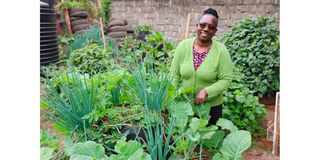
Jane Changawa tends her garden in Dagoretti North, Nairobi, on August 7, 2026.

What you need to know:
- After losing her domestic work income during Covid-19, Jane Changawa turned to urban farming and built multiple sources of income.
- A donated piece of land, organic farming skills and determination helped her transform her livelihood in Nairobi.
When Covid‑19 struck in 2020, Jane Changawa lost her Sh7,000 monthly pay from domestic work, leaving her without financial stability. “I could not just sit without a source of income,” she says. “I had to find another way.”
She turned to urban farming, and it has since transformed her life, livelihood and community presence. Jane now cultivates roughly 40 square metres in Dagoretti North, Nairobi, using vertical farming techniques that maximise limited space.
Her farming journey was made possible when a resident who owns land in the area donated space to her. She uses grow bags, buckets, and sacks to organically produce cucumbers, cherry tomatoes, spinach, sukuma wiki, onions, pumpkins, sweet potatoes, and cassava.


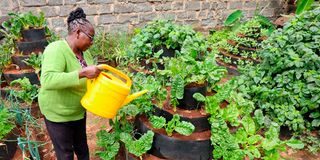
Jane Changawa waters her garden in Dagoretti North, Nairobi, on August 7, 2026.
She also grows herbs such as rosemary, mint, and lemongrass. “Some of my customers have visited the farm and seen the quality of my vegetables, such that whatever I harvest is often taken immediately,” she says.
She explains that the demand for her vegetables is so high that she cannot meet all requests. This, she says, is a challenge that motivates her to save more diligently so she can eventually purchase larger agricultural land for expansion.
A local nongovernmental organisation helped her begin by offering training in organic vertical farming and providing essential inputs such as loam soil, vegetable seeds and manure to support her first steps.
With only one sack, she began her journey, gradually expanding her efforts until she diversified her methods of growing food, showing how determination can transform limited resources into thriving and sustainable productivity.
This growth has earned her recognition from the Ministry of Agriculture, which has named her a model urban farmer in Dagoretti North, a status that has opened doors for her. Through this recognition, she has gained access to numerous opportunities, often being invited to train other farmers in urban farming. She is paid for sharing her knowledge and practical experience.
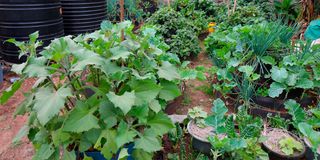
Jane Changawa's vegetables in Dagoretti North, Nairobi, on August 7, 2026.
The Agriculture ministry later connected her with an organisation that promotes organic farming. Together with her group of 18 members, the organisation provided them with a biodigester installed on her farm, enabling them to recycle waste and produce organic biofertiliser for use and sale.
“To make the biofertiliser, we use food waste, including fruit and vegetable waste, which decompose naturally inside the bin,” she explains. “The bin carries up to 250 kilogrammes and is connected with a pipe through which we harvest the liquid fertiliser after three days, once the waste has fully decomposed and released the organic nutrients.”
She says they share the bioslurry among members, sell the surplus, and then reinvest the earnings into their group through table banking. They sell the biofertiliser at Sh500 per litre.
Besides urban farming, she supplements her income through baking and briquette making, skills she acquired from the nongovernmental organisation, which initially equipped her with urban farming knowledge and practical training.
She also engages in beadwork, a craft she learnt through apprenticeship, which continues to provide her with additional income.
“I feel liberated,” she says. “These days I can juggle many things at once, unlike back when I was stuck doing domestic work. Now I’ve managed to multiply my sources of income, and that freedom feels amazing.”


