From savings groups to Saccos: How women finance their farming projects
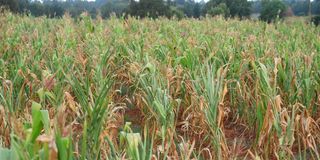
A withered maize plantation in Uasin Gishu County on August 3, 2026.

What you need to know:
- Women farmers across Kenya are relying on Saccos, savings groups and guarantors to overcome credit barriers as climate shocks threaten harvests.
- A Kippra analysis reveals persistent gender gaps in agricultural finance, with women facing collateral, savings and credit history challenges.
When Mary Cheburet, a farmer in Marigat, Baringo County, considered venturing into large-scale farming last year, her biggest challenge was raising the capital she needed.
Although she was employed, she did not have the Sh200,000 in liquid cash required to lease three acres of land to grow maize and tomatoes, as she had planned.
One thing came to her rescue: She had been saving with Boresha Sacco, which is headquartered in Eldama Ravine, Baringo County. “I took a loan of Sh200,000 from the Sacco. Five guarantors signed for me, and that helped me get started,” she says.


Although her farm is near Perkerra River, she is now grappling with low water levels caused by the prolonged drought. Thousands of other farmers also depend on the same water source. “A large percentage of the maize crop has dried up because it is not getting enough water. When you take a loan hoping to harvest enough to repay it, only to incur losses, it is stressful,” she says.
For Avia Munyao, a livestock farmer in Mutomo, Kitui County, a village savings group has become the main source of financing for her farming activities. She rears Galla goats and sells a six-month-old goat for Sh12,000.
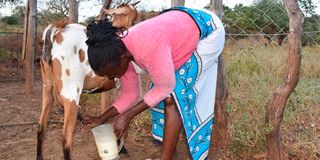
Avia Munyao milk one of her goats at her home in Kawelu village, Mutomo, Kitui South.
“We have a village savings group with 27 members. We are allowed to take loans of up to Sh30,000 because our savings are not much,” she says. “We usually guarantee one another because we are brought together by trust.”
The experiences of Mary and Avia reflect the different ways women farmers navigate the challenge of accessing finance, often relying on savings groups, Saccos, and guarantors when they lack the cash or collateral required by formal financial institutions.
Access to financing
An analysis by the Kenya Institute for Public Policy Research and Analysis (Kippra) on women’s access to agricultural finance in Kenya shows that access to credit varies by gender, age and location.
The study found that women in rural areas have greater access to formal non-prudential sources of credit, while those in urban areas are more likely to access formal prudential sources. Men, on the other hand, tend to favour formal prudential sources of credit in both rural and urban areas.
Women in rural areas are also more likely than those in urban areas, and men generally, to obtain agricultural loans from informal sources. Savings are another important component of agricultural finance. Nationally, 92.4 per cent of the agricultural population saves through formal financial institutions, according to the analysis of the 2019 FinAccess data.
Men primarily save through formal prudential institutions, with the highest proportion recorded among urban men aged between 35 and 64 years, at 88.9 per cent. Women, however, use a combination of formal prudential and formal non-prudential institutions. They are also more likely than men to use informal financial channels to save, with the highest proportion recorded among rural women aged between 16 and 34 years, at 12.5 per cent.
The study further shows that the type of collateral used to access credit differs depending on the source of financing. Guarantors are the most common form of collateral used by women seeking agricultural finance from banks. About 65 per cent of women aged between 16 and 34 years and 32 per cent of those aged between 35 and 64 years who accessed agricultural loans from banks relied on guarantors.
Men, however, predominantly use salary or income as collateral. Among men who accessed bank loans, 44 per cent of those aged between 16 and 34 years, 33 per cent of those aged between 35 and 64 years, and 43 per cent of those aged 65 years and above used their salary or income as security.
Loan security
Land or title deeds are also more commonly used by men aged between 35 and 64 years, with 26 per cent relying on this form of collateral. Guarantors, however, are the most popular form of security for both women and men accessing credit from Saccos.
The Kippra analysis notes that women use a mix of household assets, salary or income, movable assets and guarantors to secure loans from microfinance institutions. Men, on the other hand, mainly rely on group collateral, movable assets and guarantors.
Women are mainly denied credit because of low savings, existing debts, lack of collateral and poor credit histories, according to the analysis. Among rural women aged between 16 and 34 years, 40.8 per cent were denied credit because of low savings, 25.5 per cent because of existing debts and 19.5 per cent because of poor credit histories.
Lack of collateral was a major barrier for 17.4 per cent of rural women aged between 35 and 64 years. Men in rural areas face similar challenges, although the lack of financial records is an additional barrier, particularly among those aged 65 years and above.
The challenges are more pronounced among young people, with young women being the most affected. In urban areas, women are mainly denied credit because of poor credit histories, lack of collateral and existing debts.
Among women aged between 35 and 64 years, 31.7 per cent were denied credit because of poor credit histories, 24 per cent because they lacked collateral and 20.3 per cent because of existing debts. For urban men, the main barriers include a lack of guarantors, low savings and poor credit histories.
For farmers such as Mary, however, accessing a loan is only the first hurdle. Climate shocks can quickly turn an investment into a loss, leaving farmers with debts they had expected to repay from their harvests.


