From Jomo Kenyatta to William Ruto, her voice has carried through five decades
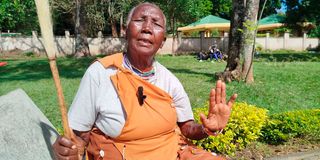
Elima Chesang, 74, a soloist with the Kewamoi traditional dancers, during an interview at Kabarnet Public Park on March 5, 2026. The Baringo performer has sung for all five Kenyan presidents over a career spanning five decades.

What you need to know:
- Elima Chesang performed before all five Kenyan presidents, starting with Jomo Kenyatta in 1968.
- Now 74, she lives alone in a rented house in Kabarnet as earnings from music decline.
In 1968, Elima Chesang was a young woman with a voice that turned heads. Selected from a pool of talented performers in Baringo North, she was among a choir chosen to travel to Gatundu to entertain Kenya's founding President, Jomo Kenyatta. Now 74, she recounts the memory decades later, but the pride in her voice has not dimmed.
"It was no mean feat. Being selected to sing for the President was a great honour for me and my group," she says, breaking into a smile.
The journey itself was an event, long, lively and full of anticipation, with the group piled onto a lorry under the sponsorship of the late Baringo North MP Henry Cheboiwo. For a young soloist from Bartolimo village, it was the beginning of something extraordinary.


Over the next five decades, Elima would go on to perform before all five Kenyan presidents. But today, she lives alone in a rental house in Kaptimbor, on the outskirts of Kabarnet town, without land of her own, wondering whether anyone remembers.
Her talent was visible from childhood. As a schoolgirl, teachers routinely picked her to lead songs at church services, school events and pastoral programmes.
In her community, her voice also carried cultural weight, she would sing to encourage girls going through traditional rites of passage, her music both a comfort and a rite in itself.
"Music is part of me. Even when I am walking or doing chores, I am singing," she says.
By the time she performed for Jomo Kenyatta, she had already built a name for herself as a gifted traditional dancer and soloist in Baringo North, her voice carrying both authority and emotion.
She was married in Kabargoge village, Baringo North, but the marriage broke down in 1974, leaving her to raise her four children, three sons and a daughter, on her own. It was not easy, but music helped her cope, she explains.
Renowned traditional dancers
When she later relocated to Kabarnet town in Baringo Central, she joined the renowned Kewamoi traditional dancers, a group that would come to define her identity as a performer.
The country was then under President Daniel Moi, and with support from the late Kabarnet Mayor Philemon Chelagat, a close ally of the President, the group performed widely at public events attended by the Head of State.
Those were better years. The proceeds from performances were steady enough to pay her children's school fees and keep the household running.
"I would do my house chores in the morning, then join my fellow dancers in the afternoon for training. When I had to travel, my relatives would step in to take care of my children," she recalls.
Along with the income, performances came with tokens, new uniforms and facilitated travel. It was not wealth, but it was enough. Music had become both livelihood and lifeline.
In the years that followed, grief found her in waves. Three of her four children are now gone. One son was killed in a road accident about two decades ago. Two others died of illness in separate years, both roughly 15 years ago. Her husband, from whom she had separated in 1974, also died about a decade ago.
Her only surviving child, her daughter, is now married and living her own life. Elima lives alone.
Yet when the drums begin to beat, she rises; to sing and dance.
Even at her advanced age, she remains one of the most recognisable figures in the Kewamoi dancers, a 30-member group, down from over 100 women in its earlier years. She is the soloist, identifiable by her trademark flywhisk and elaborate traditional regalia. The moment she steps into an event, something shifts in the room.
With the flywhisk held firmly, she sways to the drums, her beaded attire jingling softly with every movement. Her voice rises above the chorus—clear, commanding and expressive. Guests always fall silent when she is on stage. Whether it is a wedding, a cultural festival or an official function, she composes on the spot, weaving praise, storytelling and humour in her local dialect to fit the occasion.
"You cannot just sing any song. As a soloist, I must create something that fits the occasion. That is what makes people feel connected," she explains.
In her quiet moments, she still hums and shapes new compositions. Between rehearsals, she and her fellow dancers also make and sell beadwork, ushanga, as a side hustle to supplement their income.
But the reality of her situation is hard to ignore. What the group receives from performances today, she says, does not compare to what it once was.
"Things have changed. In the past, even the small tokens we received could sustain us. Now, sometimes what we are given cannot even cover transport," she tells Nation, describing their current earnings as "just a small token" given after performances.
For a woman who dedicated herself to preserving Kenyan culture, and who has performed before every president this country has had, the contrast is stark.
"If I had a chance to speak to President William Ruto, I would ask him to help me get land. I want to retire with dignity, in my own home," she says quietly.
She is also calling for broader reforms to protect traditional artists who, like her, have given their lives to cultural preservation but have little to show for it.
"For five decades, I have entertained this country, including its presidents, but I have nothing to show for it. It is my prayer that both county and national governments step in to support talent," she says.
Still, she has not stopped. Driven not by money but by love for her art and the joy it brings to others, Elima keeps performing; flywhisk in hand, regalia shimmering, voice rising above the crowd just to sing her story one more time.


