From teen mum to crusader of hope: The woman returning thousands of vulnerable youth to school
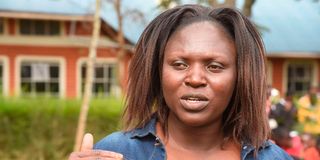
Mildred Adhiambo, from Kongoni Technical and Vocational Training College in Kakamega County, speaks at Silgich Primary School in Kipsomba, Uasin Gishu, on December 17, 2025

What you need to know:
- Mildred Adhiambo Chesum, once a teenage mother, has transformed her personal struggle into a movement that has enrolled over 4,000 vulnerable youth into technical training institutions across Kenya, offering them skills, employment, and hope.
- From overcoming stigma to empowering teenage mothers and former addicts, Mildred’s initiative demonstrates the transformative power of education and mentorship in reshaping communities in Uasin Gishu and beyond.
At 16, Mildred Adhiambo Chesum discovered she was pregnant. In that moment, standing in the quiet maize-farming village of Kipsombe in Uasin Gishu County, she believed her future had collapsed before it had even begun.
Two decades later, the same woman who once thought her world had ended has built a movement that has enrolled more than 4,000 vulnerable young people—teenage mothers, school dropouts, former drug addicts—into Technical and Vocational Education and Training institutions across Kenya. "When I got pregnant, I felt like the world had come to an end," recalls Mildred, now 36 and a mother of four.
But she refused to remain down. After her pregnancy forced her out of school, Mildred took on manual jobs to raise her own college fees. She was determined that the mistake she made at 16 would not define the rest of her life. That personal resolve would eventually transform into a crusade that is reshaping futures far beyond her village.


Today, in the same community where she once carried the weight of stigma, Mildred is no longer remembered for what halted her education. She is hailed as a heroine—the woman locals call the "Crusader of hope."
Her journey into advocacy began when she looked around Kipsombe and recognised a familiar pattern. Young girls burdened by the same shame she once knew. Young men sinking into alcoholism and drug abuse. An entire generation trapped in a cycle of hopelessness with no visible way out.
Mildred decided to become that way out. In just two years, her grassroots initiative has successfully connected thousands of vulnerable youth with Technical and Vocational Education and Training (TVET) institutions, offering them a path to skills, employment, and dignity.
Her message to teenage mothers in Uasin Gishu and beyond is simple but revolutionary. "A baby is a blessing, not a death sentence for your career. This is my message to all teenage mothers," she says.
The impact of Mildred's work is perhaps most visible at Kongoni Technical and Vocational Training Institute (TVTI) in Likuyani, where Principal Judith Akaranga has witnessed a remarkable transformation in enrolment numbers and student outcomes.
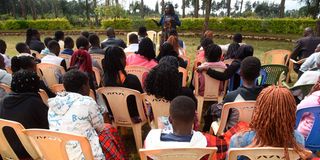
Mildred Adhiambo, from Kongoni Technical and Vocational Training College in Kakamega County, addresses girls at Silgich Primary School in Kipsomba, Uasin Gishu, on December 17, 2025. Some of the learners dropped out of school because of early pregnancies, while others could not proceed to college because of poverty. Male beneficiaries have been rehabilitated from drug abuse.
Jared Nyataya | Nation Media Group
"A significant number of our students are here because of Mildred," says Judith. "Despite arriving at the institution feeling hopeless, they have become among our best-performing students."
The initiative has extended its reach to other major institutions, including Kitale National Polytechnic, Eldoret National Polytechnic, and the Rift Valley Technical Training Institute. Across these campuses, young people who once saw no future are now acquiring skills that will carry them into the workforce.
For 21-year-old Deborah Cherop, Mildred was the bridge back to a life she thought was over.
When Deborah gave birth, her parents disowned her. Alone and without support, she saw no way forward.
"I thought my life had ended," Deborah says. "Mildred challenged me to join a technical institute. Now I am studying ICT at Kongoni TVTI, and I graduate next year. I want to secure a job and change the life of my child."
Her story is one of many.
Sylvia Atieno married at 17. For a decade, she remained a housewife, raising three children and watching opportunities pass her by. Then Mildred arrived at her doorstep—not to speak to Sylvia alone, but to convince her husband to let her pursue an education.
It worked. Today, Sylvia is enrolled in an accounting course. "The education I have acquired will transform my life as a mother," she says. "My challenge to all women is this: these skills make you a more productive and better mother. Never give up."
Mildred's campaign has also thrown a lifeline to young men who had fallen into the trap of illicit brews and drugs. Henry Kiprop spent five years idling after completing high school. By his own account, he was "dying in chang'aa and bhang." He had no money for further education, and no sense of direction.
Then Mildred spoke to him. "When Madam spoke to me, I saw sense," Kiprop explains. "My parents couldn't raise fees, but she explained that at TVETs, I only needed to pay for examinations. Today, I am a qualified electrician serving Uasin Gishu and Kakamega counties, thanks to Madam Mildred."
Local leaders have taken note of the shifting tide in the area. Mary Goreti, the area MCA, says criminal activities have dropped as young people find purpose in workshops and classrooms rather than on the streets.
"Initially, many of our youth became addicts after school. Since we embraced this programme, the situation has changed for the better," says the MCA. "I am fully committed to supporting this for the sake of our next generation."
For Mildred, the work is far from finished. She dreams of building a mentorship network that follows every beneficiary from the classroom to the workforce—ensuring that enrolment is just the beginning, not the end, of their transformation.
Her own story remains her most powerful tool. A teenage pregnancy in a quiet village. Years of manual labour to fund her own education. And now, a movement that has touched more than 4,000 lives. "The pain of the past should not deter us from changing our future," she says.


