From teenage pregnancies to authors: 28 young mothers behind 'Still, I Rise' share stories of resilience
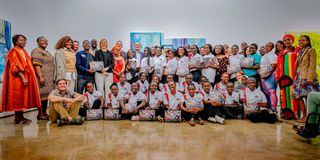
Authors of a collection of stories written by 28 teenage mothers from Kenya’s informal settlements during a group photo with CFK Africa staff after the launch of the book, Still I Rise, in Nairobi on August 7, 2026.

What you need to know:
- Twenty-eight young women from Nairobi’s informal settlements have turned their experiences of teenage pregnancy into stories of courage and hope.
- Through the book Still, I Rise, teenage mothers are challenging stigma and calling for stronger support to return to school and rebuild their lives.
When she stood up to talk about a book she has co-authored, Jane* did not need any teleprompter from which to read a speech. It was a private reception for contributors, families, media and supporters.
Cameras were focused on her, recording every bit of her speech. Bright bulbs above her head shone light on her young face, the room was quiet, all ears were listening as she narrated her story of a child who was forced to become a mother to another child. She courageously addressed the audience in the room as she told her own story the best way she could in her own words.
Soon, her voice started trembling, she struggled to hold her tears back as she reflected on the memories of an old man who betrayed the trust her family had in him before defiling her some three years ago. A sister in the room who was standing close to her, extended her right hand, gently rubbed her back to calm her down. Jane continued telling her emotional story through the microphone, which she held on her right hand to project her words to every audience in the room.


“My childhood was stolen by a man my family trusted. A man I regarded as my own grandfather. In a single moment, my life changed forever, leaving me to carry pain, pregnancy and heavy weight of judgment that was never mine to bare…,” Jane said.
As Jane told her painful story last Friday evening, the thoughts of a delayed justice pained her the most. In the book, Still, I Rise, a collection of stories written by 28 young women who became mothers as teenagers in Nairobi’s informal settlements, she also shares the accounts of circumstances that led her here today. The team wrote the book during a retreat in 2025.
The Nation is not quoting any chapter of the book in this article to avoid exposing Jane, who is still a minor because her story, like those of her co-authors, is published alongside photographs of the contributors, and all members of CFK Africa’s Girls Empowerment Programme, which supports young mothers returning to school. Jane is now back to school—a decision she says would not have been possible if she was to walk the journey alone.
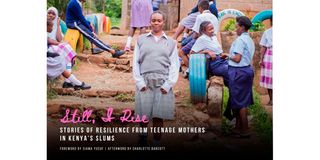
Cover of the book, Still, I Rise.
“But even when people turned away, my mother never let go and few friends who reminded me that I still mattered. I chose to go back to school, not because it was easy, but because I refused to let what happened define my future,” said the emotional Jane during the launch of Still, I Rise book in Nairobi.
When the abuser is at home
For Binti Rashid Ali, 22, the journey of writing Still, I Rise was quite challenging. It came almost three years after she gave birth to her daughter, who is now four years old. It was the fresh memories of the circumstances that led her into teenage motherhood that made putting her thoughts together in a book more difficult.
“I had mixed emotions when writing the book because I had to go back to when I had my baby and it was not an easy journey. My step-dad used to make his advances towards me and there was a time he tried to defile me; I told my mother but she brushed it off. So, I decided to run away from home to my then boyfriend and that is when I got pregnant,” Binti tells the Nation.

Binti Rashid Ali, 22, a mother of a four-year-old daughter and co-author of Still, I Rise, a collection of stories written by 28 young women who became teenage mothers in Nairobi’s informal settlements.
Binti, who at the time was living with her mother and stepfather in Kibera, one of Nairobi’s informal settlements, says life became more difficult during the Covid-19 pandemic when classroom learning was suspended to curb the spread of the virus.
“I did not have that nice mother-daughter relationship when I was growing up. If you add with the bad things my stepfather was trying to do to me in the same house, I felt safe being with my then boyfriend,” she recalls.
According to Binti, her then boyfriend wanted to protect her far from her mother and so, the two agreed to leave Nairobi. They travelled to Busia County, about 466 kilometres away. That over eight hours’ journey by bus was safe, but when they arrived home, her then boyfriend’s father had a contrary opinion about this relationship.
“My then boyfriend’s father always mentioned that the area chief would bring problems if they found out that his son was living with a young girl who was supposed to be in school. He insisted that if my boyfriend was serious about staying with me, then my boyfriend had to take responsibility, enrol me back in school and pay my school fees himself,” recalls Binti.
The old man had one more condition: “I felt that he was concerned about my future because at some point he asked me to give him my mother’s phone number, but I refused. I knew that giving him my mother’s phone number would have meant that I was going to travel back to Nairobi. What I feared most was going to happen because she was still living with my stepfather in the same house.”
The mother of Binti's then boyfriend is Ugandan. When the two felt that they could not meet the old man’s conditions, they chose to cross the border early in the morning while the old man was still asleep. “That journey to Uganda was not easy because I did not have any identification documents. We travelled by boda boda, but security officers at the border were strict. I lied to them that I was going to see my father who was working at a bank in Uganda. That is when they allowed me to go. My boyfriend was behind me, we did not want police officers to know that we were together,” she recalls.
The two stayed in Uganda as a boyfriend and a girlfriend for four months before he chose to come back to Nairobi to look for a job. He was lucky. Two months later, Binti also followed him. She was already pregnant. “I stayed in Uganda for six months, at my then boyfriend’s maternal mother’s home. When I remained in Uganda, his aunt, grandmother and most of his extended family members were taking care of my needs. According to them, I was a wife to my boyfriend. After my boyfriend got a job selling electronics, he rented a house then invited me to come back to Nairobi,” she says.
The two lived in Lucky Summer, Ruaraka. During this time, Binti, a self-taught crocheter, got financial support from her boyfriend for her crocheting business to raise some income before she delivered. Amidst every crotchet she made was the tough journey ahead of her as a teenage mother. “Back in Nairobi, we were staying in a bedsitter and it was not that easy, but at least I was comfortable. There was no one shouting at me, and I was not being beaten. My hardest part was outside that house. There was a time I was going to the market to buy baby stuff, then a certain boda boda guy mocked me that my agemates were in school while I was outside school with a pregnancy. I really felt bad and when I went back to the house, I cried,” Binti, who got her baby at the age of 18 says.
As the African proverb goes, by coming and going, a bird weaves its nest, Binti delivered her daughter and when the baby was two months old, she went back to school through the support of her baby daddy and her former primary school friend. Last year, she sat her Kenya Certificate of Secondary Education exam. She is now pursuing a two-year course in social work and community development at Kibra Technical Vocational College. Her daughter is a Pre-Primary 1 pupil.
“Last year, I went to South Africa to represent teenage mothers in Africa and shared a lived experience as a family. By writing the book, Still, I Rise, I hope parents can read my story and understand the need to listen to their children because parents are the first people their children always run to. A community where there are 10 teenage mothers means a high rate of dropout, high crime and high poverty levels,” says the coauthor of Still, I Rise.
A sister mentor
When it was her turn to speak, Siama Yusuf, who is the Girls Empowerment Programme Lead at CFK Africa and co-editor of Still, I Rise, did not shy away from telling the audience how her life as a young girl growing up in Kibra was full of lessons and hardships, especially when she reached adolescence.
“Life often takes unexpected turns, and at the age of 18, I became pregnant but did not walk through that darkness alone. I was lifted up by the women in my life — my late grandmother and my late mother. They showed me immense strength found in the community and in the bonds between women. That is why I am standing before you today, not just as a leader of the girls’ empowerment programme but also as an author, a mentor and a woman young girls look up to in my community,” she said.
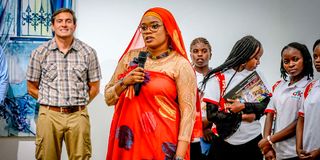
Siama Yusuf (with mic), Girls Empowerment Programme lead at CFK Africa, an organisation that empowers youth in slums, during the launch of the book, Still, I Rise, in Nairobi on August 7, 2026.
Siama called on the government, stakeholders, well-wishers and everyone present to collaborate and create policies that will keep all young girls who have dropped out of schools because of early pregnancies back in class, terming it a collective responsibility.
“We are here today not to just launch the book but to launch a movement. We are here to advocate a systematic shift [from one] that has let down our girls for a long time. We want to move beyond judging and instead create a supportive environment where these beautiful young women can reclaim their dreams,” she said.
Some 97.5 per cent of 121 respondents say teenage pregnancy is a pressing issue in their community. This is according to a poll conducted by CFK Africa in urban informal settlements in July 2026. In the poll, 81 per cent of 116 respondents also said they felt teenage pregnancy had increased over the past year. Based on its findings, CFK Africa says that as Kenya confronts increasing rates of adolescent pregnancy, the book seeks to shift public conversation from statistics to lived experience, placing young mothers at the centre of discussions about support, education, and opportunity.
“This book, Still, I Rise, is more than just a collection of papers and stories. It is a mirror. Inside it, you will read stories like mine, stories of young women who faced unimaginable challenges, judgments and obstacles, yet found courage to rise forward to rewrite their futures; they trusted us with their stories and their lives. We cannot ignore this reality, teenage pregnancy cases in our communities are rapidly growing, yet they are frequently and most underserved, stigmatised and cursed into the shadows,” Siama said.
CFK Africa founder Rye Barcott described the success of the 28 authors as a journey of persistence as evidenced by their testimonials in the book. “When they decided to write and edit a book, I thought it was a great idea, but I did not know what was going to come out of it. I really did not know whether the writing would work. That says a lot about you. Writing is hard, their writing is majestic and it is their extraordinary writing without ChatGPT. I am so impressed,” Rye said.
The launch of Still, I Rise happened at a time when CFK Africa is marking its 25 years of service that began in Kibera in 2001 with a mission to empower youth in slums through healthcare, sports programmes, girls’ empowerment, and education.
“The people closest to a problem understand it better than anyone arriving with a solution. This book is that idea in its simplest form. We did not tell these stories. We got out of the way so they could be told,” CFK Africa CEO Jeffrey Okoro said.
While Jane and other 27 teenage mothers in Kenya’s slums have found the courage to share their stories, they only represent a small percentage of their peers walking the same path. Proceeds from the book will support CFK Africa's teenage mothers’ programme. The book is also scheduled to be launched in the US.
*Name changed to protect the identity of the minor.