Dreaming beyond Mathare: The women inspiring children to reach for the stars
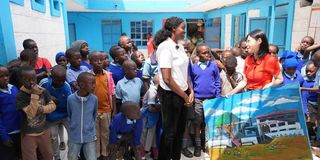
Counselling and psychologist Verah Adhiambo and digital influencer Masika Yang pose for a photo with learners at Mcedo Beijing School in Mathare, Nairobi as they celebrated the Day of African Child.

What you need to know:
- Verah Adhiambo and Masika Yang spent the day with children at Mcedo Beijing School, where the learners painted their dreams of becoming pilots, doctors and teachers in bright crayon, then gathered in a classroom to watch a film on three Chinese astronauts, Zhai Zhigang, Wang Yaping and Ye Guangfu, living aboard China's Tiangong space station.
In Nairobi's Mathare informal settlement, where gender-based violence and defilement are common, young learners need someone to hold their hands and remind them that their dreams are still possible. This year, as the world marked the International Day of the African Child, two women, one Kenyan and one Chinese, chose to be that hand.
Verah Adhiambo and Masika Yang spent the day with children at Mcedo Beijing School, where the learners painted their dreams of becoming pilots, doctors and teachers in bright crayon, then gathered in a classroom to watch a film on three Chinese astronauts, Zhai Zhigang, Wang Yaping and Ye Guangfu, living aboard China's Tiangong space station.
Also read: Rising from rejection: Inside the initiative giving Bungoma teen mothers a second chance at life


"I feel good, and I want to be a pilot because I love technology," said 10-year-old Roman Reigns, who is in Grade Five. Eight-year-old Marion Joyce watched the astronauts eat, brush their teeth and sleep in zero gravity, and decided she had found her calling, too.
"I have drawn people in space as they float, eat, brush their teeth and sleep. I have loved watching the film. When I grow up, I will want to work in space like those astronauts. I am very grateful to Masika for her gifts to us," she said.
For Masika, the film was a deliberate choice over a straightforward talk.
"I think that in celebrating the Day of the African Child, and since children really enjoy watching films, I felt that gifting them a film and telling them what is happening in the film as they were watching it was better than me coming to just talk with them. I believe that through the film, the children benefitted and better understood several things about China, especially technology, because in recent years, airspace technology has developed in a very big way in China and across the world," she told Nation.Africa.
Masika grew up in Habei Province in northern China, dreaming of becoming a teacher who would pass on values and skills to young learners. After secondary school, she chose to study Kiswahili instead, a decision sparked by a single newspaper article.
"Two months before I sat my exams to join university, I read a news article that talked about East African countries, and it mentioned Kiswahili as a major language that people on that continent speak. Although the continent was very far from China, I loved their language. I studied the language in China and later travelled to Tanzania and perfected my Kiswahili at the University of Dar es Salaam," she explained.
Her fluency grew alongside her love for East African culture, and she went on to build a TikTok account for her Kiswahili content, which is now followed by more than 40,000 people.
"At first, I thought that all I needed to learn in Kiswahili was greetings, but later on, I realised that there was very little I could communicate with the East African people. So, I looked at Kiswahili as a career. Honestly, I am very happy that I now have many Swahili-speaking friends, like the young learners in Nairobi's informal settlements," she said.
Spending the day with the children at Mcedo Beijing, Masika used the moment to make a simple point: no country, China included, is made up only of wealthy people, and big dreams are still possible regardless of where a child starts.
"After watching the film, many children here have told me their big dreams. Each one of them wants to achieve certain career goals in future, and some of them said they want to work in space. I believe that through gifting them a film, I am contributing to their big career dreams and motivating them to know that they need to put in a lot of effort to achieve those dreams. I see this as an important opportunity, because dreams are very powerful among children," she added.
That same belief in big dreams drives Verah, a Kenyan psychologist who founded a counselling club at Mcedo Beijing School. A counselling psychology student at KCA University who also grew up in Mathare, Verah mentors the learners as a way of giving back to the community that shaped her through difficult years.
"I grew up here in Mathare when it was very dirty. Even the school I went to was not as it looks today. The changes we are seeing now are something very new that started showing after our secondary school education. There was crime everywhere, mob justice… We could witness someone being killed right in front of us, which tended to traumatise us as we were growing up," she told Nation.Africa.
Much has changed since then, and Verah has chosen to be part of that change.
"Growing up in an environment where it is not easy for girls to excel academically requires a lot of support because of the many defilement cases. It is the inspiration I got from my uncle, after he took me from the village so that I could build my future, change my family and better my life after losing my mother at a young age, that kept me focused on my education. My counselling and psychology career helps me to better understand children when I talk with them in a safe space," said Verah.
Through her counselling initiative, she gives girls a safe classroom to open up and speak, and teaches them how to respond when they face challenges such as gender-based violence.
"I create awareness on how these children can protect themselves and abstain from things like crime and violence as they grow up," she noted.
The school's director, Benedict Kiage, described the Day of the African Child as an important one for learners from Mathare's informal settlement, but warned that without support, most of the dreams painted on manila paper that day may go no further than the classroom wall.
School enrollment data show that 59 of the 3,226 learners enrolled across the primary, junior and senior secondary sections in 2024 and 2025 dropped out.
Enrolment is highest at primary level, but most learners do not proceed to junior secondary. In Term One of 2025, six of 302 primary learners dropped out before Term Two; in Term Two, two of 309 left before Term Three; and in Term Three, two of 307 also dropped out.
"The main challenge which we have is that several students are dropping out of school, both boys and girls, in Mathare, because of some vices that come from their background like lack of food and school fees. You realise that several students still cannot access education. It is my appeal to the government and well-wishers to ensure that students from vulnerable communities are supported so they can acquire even basic education, because education helps in bringing equity and equality to families," said Kiage.
[email protected]