Global pact shines light on forgotten women behind bars
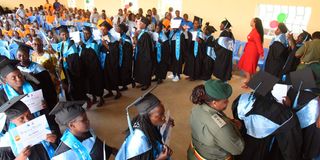
Women inmates at the graduation of 26 prisoners at Eldoret Women's Prison on April 11, 2025, after completing a programme in rehabilitation and reintegration, stress management and other skills. Women in Kenya's prisons come overwhelmingly from backgrounds of poverty and past abuse, yet access to legal support and structured reintegration remains scarce.

What you need to know:
- Landmark global agreement recognises unique struggles of incarcerated women and calls for urgent justice reforms.
- Advocates warn that poor prison conditions and limited legal support continue to fail women offenders in Kenya.
For the first time in history, the global stage has recognised the plight of women behind bars.
In the agreed conclusions of the 70th session of the Commission on the Status of Women (CSW), held in March 2026, member states, including Kenya, expressly commit to addressing the specific needs and circumstances of all women and girls who are arrested, detained, prosecuted, tried and sentenced, including those facing irreversible criminal penalties, or who serve as witnesses.
In doing so, countries are to consider the linkages between discriminatory laws, violence against women and girls and increased risk of incarceration, then adopt appropriate measures to address root causes and ensure accountability for perpetrators of abuse of women and girls in detention, custody or in prison settings.

Women make up 18 per cent of the country's population, according to a document by the Kenya National Commission on Human Rights, a government watchdog. It notes that while women account for a relatively small proportion of violent crimes, around four per cent, they are increasingly involved in offences that were once male-dominated.
Largely, women end up in prison for committing assault, loitering, littering, hawking, and illicit alcohol brewing and sale. But increasingly, they are being arrested for crimes such as prostitution, child neglect, child trafficking, drug trafficking, economic fraud and homicide.
Their backgrounds speak of women in need of support. The document says the majority come from homes that could not afford to send them to school. Some prisons are not properly built to accommodate women. In other cases, it notes, they are victims of past abuse, which may predispose them to committing a crime.
Human rights
Yet, as Winnie Syombua, a gender and human rights advocate with Reprieve UK, explains, the conversation around gender justice has long overlooked women in conflict with the law. Reprieve UK is a legal action charity that uses the law to protect the human rights of prisoners worldwide.
"Access to justice for women is hugely constrained," she says.
"Most women lack the resources to afford legal services, and they lack the social networks that men often rely on for guidance or support. The educational gap is glaring; many women have lower literacy levels, which compounds the challenge."
Despite this need, few pro bono lawyers visit prisons to help these women, she says. She describes conditions in Kenyan prisons as dire. Women, she says, are often deprived of basic necessities such as sanitary towels, which they rely on donations to access.
Sleeping arrangements are harsh: thin mattresses and threadbare blankets on cold floors, meals that fail to meet women's dietary needs, and minimal access to mental health support.
For mothers incarcerated with their children, permitted in Kenya until the child reaches the age of five, the situation is particularly complex.
"During the day, children are cared for by others while mothers perform assigned duties, disrupting bonds and exposing both to the stress of prison life," she says.
She further points out that many women offenders have been victims of gender-based violence or property disputes, yet courts rarely take these circumstances into account.
"Some women end up in prison for offences that could have been avoided if the right legal support and social protections were in place," she notes.
"This is why this CSW agreement is so timely. It has the potential to reduce the population of women in prison if implemented seriously."
For Winnie, implementation means the government taking steps that meet international standards for the treatment of women offenders, from programming that provides legal education and psychosocial support, to reintegration services tailored to women's unique challenges after release.
She stresses that without dismantling the systemic inequalities of income, property ownership and education, access to justice for women remains a nightmare.
Mental health
In Kenya, funding for gender-focused programming is pitiful; it operates mainly on donor funding. Winnie says this must change.
"Without deliberate action from government and civil society, the CSW agreement risks becoming another well-intentioned document cited in reports but invisible in practice," she says.
Shirly Amayo, a human rights lawyer at Reprieve UK, paints a sharper picture of the realities facing women accused of crime.
"Courts do not consistently take into account mitigating factors like mental health conditions such as post-partum depression, particularly in cases involving maternal offending," she says.
"The complex realities surrounding infanticide, for example, are often closely tied to psychological distress, a lack of support, stigma and histories of gender-based violence. Such realities directly influence the circumstances of the offence, as well as women's roles as caregivers and the impact of incarceration on their children. At the same time, they face heightened stigma, including in the criminal justice process, where we see gendered language used against women and social exclusion, which undermines reintegration upon release."
While she welcomes the agreement as a sign that the global community is finally recognising that women in prison are often there due to structural inequalities, she cautions that its true value will depend on what follows: implementation by states.
"Global agreements often risk remaining aspirational without domestic reforms to back them up," she says.
What, then, should that implementation look like?
"First, Kenya must make gender-responsive sentencing the norm, not the exception. Courts should be required to consider the social and economic realities that can lead women to commit criminal offences. This is not about excusing crime; it is about ensuring proportional and context-sensitive justice," she explains.
"Second, Kenya must reduce its overreliance on imprisonment. For non-violent and first-time offenders, prison should be a last resort. Probation or restorative justice are more cost-effective, more humane and far better at addressing the root causes of offending. Locking up women for survival-driven offences devastates families and communities and does nothing to improve public safety."
"Third, there is a critical need to strengthen data, monitoring and accountability frameworks. This includes systematically collecting and analysing sex-disaggregated data on sentencing patterns and incarceration to understand better how women are affected by the criminal justice system. At the same time, robust oversight and accountability mechanisms must be established to ensure that gender-responsive standards are applied in practice, not just in policy."
Importantly, she notes, Kenya does not need to start from scratch. The United Nations Bangkok Rules provide a practical framework for gender-sensitive justice, covering sentencing, conditions of detention and reintegration.
"What is lacking is the political will to make these changes," she says.
She cites embedding gender-responsive and trauma-informed sentencing, expanding non-custodial alternatives for certain offences, and strengthening legal aid and prison paralegal programmes as concrete ways of addressing the specific needs of women prisoners in Kenya, alongside investing in reintegration support systems that address stigma, economic vulnerability and family reunification.
"A system that treats unequal circumstances as if they are equal cannot deliver fairness," she says. "A system that ignores the realities of women's lives cannot claim to serve them. And a system that defaults to punishment, without addressing root causes, will continue to reproduce the harms it seeks to prevent."


