Homa Bay leaders push for local sanitary pad production to combat period poverty

What you need to know:
- While some sanitary pads used in the country are manufactured locally, others are imported from Asia and Europe.
- Imported pads are expensive due to shipping costs, making them unaffordable for people who must balance between buying the products and meeting other needs.
Female leaders in Homa Bay are calling on the government to engage local manufacturers in the production and supply of sanitary pads to schools to cut costs and support small and medium enterprises.
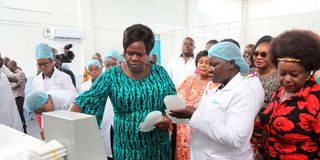
Homa Bay Governor Gladys Wanga and Suba North MP Millie Odhiambo said this on Wednesday when the governor officially opened Galentine Care Sanitary Pad Factory in Kasgunga Ward.
The leaders said many teenage girls and women cannot afford sanitary towels because some products are too costly for poor families. They argued that local production can provide cheaper products.

While some sanitary pads used in the country are manufactured locally, others are imported from Asia and Europe. Imported pads are expensive due to shipping costs, making them unaffordable for people who must balance between buying the products and meeting other needs.
The leaders said this exposes vulnerable groups to health risks. Lack of funds forces women and girls to use makeshift, unhygienic alternatives like old rags and mattresses, significantly increasing the risk of reproductive and urinary tract infections. If left untreated, these can lead to chronic pain or future infertility.
Inability to afford sanitary pads also limits economic participation. Women and girls avoid work or community activities during their periods, resulting in lost wages and limited opportunities. It also disrupts education, with affected learners falling behind in their studies.
Women who lack access to pads suffer psychological distress from the fear of leaking or staining clothes. Combined with lack of private, safe washing facilities, they face immense anxiety, shame and low self-esteem, worsened by cultural taboos that treat menstruation as a "dirty" or forbidden topic.
Wanga said the government has a Sh500 million budget for purchasing sanitary towels distributed in schools through the National Government Affirmative Action Fund (NGAAF). Women representatives handle the distribution to keep girls in class and reduce absenteeism.
"We fought for the budget when we were in parliament. I left it when it was Sh500 million. We used to get it through NGAAF, Ministry of Gender or Education," the governor said.
She said the government should focus on local production for affordability.
"There are only a few factories in the country that manufacture sanitary towels. So instead of taking the Sh500 million to other countries, we should fight together and use the money to buy what is produced locally," Wanga said.
The ODM chairperson said leaders should support local manufacturing and explore local production when distributing pads to their constituents.
The Galentine Care factory can produce 200 pads per minute and supply across the lake region.
Peter McOdida, the factory proprietor, said he started the business after realising school-going children in the region still face absenteeism challenges. Women told him the region faces period poverty, with people unable to afford sanitary towels.
"Most women we spoke to said they wanted sanitary towels that cost less than Sh50. They also proposed packages that can be sold by mama mboga and accessed at the nearest point, not necessarily from the shop," he said.
MP Millie said the factory responds to the need for affordable pads. She explained that many people do not understand menstrual hygiene, with some women and girls experiencing painful menstruation.
"Personally, I had one of the worst experiences. When I was in high school, I could not attend class during my periods because I needed many packets of pads. I would faint because of extreme pain," she said.
The MP sponsored the Assisted Reproductive Technology (ART) Bill 2022, a landmark law creating the nation's first legal framework for services like In Vitro Fertilisation (IVF) and surrogacy. She said the bill will ensure sanitary pads are availed at a cheaper price.
"I encourage male MPs to consider the bill. It is not about abortion but is meant to help women," she said.
McOdida said the factory will solve some of the problems women face. He engaged researchers who developed a pad that his firm makes.
"Our focus is to have the product at different selling points. We have factored in the kadogo economy and offer fewer pads packed in smaller packages at lower cost," he said.
Teen pregnancies
Wanga said Homa Bay continues to record high teenage pregnancies. The region had 17,000 teenage pregnancies in 2024, accounting for 22 per cent of all reported pregnancies. By mid-2025, over 10,000 additional cases were recorded, with most girls having their education affected as they either dropped out of school or missed moving to the next class with their colleagues.
The governor said lack of access to sanitary pads is linked to the problems teenage girls face.
"When a girl misses school because of lack of sanitary pads, she becomes vulnerable to teenage pregnancy. When pregnancy comes early, her chances of securing education, getting employment and shaping her future are reduced," she said.


