From menstrual absenteeism to lack toilets: Inside Kenya's war on girls' education
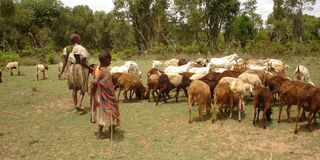
Girls herd goats and sheep in Kirisia forest, Samburu West. Many children in the area have abandoned school because of poverty.

What you need to know:
- A report by the National Gender and Equality Commission reveals persistent gender disparities in access to education across Kenya, particularly in arid and marginalised regions.
- Harmful cultural practices, period poverty, poor sanitation, long distances to schools, and weak implementation of education policies continue to push girls out of classrooms.
- From escaping forced marriage and FGM to missing school due to lack of sanitary towels, girls across Kenya face layered barriers to education.
Hellen Lolosoli was in school one day, and a cattle herder the next. The evening her father summoned her, she had no idea her childhood was about to end. There were men coming to the homestead, he told her. One of them would soon be her husband. School, he declared, had no meaning for a girl whose bride price was already being negotiated.
“My father told me that from now henceforth, I would not be going to school,” Hellen recalls. “I asked him why and he told me that school had no meaning since a man would soon come to marry me.”
For one month, she stayed home—herding cattle by day, helping her mother with domestic chores by evening. Dozens of men flocked to her home during this period, some bearing gifts, all scrambling to claim her.

Then her elder sister delivered the intelligence that would change everything. “My elder sister came and told me one evening that she had overheard a conversation between my parents which indicated that I would be cut the following day in the morning before my supposed future husband would come to pick me up later that day,” Hellen says.
That night in 2017, armed with her sister's warning, Hellen fled—escaping both female genital mutilation (FGM) and child marriage by a whisker. Hundreds of kilometres away, in Nairobi's sprawling Kibera slums, 16-year-old Rose Achieng fights a different but equally relentless battle just to stay in school.
Every month, when her period arrives, the same crisis unfolds. Her mother rarely has money for sanitary towels. Rose must then hunt for assistance from well-wishers and organisations that distribute pads to needy girls in the slums. When none is available, she turns to old clothes—and misses school for close to a week.
“My mother in many instances lacks the money to buy sanitary towels for me,” says the Form Two student from Lindi village, situated at the heart of the slum. “Whenever they do not have, I have to look for alternatives including using old clothes and missing school for close to one week.”
The predicaments of Hellen and Rose are not isolated. They mirror the experiences of millions of girls across Kenya who grapple with accessing quality education due to barriers that are at once social, structural, and economic.
A comprehensive new report by the National Gender and Equality Commission (NGEC) has now lifted the lid on the scale of the crisis—and the findings are damning. The survey, conducted across 19 counties drawn from Kenya's arid and semi-arid lands (Asals) and Nairobi, exposes entrenched disparities that continue to lock girls out of classrooms in the country's most marginalised regions.
The numbers paint a grim picture. School enrolment data reveals persistent gender gaps favouring boys at 52 per cent, with girls at 48 per cent—a disparity most severe in Asal counties. Girls are underrepresented both in overall enrolment and among learners with disabilities.
Distance remains a significant obstacle. In West Pokot, children walk for two hours to and from school—a factor that contributes to absenteeism, fatigue, and early dropout, especially among girls. Sanitation infrastructure is in crisis. Mandera County recorded the worst pupil-to-toilet ratio at 97:1 for boys, followed by Wajir at 86:1 and Turkana at 69:1. Fewer than 30 per cent of schools have disability-accessible toilets, highlighting glaring inclusion gaps.
Water, sanitation, and hygiene (Wash) facilities are inadequate across the board, particularly in Asals, with direct consequences for girls' attendance and wellbeing. The menstruation crisis alone is costing girls their futures.
Studies cited in the report show that girls from poor families miss 20 per cent of school days each year due to lack of sanitary towels. In an academic year of nine months, a girl loses 39 learning days—equivalent to six weeks. Between grades six and eight, a girl in primary school loses 18 learning weeks out of 108 weeks. Within four years of secondary school, she can lose 156 learning days—nearly 24 weeks out of 144 weeks of learning.
The Basic Education (Amendment) Act 2017 requires the Ministry of Education to provide free, sufficient, and quality sanitary towels to every girl who has attained puberty and is enrolled in a public school. Yet the report notes that the packs distributed have been insufficient.
Social challenges compound the structural failures. Teenage pregnancy was reported in 30 per cent of schools surveyed. Child marriage continues to pull girls out of classrooms. Menstruation-related absenteeism persists despite policy interventions. The re-entry policy for teenage mothers is gaining traction, with 52.4 per cent of schools now re-admitting girls after pregnancy. However, only 63 per cent of these schools offer counselling support, leaving many young mothers without adequate psychosocial assistance.
Leadership in education management remains overwhelmingly male. Nationally, 76 per cent of head teachers are men, with only 24 per cent being women. The picture shifts dramatically in Nairobi's informal settlements, where 89 per cent of schools are headed by women—a pattern the report attributes to proximity and day-to-day parental interaction supporting inclusivity.
Among teachers overall, the gender split is nearly balanced: 52 per cent male and 48 per cent female. But stark disparities persist across counties. Counties such as Tharaka Nithi, Kitui, and Laikipia demonstrated promising gender balance in Parent-Teacher Association leadership, offering more inclusive school management models.
NGEC chairperson Rehema Jaldesa acknowledged that Kenya has made commendable progress towards equitable access to quality education. But for girls in marginalised communities, she noted, the journey remains fraught with persistent structural barriers and harmful social norms.
“The findings reveal significant disparities in leadership representation, teacher deployment, menstrual hygiene management, and protection from harmful practices such as child marriage and gender-based violence,” Rehema said. “Education is not only a fundamental human right, but it is the foundation upon which inclusive development, gender equality, and national transformation are built.”
The report also highlights counties making notable strides. Nairobi, Tharaka Nithi, and Makueni are singled out as areas where inclusive policies, community engagement, and gender-responsive leadership have begun to yield positive outcomes.
NGEC observes that limited female leadership in Asal areas affects how schools respond to challenges uniquely affecting girls. NGEC chief executive officer Purity Ngina lauded the integrity, accuracy, and depth of the data collected. “We remain committed to using the findings of this report to inform transformative action for gender equality in education,” Dr Ngina said at the launch. “These findings confirm that girls in marginalised communities are navigating obstacles at every level—from their homes to school environments.”
The Kenya Demographic and Health Survey (2022) underscores these disparities, revealing that girls from marginalised communities experience lower enrolment, retention, and transition rates, compounded by inadequate hygiene management facilities and poor sanitation.
The survey also identifies gender-based violence, harmful traditional practices such as child marriage and FGM, long distances to educational facilities, and entrenched social norms that deprioritise girls' education as key drivers of exclusion.
The 19 counties surveyed were West Pokot, Samburu, Narok, Baringo, Kajiado, Laikipia, Kwale, Kilifi, Tana River, Garissa, Wajir, Mandera, Isiolo, Meru, Tharaka-Nithi, Machakos, Makueni, Kitui, and Nairobi.


