How NGO funding cuts hurt Kakuma women entrepreneurs
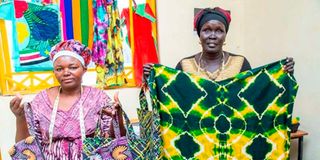
Neema Florence, a refugee from DR Congo, and Nyakoang Kai Tenga, a refugee from South Sudan, display their products at their tailoring shop in Kakuma on September 17, 2026. They are among Kakuma women entrepreneurs who have been affected by funding cuts.

What you need to know:
- Refugee women running tailoring and barbering businesses in Kakuma are struggling with rising costs after NGO support declined.
- Funding cuts have left women entrepreneurs in Kakuma paying for materials, power and repairs that were previously covered by NGOs.
Neema Florence from the Democratic Republic of Congo has been a tailor in the sprawling Kakuma Refugee Camp since 2023. In 2022, Neema remembers embarking on training to become a tailor, with the aim of using the skill to put bread on the table.
“After the training, we were each given a new sewing machine, materials, and other essentials to start our tailoring journey. Every time the materials would run out, and when the sewing machines would break down, the supporting organisations would replace and repair them for us to offer support,” Neema tells the Nation in an interview.
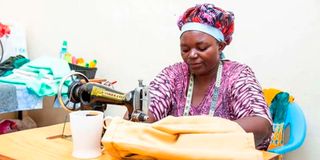
Neema Florence sews a dress in her tailoring shop in Kakuma refugee camp on September 17, 2026. She makes dresses, shirts, shorts, and bags.


In the first year, Neema says business was good, as she was never required to part with any money to buy materials and other tailoring accessories, pay for electricity and bills, or cover the cost of machine repairs in case of a breakdown. However, the mother of six observes that things have changed since January last year, after funding started dwindling.
“Since last year things have been tough. The support we used to get is no longer forthcoming. The NGOs are complaining that they do not have the money as a result of funding cuts. We are no longer receiving the materials and other tailoring accessories,” she adds.
Neema also adds that she is required to foot her electricity bill for her tailoring shop and meet the expenses of repairing the sewing machine. Neema, who specialises in making dresses, shirts, shorts and bags, says that of late, business has been down, with overall income from sales and repairs coming down drastically.
In a month, Neema says she is now able to make about Sh4,000 from part-time work, which she notes goes down to about Sh2,000. This is well below the Sh10,000 or more that she used to make a month before the effects of funding cuts started to be felt. The story is no different for Nyakoang Kai Tenga from South Sudan, who shares a tailoring shop with Neema.
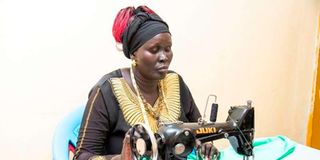
Nyakoang Kai Tenga sews a dress in her tailoring shop in Kakuma refugee camp on September 17, 2026.
Tenga, who also started her tailoring business in 2023, associates herself with the challenges outlined by her colleague. “The materials and other tailoring expenses are very expensive. When the sewing machine breaks down, it's very costly to fix it. This is taking a toll on me since the little that I make I have to divide it between buying more materials and taking care of my family,” Tenga tells the Nation.
On a good day, Tenga reveals that she normally makes about Sh400, while on a bad day she usually goes home empty-handed. The mother of 12 says she misses the good old days when they used to be supported in their tailoring work.
Also read: The women-led band of Kakuma Refugee Camp
Nyanichew Gatkuoth has been a barber in Kakuma since 2024. She was among the women who benefited from skills training through a UN Women-funded project.
Nyanichew tells the Nation that she initially started training as a salonist, but the training proved tough for her, which led her to opt for training as a barber. “After the training, there were three women who specialised in being barbers. We were all given shaving machines and all the other materials that are needed to start a Kinyozi,” she says in an interview with the Nation.
The mother of six says the business was initially tough, though it later stabilised after about four months. The South Sudanese national says she received three shaving machines two years ago from the International Rescue Committee, which she has been using for her barbering work.
During all this time, her machines were being repaired by the NGO whenever they developed mechanical problems. However, things are different now. She says two of her machines have broken down completely, and she is unable to replace them.
Repair costs
The one remaining machine, she adds, also has mechanical challenges, which have been forcing her to meet repair costs from her earnings. “In the past, I never used to reach into my pocket to get money to have the shaving machines repaired or replaced whenever they broke down. However, things have changed; the organisation that used to help in doing that can no longer do so due to dwindling funding,” she says.
This, she says, has greatly affected her income from her barbering business, as repairing the machine is a bit expensive. “Repairing the shaving machine does not cost less than Sh1,200, which is a lot of money, bearing in mind the current prevailing hard business environment. Such is the money that I could be using to take care of my family,” she adds.
She says the high cost of power has been a major setback for her business, adding that she is also now required to pay for the power bill centrally, unlike in the past when it was usually paid for her. “I have been a category four refugee since I have a business, which means I cannot benefit from food rations from the WFP. I am the father and mother of my household as my husband is in South Sudan,” she notes.
To lower the cost of power, Nyanichew says she has resorted to using solar, which she notes has helped her save some money.
In a week, she says that she usually makes between Sh4,000 and Sh6,000 from her barbershop. She usually charges Sh30 for young boys and Sh50 for adults. To deal with the issue of expensive materials, Neema says they are exploring ways to import them from neighbouring countries, Uganda and Tanzania, where they are relatively cheaper.
The trio has been among the beneficiaries of the Women's Leadership, Access, Empowerment and Protection (Leap) project by UN Women, supported by Japan. The Leap project has been instrumental in helping strengthen the technical and livelihood skills of women in Kakuma.
Antonia Sodonon, the UN Women Country Representative to Kenya, said her organisation remains committed to sustaining and building on these gains through continued collaboration with communities, implementing partners and stakeholders.
“The project has demonstrated the transformative impact of investing in women and girls across refugee and host communities in Kakuma and Kalobeyei. Through vocational skills development, entrepreneurship, leadership, protection, and social cohesion initiatives, women and young people have strengthened their livelihoods, built greater resilience and self-reliance, and emerged as entrepreneurs, seasoned employers, community leaders, mentors, and agents of change,” she told the Nation.
She added that their achievements demonstrate what is possible when women and young people have the skills, opportunities, agency and resources to shape their own future and contribute to the resilience and development of their communities.
“We are deeply grateful to Japan for its generous funding support, which has enabled women, girls, and young people from refugee and host communities to access opportunities for economic empowerment, leadership and protection,” she added.
Mercy Mbugua, a GBV Case Worker at the International Rescue Committee, which has been one of the implementing partners of the project, acknowledges the difficulties that some of the beneficiaries are currently encountering.
“The funding issue has really affected us. We used to give material and other tailoring accessories to our tailors, and beading materials to the women in beadwork, but now we no longer do that. This has affected a lot of women who are now unable to upgrade their businesses,” Mercy tells the Nation.
According to a comprehensive gender assessment by the International Finance Corporation, only seven per cent of women in the camp act as entrepreneurs, compared with 23 per cent of men, and the vast majority of their ventures remain informal due to barriers to accessing business information and formal capital.