How poor sanitation facilities in schools undermine goal of providing pads
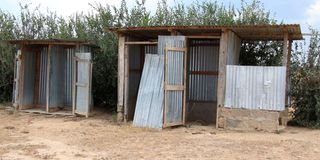
Pit latrines at a primary school in Laikipia County on September 28, 2020. Poor school latrines undermine Kenya’s free sanitary pads programme for girls.

What you need to know:
- Poor sanitation facilities in Kenyan schools continue undermining government efforts to keep menstruating girls in classrooms nationwide.
- Despite free sanitary pads distribution, inadequate toilets and changing rooms force many schoolgirls to miss classes regularly.
Esther Rukia* dropped out of Form Two in 2023 from a mixed day school in Mathare, Nairobi. While her studies were cut short because of a lack of school fees, one thing made her feel uncomfortable while in school: menstrual periods.
She says that although her school gave her one packet of sanitary pads per term, which was not even enough for her because she experienced heavy periods, finding a place to quickly change was distressing. They had no bathing or changing room, but only latrines and a water tank where they could wash their hands.
“We were not so many, but the fear that the blood would overflow while you were waiting in the queue would make me avoid going to school on the second and third days of my periods because those were the heaviest days. Mine lasted for four days,” she said.


The Ministry of Education launched the sanitary towels programme in 2011 to improve access to sanitary towels for girls in public primary schools. Six years later, the programme was revamped. In 2017, an amendment was made to Section 2(k) of the Basic Education (Amendment) Act, providing for the distribution of free, sufficient, and quality sanitary towels to every girl enrolled in a public basic education institution who has attained puberty.
Although the programme was originally under the Ministry of Education, it is now implemented through the Office of the Woman Representative under the Ministry of Gender. However, inadequate water, sanitation, and hygiene facilities are undermining this goal, as Esther’s experience shows.
According to a report by Usawa Agenda on the state of gender equality in basic education, released last Tuesday in Nairobi, almost twice as many girls share a toilet, contrary to the recommendations of the Ministry of Education and the World Health Organization. While the guideline is one toilet for every 25 girls, in both rural and urban primary schools, 46 girls share a toilet.
Read: 'Blood may overflow and stain my skirt': Schoolgirl's struggle with period poverty during holidays
The situation is no better in private primary schools, where 39 girls use one toilet, compared to 46 girls per toilet in public primary schools. Yet, 85.2 per cent of public primary schools provide girls with sanitary towels, followed by 77.8 per cent of refugee community primary schools and 57.5 per cent of private schools.
When it comes to bathing and changing facilities, private schools lead at 42 per cent, followed by public schools at 25.1 per cent, and refugee community schools at 22.2 per cent. The same challenge extends to senior schools. In girls’ schools, about 38 learners share one toilet, while in mixed schools the ratio is 35 girls per toilet.
The highest number of senior school learners per toilet is in the Rift Valley and North-Eastern regions, where the ratio is 43 girls per toilet. The Central region has the lowest ratio, with 29 girls per toilet.
Priorities
Stephen Barongo, head of the Directorate of Primary Education at the Ministry of Education, said the study highlighted priorities requiring urgent intervention to create a supportive learning environment for girls.
“If you are told that girls are not staying in school because the schools are not inviting enough, then you make the schools inviting. How do you make the schools inviting?” he asked. “By ensuring the facilities in those schools are friendly for girls to use. When a report shows that 60 or 70 girls are sharing a toilet, it means the queue for a girl to use the toilet is long, time-consuming, and quite disturbing for the child.”
He added that the Ministry of Education will prioritise water, sanitation, and hygiene, mobilising resources within the government and reaching out to partners to help. In Kenya, it is not news that latrines in schools have either collapsed or health officials directed their indefinite closure to save the lives of children from dangers of overflowing waste.
It is, however, news that the government is distributing sanitary towels to keep girls in school, yet sanitary facilities are so poor that girls cannot use them to change or dispose of the pads. For instance, in January 2023, public health officers closed Ogada Primary School in South Kabuoch, Ndhiwa, Homa Bay, because the latrines were full. About four years earlier, 16 latrines had collapsed in Sukwo Primary School in Saboti, Trans Nzoia.
The auditor general has conducted a performance audit on the provision of sanitary towels to girls in public primary schools, and while this partially addresses the challenge of access, it does not solve the problem of utilisation. The report dated November 2022 found that the packets distributed were insufficient. Annually, the education ministry is expected to provide nine packets of pads to the girls, which translates to one packet per month during the learning period.
However, it only budgeted for seven, a deficit attributed to budgetary constraints. For instance, in the 2021/22 school calendar, 1,675,299 girls were enrolled in classes 6, 7, and 8, the report showed. This means, the education ministry needed Sh621,200,869 to buy nine packets for each girl. It was, however, allocated Sh259,092,503, nearly three times less.
The distribution of fewer pads resulted in girls avoiding school, using unhygienic materials like torn pieces of clothes and blankets, and girls engaging in sexual activities in exchange for sex. Worse still, the schools are equipped with neither disposal facilities nor proper latrines or toilets.
The Act mandates the Education ministry to provide a safe and environmentally sound mechanism for disposal of used sanitary towels. Further, the Kenya Environmental Sanitation and Hygiene Policy (2016–30) requires all schools to have separate private collection and disposal systems for used menstrual cloth and sanitary towels.
Similarly, the Water, Sanitation and Hygiene Standards and Guidelines on infrastructure in pre-primary and primary schools require these learning institutions to have at least one cubicle in each girls’ toilet block equipped with a foot operated pedal bin for disposal of used pads. It also guides that the bins be emptied at least once every week and the materials fully incinerated at a designated area using a proper incinerator.
But the Auditor-General found the education ministry had greatly failed in providing the necessary sanitation and disposal infrastructure. A circular dated 23 April, 2026, from the Basic Education Principal Secretary, Prof Julius Bitok, outlined the disbursement of funds to public primary schools.
Of the Sh93.08 allocated per learner under the operations account, Sh23 was earmarked for renovating classrooms, building toilets, repairs, maintenance, and improvement of physical facilities. However, Kenya Comprehensive Schools Heads Association Secretary General Irene Yiaile argues that the allocations are inadequate.
“The government does little when it comes to infrastructure in schools,” she says. “Normally, it is either parents, well-wishers, or the Constituency Development Fund under the area Member of Parliament.”
She adds that the operations capitation mainly covers minor expenses such as water, electricity, and postal services, leaving schools unable to construct essential facilities like toilets.
*Name changed to protect the privacy of the girl.


