Sweet solution: The woman turning forest honey into sanitary pads for schoolgirls

Monica Marura, 35, displays sanitary pads in Lamu Old Town on February 4, 2026. She is determined to end period poverty among schoolgirls and women in Lamu through honey proceeds used to purchase sanitary towels.

What you need to know:
- A Lamu social entrepreneur sells forest honey to fund sanitary pads, helping vulnerable girls stay in school.
- Through Eco Dada, Monica Marura links honey sales to menstrual health, empowering girls and reducing absenteeism.
It is a Wednesday morning at Bahari Secondary School in Mpeketoni, Lamu West, and a group of girls has gathered in a corner of the school compound, accompanied by several female teachers. At first glance, it looks like a casual assembly, but the large open-top bag that Monica Marura carries, overflowing with packs of sanitary pads, tells a different story.
Monica moves through the group steadily, greeting each girl with a gentle smile and a reassuring nod. She speaks softly but with conviction, reminding them that their education matters and that their periods should never be a reason to miss school. For many of the girls standing here, that reminder is not rhetorical; it is something they have had to learn the hard way.
Monica Marura is 35 years old, a mother of two and the executive director of Eco Dada, a community-based organisation she founded in January 2024. For the past two years, she has been distributing free sanitary towels to schoolgirls and young women in rural Lamu, working to combat period poverty, reduce school absenteeism and dropout rates, and protect girls from the exploitation that poverty too often invites.


What makes her initiative stand out is how she funds it: through honey.
Monica sources organic honey from harvesters in the Boni Forest, packages it under the Eco Dada brand and sells it to locals, domestic tourists and international visitors. A 500-millilitre bottle goes for Sh500. In a good month, she earns a profit of between Sh40,000 and Sh45,000, every shilling of which goes towards buying and distributing sanitary towels and running sewing workshops where girls and women learn to make their own reusable pads.
In two years, she has spent at least Sh1 million on the programme. More than 2,000 girls and young women have benefitted, and on average, 100 are reached every month across Lamu's schools and villages.
She has not received a single shilling in external sponsorship.
What she saw in the forest
The idea did not come to Monica at a desk or in a boardroom. It came during a visit to Basuba, a village deep inside the Boni Forest in terror-prone Lamu, which is home to the Boni minority community, also known as the Aweer, an indigenous, forest-dwelling people who have traditionally lived as hunter-gatherers, relying on wild fruits, roots, honey and game for sustenance. They hunt with bows and arrows and carry deep, generational knowledge of herbal medicine and honey harvesting.
What Monica found in Basuba shook her. Poverty had pushed schoolgirls and young women into using methods to manage their periods that were not only unhygienic but also deeply undignified, digging holes in the ground and sitting over them for hours, using rags or animal hide because they could not afford sanitary pads. Many simply stopped going to school when their periods came.
"I got concerned," Monica says.
"The situation definitely increased their vulnerability to exploitation. That is why I came up with the idea of sourcing the natural Boni Forest honey from the locals themselves, packaging it, selling it, and using the profits to buy sanitary pads to fight period poverty not only in Boni Forest villages but across Lamu County. It is working."
The Boni community's own deep relationship with honey harvesting gave her the link she needed. Rather than bring in an entirely outside product, she could buy from local apiarists, inject money into that community, package the honey and sell it — creating a chain that moved from the forest floor to a school girl's dignity.
"By choosing honey, we settled on a product that is both practical and impactful in every home," Monica says.
"Honey is used in tea, baking, cooking, skincare and traditional remedies. It boosts immunity, soothes coughs and aids digestion. But for Eco Dada, honey is more than nutrition — it is mobilisation."
Model sustains itself
Monica has established reliable relationships with traditional apiarists who supply her with raw honey on a weekly basis. She packages it, applies the Eco Dada branding and markets it through social media as well as through the community forums and meetings she regularly attends.
"My clients are locals and domestic and international tourists visiting Lamu and the Coast region," she says. "I am happy that through the purchase of that bottle of honey to add to your daily sweetness, you are promoting that poor girl's monthly dignity and keeping her in school."
The model is deliberately designed to stand on its own. The initial capital is preserved and recycled to restock honey, ensuring the business continues running and the distributions do not stop. Monica is clear-eyed about why this matters: donor funding is shrinking, and grassroots organisations that depend on it are increasingly exposed.
"Rather than depend solely on external support, I asked myself a critical question: how can I build a self-sustaining model that empowers my mission while serving the community? Honey became the answer," she says. "Every jar of honey purchased becomes more than a transaction. It becomes a contribution towards keeping a girl in school, restoring confidence and advancing gender equality."
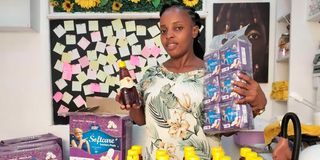
Monica Marura, the Eco Dada executive director, displays branded honey and sanitary pads in Lamu on February 4, 2026.
Eco Dada's work also goes beyond pad distribution. Monica runs workshops teaching girls and women how to sew their own reusable pads from locally sourced materials, offering a cost-effective and sustainable alternative to disposable products that many families simply cannot afford.
There is another layer to Monica's determination, one she does not shy away from sharing.
During her own high school years at Moi Kadzonzo Girls Secondary in Kaloleni, Kilifi, Monica experienced period poverty first-hand. When her menstrual cycle came, and she had no pads, she would walk through the dormitories borrowing pieces from classmates, navigating the embarrassment quietly and hoping someone could help.
That memory has never left her, and it is part of what drives her to show up at schools like Bahari every month with a bag full of pads.
"Sometimes I feel like crying when I realise that some girls are still using rags and cardboard or being forced to drop out of school," she says. "But through one jar of honey at a time, period poverty will end."
The impact is visible to those who work closest with the girls Eco Dada reaches.
Hellen Kibe, a teacher at Manda Airport Secondary School in Lamu West, says at least 80 girls from her school benefitted from a recent distribution. She describes the initiative as timely, noting that the government has been slow to deliver pads to schools — a responsibility that was transferred from the Ministry of Education to the Ministry of Gender Affairs over five years ago, owing to budget constraints, with distribution placed under women representatives to improve logistics.
"All my girls here benefitted. We want more similar programmes. Most girls come from humble family backgrounds and cannot afford Sh100 to buy pads. Sometimes we, the teachers, are forced to help our girls get the dignity packs and stay in class," Hellen says.
For the girls themselves, the difference has been tangible and immediate. Gladys Charo, a Form Four student at Manda Airport Secondary, says the programme has directly reduced absenteeism. "Now that sanitary towels are available through the Eco Dada initiative, we girls in this area can attend school consistently, unlike before," she says.
Read: 'Blood may overflow and stain my skirt': Schoolgirl's struggle with period poverty during holidays
Her schoolmate, Caroline Karembo, a Form Three student, says the distribution has done something beyond the practical: it has restored confidence. "It has created confidence in us, enabling us to attend classes without fear of embarrassment," she says.
Susan Ndanuu, a parent and community mobiliser in Baharini, Mpeketoni, Lamu West, frames the stakes even more sharply. "It has become a sustainable solution, keeping girls in school and curbing cases of boda boda riders preying on our girls and getting sex in exchange for sanitary pads," she says. "It has eliminated shame and prevented girls from missing school."
In two years, Eco Dada has reached 10 out of 97 primary schools and five out of 24 secondary schools across Lamu West and Lamu East, including Manda Airport, Bahari, Hindi and Witu secondary schools. Primary schools and villages covered include Katsaka Kairu, Witu, Manda Airport Primary, Manda-Maweni and the Anidan Children's Home, with each girl receiving between two and three packets of sanitary pads per outreach, depending on the number of girls at each school.
Woman behind the bag
Next month, Monica plans to extend the programme to Bar'goni, Basuba, Kiangwe, Mangai and the surrounding areas of Boni Forest, the very communities that first opened her eyes to the problem. The fact that she has not yet been back to Basuba, where the idea was born, is something she acknowledges with a measure of frustration. Insecurity and difficult logistics have kept her out of those forest villages so far.
"We are planning. Next month, we shall move in to distribute sanitary pads to Boni schoolgirls and young women," she says.
Monica was born in Mwanda, near Vuria Hill in Taita Taveta, and grew up attending Frere Town Primary and Kisauni Baptist Primary School in Mombasa, where she sat her Kenya Certificate of Primary Education. She later joined Moi Kadzonzo Girls Secondary in Kaloleni, Kilifi, for her high school education, then pursued a computer studies course at a Mombasa college before enrolling for a hotel and hospitality course in Malindi, where she met her husband. They settled in Lamu Old Town, where Monica has built a life that now includes professional photography and the honey initiative.
She appeals to girls and young women never to feel ashamed of menstruation, and she appeals to everyone else, customers, community leaders, well-wishers and the government, to support Eco Dada, whether by buying honey or stepping in to help scale what she has built.
"Once you purchase this honey, you are not just buying a product, you are investing in dignity, health, and the future of young girls out there," she says. "In a changing funding landscape, we are today proving that local solutions like this honey business can drive lasting impact. My honey business is demonstrating that sustainability is possible when innovation meets purpose."


