How two Kakuma women turned their love for cars into careers
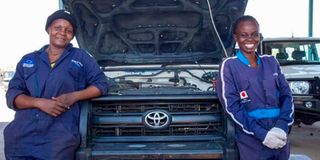
Mechanics Norah Matanda (left) and Sharon Mwende at the UNHCR motor vehicle workshop in Kakuma on September 17, 2026.

What you need to know:
- Women in Kakuma are challenging traditional gender roles by pursuing careers in automotive repair and maintenance.
- UN Women’s Leap project has helped strengthen the technical and livelihood skills of women mechanics in Kakuma.
As she grew up in Lodwar, Turkana County, Sharon Mwende would always be mesmerised whenever she passed a garage where vehicles were being repaired.
She was curious to know how vehicles were repaired and what they were made of. “I always admired the mechanics whenever I passed through a garage. I wanted to be like them,” Sharon tells the Nation in an interview.
After sitting her Kenya Certificate of Secondary Education examination, Sharon’s dream of becoming a mechanic faced a litmus test as resources became scarce. To make ends meet, Sharon got a job selling mitumba clothes, earning Sh6,000 a month. With little savings, she began her journey towards becoming a mechanic by enrolling for a Certificate in Automotive Engineering at the National Industrial Training Authority.


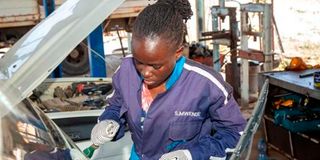
Sharon Mwende, a mechanic from the Kakuma refugee camp, repairs a vehicle at the UNHCR motor vehicle workshop in Kakuma on September 17, 2026.
However, Sharon says her luck would change while she was undertaking her attachment in Lodwar, when she got a tip about an upcoming scholarship for women mechanics to further their training. Sharon would later become a beneficiary of the first phase of the Women’s Leadership, Empowerment, Access and Protection in Crisis Response (Leap) project in Kakuma refugee camp and Kalobeyei settlement, which equipped women with leadership and livelihood skills, with support from UN Women and Japan.
“I was among the nine women and 21 men who did the interview and passed. They wanted a person who had some basics in mechanics, which I happened to have,” Sharon says.
The training in the automotive repair and maintenance programme targeted marginalised women and young people in Kakuma. Sharon enhanced her mechanic skills through the programme.
“I can do engine service, brakes and suspension system service, repair of car air-conditioning systems, vehicle inspection, bodywork repairs and painting, among other services,” she says.
She is now a mechanic at the UNHCR motor vehicle workshop in Kakuma, where she and other mechanics handle vehicle servicing, repair and maintenance. She says being a female mechanic has not been easy. Her major challenge is handling heavy machinery that requires a lot of energy to lift, a situation that takes a heavy toll on her.
She also lists the lack of trust in female mechanics as another challenge. “I have met many clients, some of them women, who have doubted that a woman can do a good job like a man. They always have to confirm whether my work was indeed perfect,” she adds.
Also read: The female mechanics of Marsabit
Sharon is happy with the financial independence that her mechanic career has given her. She is now able to live on her own, pay all her bills and support her parents. In addition, she has gone back to school and is pursuing a Diploma in Supply Chain Management and Logistics.
Her happiest moment is seeing repaired cars functioning well without their owners raising further complaints.
Nora Matanda is another mechanic who has built a name for herself in Kakuma. Growing up, she enjoyed watching her brother, who was a mechanic, fix vehicles. Nora tells the Nation that she would always be glued to and admire her brother as he carried out his mechanical duties.
Since she loved what she saw her brother doing, Nora decided to enrol for a mechanic course. “I was lucky that I got a scholarship at Don Bosco Training Institute, which is owned by the Catholic Church. I graduated with a grade of one to three in automotive engineering and wiring,” she says.
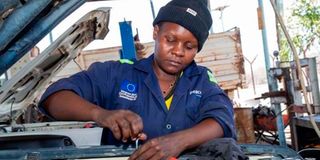
Norah Matanda, a mechanic from the Kakuma refugee camp, repairs a vehicle at the UNHCR motor vehicle workshop in Kakuma on September 17, 2026.
Among the duties she is able to perform are engine and brake servicing, suspension and transmission system servicing, bodywork and puncture repairs. After her training, Nora worked as a volunteer for six months, after which she sought jobs in various garages in Kakuma town. She was lucky to undergo further automotive training through the UN Women Leap project.
Life as a mechanic has not been a bed of roses for her, but one riddled with myriad challenges, including male clients hesitating to hand over their vehicles because they doubt a woman can fix them. “There is a serious mistrust of women mechanics. There are clients who do not think a woman can fix a car. We, however, have supportive men willing to assist,” she says.
Nora lists inconsistent income and mistreatment by some established mechanics among her other challenges. “The income from the job at times is erratic. Some mechanics do not want to train those under them to learn new things. However, each day is a learning opportunity, and we keep on moving.”
Despite being a male-dominated trade, Nora says she is happy that it has helped her earn a living and put food on the table. She is currently working as a mechanic at the UNHCR workshop in Kakuma and is grateful for the opportunity.
“Being a mechanic is a good skill; I cannot sleep hungry with it. It will always help me to put bread on the table.”
Nora says her dream is to have her own garage, which will offer training opportunities to young aspiring women mechanics.
Antonia Sodonon, the UN Women Country Representative to Kenya, says her organisation remains committed to sustaining and building on these gains through continued collaboration with communities, partners, and stakeholders. "The project has demonstrated the transformative impact of investing in women and girls across refugee and host communities in Kakuma and Kalobeyei.
"Through vocational skills development, entrepreneurship, leadership, protection, and social cohesion initiatives, women and young people have strengthened their livelihoods, built greater resilience and self-reliance, and emerged as entrepreneurs, seasoned employers, community leaders, mentors, and agents of change,” she told the Nation.
She added that their achievements demonstrate what is possible when women and young people have the skills, opportunities, agency and resources to shape their own future and contribute to the resilience and development of their communities. "We are deeply grateful to Japan for its generous funding support, which has enabled women, girls, and young people from refugee and host communities to access opportunities for economic empowerment, leadership and protection.”
Vitus Tangishaka from Burundi works with the two mechanics at the UNHCR workshop. He hails them for the good work they do. He notes that the two female mechanics have no fear and possess the requisite skills to do their work professionally.
“The two female mechanics are doing a wonderful job here. They have all the required capacity and experience and are equal to the task. There is no difference between their work and that of men at all. They have the necessary training and skills and are a perfect team,” Vitus says.
Vitus, who underwent the UN Women Automotive Training programme, is appealing to young women to consider pursuing a mechanic course, describing it as a well-paying career.
Despite facing criticism for taking on a traditionally male job, the two women say they remain focused on becoming the best mechanics, earning a better income and inspiring other women.
The duo is happy that their technical skills were strengthened through Leap and that they now work as mechanics in a traditionally male-dominated sector. They call on girls aspiring to become mechanics not to fear, saying they have what it takes to excel just like their male counterparts.