Inheritance, daughters and a changing Kenya: When a father gives his daughter land
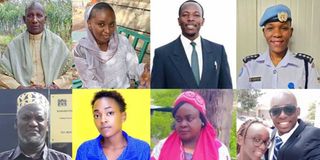
Top from left: James Aritei Kholbokha, his daughter Stella Deraso Kholbokha, the late Rev Joseph N Chege, his daughter Caroline Njuguna. Bottom from left: Rashid Mzee Oloo of the Kajiado County Environmental Land Court Users Committee and Alternative Justice System Secretariat, Pauline Lucy Nyandiek, Mwanaharusi Mkoba and Norbert Aluku and his daughter Norah Aluku.

What you need to know:
- In tradition-bound Kenyan communities, a handful of fathers are gifting daughters land, challenging patriarchy and reshaping economic futures.
- From Marsabit to Kilifi, women empowered by paternal support are transforming inheritance into education, stability and generational change.
In Kenya's most tradition-bound communities, a handful of fathers are quietly defying custom. They are giving their daughters something most girls in their communities never expect to receive. The ripple effects are still being felt.
James Aritei Kholbokha did not grow up expecting much. Born in Korr village, Marsabit County, he spent his early childhood moving across arid land with his parents, following their livestock in search of pasture. School was not part of the plan. For a boy from a poor Rendille pastoral family in a region where drought and food insecurity are a way of life, wearing a school uniform was not a given, it was a privilege.
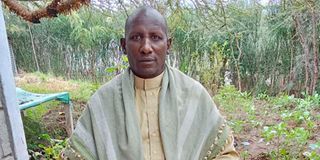
James Aritei Kholbokha, a father of four, bought a piece of land that he gifted her daughter Stella Deraso Kholbokha in Korr, Marsabit County.


That changed when the Catholic Church in the area offered him a sponsorship. From primary school through to a technical institution, James got the education that his community had never promised him. And when he eventually married and started a family, four boys and one girl, he made himself a promise: every one of his children would go to school, including his daughter.
In the Rendille community, that is not as straightforward a commitment as it sounds. “Girls in my community are married off even before they reach the right age," he says. "I made it clear that even though I had been brought up in a poor community, I was going to educate my daughter."
The pressure to do otherwise is not simply cultural stubbornness—it is economic. In his community, a daughter's marriage brings livestock—sometimes enough to lift an entire household out of poverty overnight. For families with nothing, that is a difficult offer to turn down. “When the community says it is time to marry off a girl, parents freely give out their daughters because they have no money to educate them,” James explains. “They believe a girl is wealth. When she is married off, even the poorest family begins to upgrade their lifestyle.”
He understood that logic but simply refused to live by it. Landing a job as a General Service Unit (GSU) officer gave him the financial means to back his conviction. He paid school fees for all his children equally, occasionally brought the family to Nairobi to expose them to life beyond Korr, and set clear household expectations, attend school, and excel at it. When it came to his daughter, Stella Deraso James, he had specific ambitions.
“Personally, I wanted her to be a doctor. I took her to a university in Kitui County but she missed a point in mathematics and did not qualify. That is when I decided to let her choose her own course,” he says.
Stella went to Bishop Cavallera Girls, one of the best secondary schools in Marsabit County, and later graduated from Mt Kenya University with a qualification in Animal Health and Livestock Production. Her father describes her as disciplined, bright, and someone who thinks not just of her own future but of the people around her.
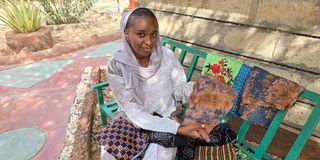
Stella Deraso Kholbokha in Laisamis, Marsabit County. on August 1, 2025. She was given land by her father James Aritei Kholbokha in Korr, Marsabit County.
Then he did something the community was not prepared for. He bought her land. “There was no negotiation with anyone. It is land I bought myself, so I made the decision myself. That saved me a lot of backlash from the community because nobody could ask me why I gave land to a girl,” he says.
Stella received the news during a family meeting while she was still a high school student. She was completely caught off guard; girls in her community did not receive land from their fathers, and she had grown up accepting this as simply the way things were. Yet here was her father, telling her she had a plot of her own. “I felt treated the same as my brothers,” she says.
She did not immediately know what to do with it. She was still studying. But when she completed her education and looked around her, she noticed a relative who had been left homeless after her husband died, with four young daughters and nowhere to go. Stella offered her the plot. The woman has been living there for nearly 10 years now. Her eldest daughter, who was in Standard One when the family moved in, is about to join secondary school.
“When you do something good without expecting anything from the person you helped, God opens doors of blessing in your other things,” Stella says.
The community's reaction has been mixed. Many people still do not believe that her father actually bought land for a daughter. “After we got married, my husband told me he had bought land elsewhere for future investment. That is when I told him I also had a piece of land at my father's home. He did not believe me at first,” she laughs.
The disbelief did not last. Together, Stella and her husband now plan to build rental shops on part of the plot, a monthly income stream for their family's future. A piece of land that began as a father's quiet act of defiance against tradition is on its way to becoming something else entirely.
James attended Stella's wedding in Korr after she completed her studies, and something about that day undid him. “I was overwhelmed with joy. I shed tears. I never thought about her marriage twice because I know that even though my daughter is now building her own home, she is already valued by her first family,” he says.
He has a word for fathers who are still weighing their daughters' futures against what tradition demands. “Female children are as important as their brothers. You have no reason to discriminate against your daughters. Treat all your children equally, they all carry your blood. When we discriminate against our children, they begin to discriminate against themselves, feeling that their father loves the others more.”
Equality by God's word
Caroline Njuguna's story starts with the same kind of father—deliberate, loving, ahead of his time, but it takes a turn that many Kenyan families will recognise all too well. Caroline grew up in Thika, the firstborn of the late Rev Joseph Chege, who founded the Good Samaritan's Centre in Kiandutu, Thika. She has two younger brothers. Her father, by her account, was a patient and present man who made her feel important. When he died while she was still in secondary school, the family fell to her to hold together.

Caroline Njuguna, a security risk management professional at the National Police Service. She learned that her father, Rev Joseph N Chege, had given her land, two years after his death.
Two years after his death, her grandmother called her aside and placed something in her hands, a piece of land her father had set aside specifically for her. “She told me there was something she wanted to hand over to me. It was a piece of land. She said, ‘This was given by your father.’”
For Caroline, who now works in security risk management with the National Police Service, that moment carried weight that went far beyond property. “This was not merely a transfer of property. It symbolised trust, legacy, and the continuity of family values. He trusted me with that portion. I felt honoured. It came with a sense of responsibility; stewardship, and the importance of being a firstborn in preserving family heritage,” she says.
The land had not been divided between Caroline and her brothers. It was entirely hers, and on paper, it represented stability, security, and something tangible she could build on for herself and for the two brothers she was now responsible for. Caroline was young, still at university, and by her own account, still operating within the framework of a patriarchal society.
When the documents were placed in her hands, she handed them to her brother for safekeeping. “I took the paper to my brother to keep it for me,” she says. “You can imagine how messy it got later.”
Her brother sold the land and kept the money. At the time, Caroline was at Kenyatta University (KU) pursuing a Bachelor of Arts in Counselling Psychology and Gender Studies, deferring semesters when money ran out and working to put together enough fees to return each year. The money from that sale could have kept all three of them in school.
“It was not a good feeling. I felt betrayed. I felt I did not have family or teamwork. My dad used to say, ‘Caroline, you are the one to lead this family.’ I felt like I had failed him. That land should not have been sold, it should have stayed to benefit all three of us,” she says.

The late Rev Joseph N Chege, the founder of Good Samaritan’s Centre in Kiandutu, Thika. He left land for her daughter, Caroline Njuguna.
She graduated anyway, then completed a Master's degree in Project Planning and Management at the University of Nairobi. She is currently a doctorate student in Security Studies back at KU. Along the way, she has received Outstanding Security Performance Awards and founded the Boots and Brains Initiative, a mentorship programme for university students running under Asis International Kenya. She also, eventually, forgave her brother.
“Cultural stereotypes led to his decision. We are now best friends. Cultural and traditional beliefs are changing; we are seeing gender mainstreaming, and women are receiving property from their parents here and there. Not in big portions yet, but it is happening,” she says.
What her father gave her could not, in the end, be sold. Caroline has two daughters of her own now. Her eldest is seven years old and already has land and a house in her name, bought and registered by her mother. “I am empowered enough to do for my daughters what I would have wanted done for them. If their father also wants to do something for them, that is up to him. But in this society we are in right now, it is up to us to do for our children what we would want for them.”
She still talks about her father the way you talk about someone whose influence you keep discovering long after they are gone. “My father's love built the foundation that still supports me today. He carried me with patience. When you are dealing with girls, you have to listen, care and be present—let them feel important. The way he embraced me has made me empathetic, even today in the way I deal with others.”
In Kilifi County, Mwanaharusi Mkoba's story is less dramatic but no less meaningful. After sitting her Kenya Certificate of Primary Education examination, she did not proceed to secondary school—her family could not afford it. Her father enrolled her in tailoring school, then hospitality school.
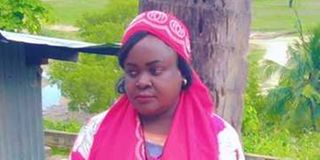
Mwanaharusi Mkoba in Kilifi County. She continues to harvest maize, cow peas, green grams and cassava from the land she was gifted by her father.
Between classes, she farmed. Tomatoes, vegetables, whatever the land would carry. Her father watched quietly, and eventually he did something about what he saw: he gave her a piece of land.
“He did not discriminate between boys and girls. He treated us equally. I am the last daughter, and I grew up after my other sisters had already married. Seeing that I was always working on the farm, he gifted me a piece of land,” she says.
The news surprised her. She told her father frankly that she had always heard girls were not supposed to inherit land. “He said no. He explained that at his home, there is nothing that stops him from giving land to his daughters. They have equal rights, just like his sons,” she recalls.
She is married now and lives in town but she goes back to that plot every season without fail. Maize, cow peas, green grams, cassava—the land yields steadily, supplementing what her husband farms on his own land. In a good year, she shares the harvest with her brothers and mother and sells the rest. “We always have maize that we do not buy,” she says, and in a region where food on the table is never guaranteed, that is not a small thing.
Some people in her community still argue that the land is not really hers because she does not hold the title deed. She has learned not to argue back. “My father gave me that land voluntarily. My brothers are fine with it. My older sisters have not complained either, they got married before dad divided the land.”
For every father who gives his daughter land in Kenya, there is a community watching, and often an old argument waiting to be heard.
'No women in committees'
Rashid Mzee Oloo, a member of the Environmental Land Court Users Committee and the Alternative Justice System Secretariat in Kajiado County and founder and CEO of the Mind Body Peace Justice Initiative, has been in the middle of this shift for years. He remembers the time they were putting together the Alternative Justice System for Kajiado County and male elders refused outright to allow women onto the committee handling land cases. Women and children, in the view of those elders, belonged in the same category, people to be told what had been decided, not people who took part in deciding.
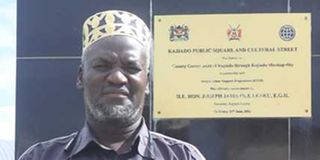
Rashid Mzee Oloo of the Environmental Land Court Users Committee and Alternative Justice System Secretariat, Kajiado County. He says that although women have not been owning land in Kenya because of traditions, the situation is now different under Article 27 of the Constitution, which guarantees equal rights and freedom from discrimination.
“Even if a woman goes back to her family home after a marriage breaks down, it is difficult for her to get land because her brothers see her as a refugee who is only there temporarily and is expected to leave,” he says.
The Constitution shifted the ground beneath those attitudes, at least legally. Article 27, which guarantees equality and freedom from discrimination, gave advocates something they had not had before, a formal basis to challenge cultural practices that locked women out of landownership. Communities that had excluded women from land discussions could now be held to a constitutional standard.
“This law has helped us. Even when a committee of men refuses, on cultural grounds, to allow women to participate in landownership discussions, we are now able to bring women to those tables,” Rashid says.
But a seat at the table is one thing. What happens away from the table is another. Rashid describes a pattern he still encounters regularly: women who have been given land are quietly told by their families that they may not sell it without everyone's approval, and that if they do sell, the money must be brought back to the family to be divided as the family sees fit. “You have land on paper, but you cannot make decisions over it alone,” he says.
He is also clear-eyed about what the consequences look like when women are denied land entirely. “This woman is also a mother. When her rights are violated, she is psychologically affected, she does not know where to turn when she is not welcomed anywhere. Land drives many social and economic factors. The effects go far beyond the individual.”
New dawn
Maurine Nduati, Partnership, Engagement and Gender Officer at Taita Taveta Wildlife Conservancies Association, sees the change coming, even if it is coming unevenly.
“Landownership is a deep issue, but the Constitution has made it clear that a woman can own land. Slowly, even in rural areas, we are starting to see men being more intentional about leaving land to their daughters alongside their sons. There is a small shift happening. As we progress, with more awareness, knowledge and conversations about attitude change, we will see that shift grow,” she says.
She also makes an observation that is hard to argue about. “Women tend to be more development-oriented. They put development into the land they receive. It is unfortunate that in some communities, when men inherit land from their parents, many of them sell it. Giving girls land gives them economic independence and resilience. And it also makes them proud of where they come from.”
VOX POP
Would you accept land from your father, or gift land to your daughter?
Pauline Lucy Nyandieki, Kisii: “Had my dad gifted me land before he died, I would have accepted it. I am now a known farmer, working a portion that my mother and brothers divided for me after my marriage failed. I grow vegetables and sugarcane to earn money for myself and my two children.”

Pauline Lucy Nyandieki. She says she would have taken land had her father gifted her before his death.
Norbert Aluku, Nairobi: “Yes, I would give my daughter land. Proverbs 13:22 says we are to leave an inheritance for our children's children. But the most important reason is that my daughter, Norah, is the one I love most in this world.”

Norbert Aluku and his daughter Norah Aluku. He says he would gift her a piece of land because of his love for her.
Sarah Bigingi, Embu: “In our culture, women were not supposed to be given land. Even if a family had only daughters, the father would be forced to look for boys to inherit. But now we see people saying girls should also receive land. If my dad gave me land, I would accept it.”