Kevin Wekesa, 26, estimates that a single rugby tournament in Kenya generates about 850 kilogrammes of plastic waste.
The international rugby player is working to address the problem by pushing for reduced plastic use and more sustainable practices in sport.
Speaking to the Nation, Mr Wekesa said he and his team measured the waste generated during the 2026 Safari Sevens tournament, which attracted about 17,000 people.
“We can't always recycle ourselves out of climate change,” he emphasised, “the main thing we are looking at is reduction.”
The exercise was aimed at establishing a baseline for tracking and reducing plastic pollution in sport.
“The findings gave us a starting point to reduce plastic use in sport,” he said, “improve recycling and encourage sports organisers to adopt more sustainable practices.”
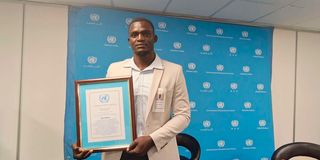
His work through Play Green, an initiative he founded in 2023 to promote environmental action through sport, has earned him recognition as runner-up for the 2026 United Nations in Kenya Person of the Year Award, announced during celebrations marking the organisation's 81st anniversary.
According to Wekesa, Kenya has lacked a baseline measuring the plastic waste generated by sporting events, making it harder to determine how much pollution the sector produces and whether existing interventions are working.
“This has made it harder to determine how much pollution the sector produces,” he noted, “and whether existing interventions are working.”
Wekesa's route into environmental work began on the rugby pitch, where he discovered an opportunity to pursue an education and represent Kenya at the highest level of the sport. He started playing rugby in high school before progressing to the national team and competing internationally.
Kenya Shujaa Kevin Wekesa appreciates applause from the crowd while playing against Uruguay during the World Rugby HSBC Division Two Rugby tournament on February 15, 2026, at Nyayo National Stadium.
Photo credit: Chris Omollo | Nation
His journey included the Olympic Games, giving him first-hand experience of the audiences, influence and organisational structures surrounding elite sport.
Speaking during the United Nations Day ceremony, Garry Conille, the UN Resident Coordinator in Kenya, said Mr Wekesa’s journey started from primary school in Mumias, western Kenya, to St Joseph’s High School in Kitale, where he pursued his rugby ambitions.
“A club in Kakamega recognised Wekesa's potential and helped support his university education,” Mr Conille said.
“The support Wekesa received showed how investing in one young person,” he noted, “can create opportunities for others.”
In 2023, Wekesa began looking beyond the sport itself. He saw how rugby commanded large audiences and believed those audiences could be mobilised around environmental protection.
“I wanted sports to do something more because we commanded a lot of audiences,” he said.
He established Play Green to use schools and sporting events as entry points for environmental education, ecosystem restoration and changes in how sport manages its environmental footprint.
The initiative works with schoolchildren through workshops and environmental education, encourages tree planting and seeks to reduce reliance on single-use plastics across Kenya's sporting ecosystem.
Wekesa believes environmental awareness must begin at the grassroots, particularly among children growing up through sports programmes.
“Kenya wants to grow grassroots levels,” he said, “but how are the children growing up through grassroots levels? What is in their head in terms of their environmental stewardship?”
Beyond waste reduction, Wekesa says some of the most meaningful outcomes of Play Green have emerged from its school-based activities, where environmental education and sport have opened opportunities for children facing financial difficulties.
He recalls two 13-year-old girls, who participated in the programme as green ambassadors.
“The girls had struggled to access school because of financial constraints. They had considered repeating a class in the hope of obtaining better grades that would help them secure admission to a better school with sporting opportunities,” he explained.
Kevin Wekesa, 26, was recognised as runner-up for the 2026 United Nations in Kenya Person of the Year Award during the UN Day celebrations at the UN-Habitat headquarters in Nairobi on Tuesday, October 27, 2026.
Photo credit: Kimani Mwangi | Nation
However, their involvement in the programme brought their abilities to the attention of someone from another school, who offered them scholarships covering their education.
“When others have success through me, it's a real joy in the heart for me,” he said.
Wekesa hopes to reduce the 850 kilogrammes of plastic waste recorded at Safari Sevens to 300 kilogrammes initially, with a long-term target of bringing it down to zero.
“Achieving that will require more than persuading spectators to dispose of their rubbish correctly,” he said.
Mr Wekesa says sports federations must examine the vendors allowed to operate at tournaments, the packaging used to sell food and drinks, the bottles players use for hydration and the waste-management infrastructure available at stadiums.
“The objective is to change the system that produces the waste,” he explained, “rather than place the entire responsibility on spectators after plastic has already entered the environment.”
Speaking on behalf of UN Secretary-General António Guterres, Zainab Bangura, the Under-Secretary-General and Director-General of the United Nations Office at Nairobi (UNON), said the world was being shaken by conflict, battered by the climate crisis and strained by rising inequalities.
“We need renewed commitment to the values of dialogue, cooperation and solidarity that underpin the United Nations,” she said.
Soomi Ro, Director of the Corporate Services Division at UN-Habitat, highlighted the organisation's responsibilities in addressing climate change, nature and land loss, pollution and waste.
Kenya Shujaa Kevin Wekesa charges past Shogun opponent during Tusker Safari 7's Rugby final match on October 12, 2025 at Nyayo National Stadium.
Photo credit: Chris Omollo | Nation
“More than 150 sports have committed to action for nature, creating an opportunity to use major sporting events to advance environmental sustainability,” she said.
Wekesa believes the government should focus more on public education and invest in efforts to help people understand environmental challenges.
“The higher the food chain, the more impacted it is,” he said, arguing that environmental advocacy should reach people at the grassroots and explain why particular practices need to change.
Once people understand the reasons behind environmental measures, he believes, it becomes easier to implement laws and policies designed to address pollution.