Kenyan football beyond the boys’ club: A game growing against the odds
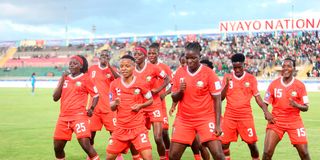
Harambee Starlets’ Tereza Obunyu leads teammates in celebrating her goal against India during Fifa Series International friendly match on April 1 at Nyayo National Stadium.


What you need to know:
- Vihiga Queens remain one of the most vibrant clubs in Kenya.
- The four-time FKF Women's Premier League champions are the only Kenyan club to have qualified for the CAF Women's Champions League, a place they earned by winning the 2021 CAF Women's Champions League Cecafa qualifiers, representing the region at the inaugural edition hosted in Nairobi.
- No other Kenyan club has qualified since.
Harambee Starlets will run out at the Women's Africa Cup of Nations (Wafcon) in a matter of days, for the first time in 10 years, and for the first time in the team's history, under a female head coach. For players like Enez Mango, a defender who left Kisumu for a professional contract in Romania, and coaches like Ann Aluoch, who once captained the Starlets at their maiden Wafcon in 2016, the tournament is proof of how far the game has come, from bare school fields to a national team about to face Morocco, Senegal and Algeria on the continent's biggest stage. This is where Kenyan women's football stands, just before its biggest test in a decade.
From Kisumu to Romania
Enez fell in love with football as a young girl in primary school. Her school had no football club, so she played with her brothers at home and with the boys in her neighbourhood instead.


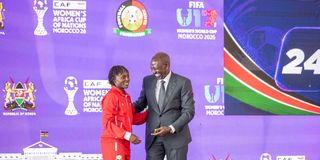
President William Ruto with Mango Enez, a Harambee Starlets player, during the flag-off ceremony for Junior Starlets and Harambee Starlets at State House, Nairobi.
By high school, her luck had turned and she landed a slot at a football academy in Kisumu.
"At the academy, I was exposed to professional football. Whenever school closed, I would go there for training. That is where I cut my teeth in football," Enez tells the Voice.
While still in school, she played in the National Super League for women between 2015 and 2016. Her rise continued when she won a scholarship from Kenya Methodist University to study for a Bachelor of Science in Computer Science. Football, she says, is what saved her education and kept her from giving it up altogether.
In 2017, she joined Vihiga Queens, a professional women's club based in Mbale, Vihiga County, which competes in the top-tier FKF Women's Premier League. Founded in December 2013, it is one of the most successful and dominant women's clubs in East Africa.
"As a defender, I played for Vihiga Queens for six years, during which we won the national league three times. The team also qualified for the Cecafa Club Champions' League for the first time, which was held in Egypt," she says.

Harambee Starlets coach Beldine Odemba gestures from the touchline during the FIFA Series international friendly match against India at Nyayo National Stadium on April 1, 2026.
Juggling school and football was never easy, Enez says, but it can be done "Girls, if you have a talent, use it very well because it pays off," she says. Her biggest break came when she secured a slot at Farul Constanta in Romania, where she now plays. The contrast with home, she says, is stark.
"In Romania, they have invested in world-class football facilities for training and playing. Players are well remunerated, and there are well-structured systems in football management," says Enez, who also plays for Harambee Starlets. Back home, she explains, players face limited facilities, meagre earnings and insufficient medical support. She hopes to one day play for one of the top women's clubs in the world.
Kenya returns to Wafcon
With only a few days to go before the 2026 Women's Africa Cup of Nations, Harambee Starlets are on final preparations for a return to the continent's biggest women's football showpiece. The 16th edition of the tournament runs in Morocco from July 26 to August 16, and doubles as part of the qualification pathway to the 2027 Fifa Women's World Cup.
Coached by Beldine Odemba, the Starlets have been drawn in one of the tournament's toughest groups, alongside hosts Morocco, Senegal and Algeria, in Group B. Their qualification, together with a second-place finish in the 2026 Fifa Series, has pushed Kenya up the Fifa Women's World rankings. The team climbed from position 150 to 143, continuing an upward run that had already taken them from 149th to 142nd in March.
Sixteen teams will compete at this year's finals. Kenya is making its first Wafcon appearance in a decade, and their first under a female head coach. Beldine is the first woman to guide the Starlets to the tournament.
Their Wafcon debut was at the 2016 finals in Cameroon, under Coach David Ouma. The team finished bottom after losing 3-1 to Ghana, 4-0 to eventual champions Nigeria, and 3-1 to Mali. Kenya then failed to qualify for the 2018 edition, saw the 2020 tournament cancelled because of the Covid-19 pandemic, was barred from the 2022 qualifiers following Fifa's suspension of the Football Kenya Federation (FKF), and missed out on the 2024 finals as well.
The Junior Starlets, Kenya's Under-17 women's national team, have been putting the country on the global map too. Last Sunday, they staged a magnificent second-half comeback to beat South Africa 3-1, sealing a historic 5-1 aggregate victory and punching their ticket to the Fifa Under-17 Women's World Cup in Morocco. It is Kenya's second appearance at the tournament after the Junior Starlets made history in 2024, becoming the first Kenyan football team to qualify for any Fifa World Cup. When the Fifa U-17 Women's World Cup gets underway in Morocco later this year, Kenya will once again compete among the world's best.
Grassroots to global stage
Enez's story mirrors that of many young Kenyan women who have made their mark in football, both locally and abroad, over the last decade. New women's clubs have sprung up across the country, structures have strengthened, and more women have taken up leadership roles on and off the pitch. Harambee Starlets won their first regional title at the 2019 Cecafa Women's Championship, building on their debut Wafcon qualification in 2016, and the Junior Starlets' World Cup run has added to that momentum.
Even so, the sport still struggles with financial inconsistency and a lack of steady corporate sponsorship at the local league level. According to the FKF, there are currently 12 teams in the Women's Premier League, 24 in the Women's National Super League, and 40 more at the Women's Division level.
The status was different before the 1980s when football was considered a boys' game, with girls being steered towards netball instead. In 1980, former President Daniel Moi decreed that Physical Education becomes compulsory in Teacher Training Colleges. As a result, male and female trainee teachers alike learned and played the sport. By the mid-1980s, the first formal women's teams began to emerge, mostly in Nairobi and Western Kenya. Early pioneer clubs included Eastlanders, Nairobi City Council, Standard Chartered Bank, Kenya Utalii College, Nyayo Stars and Eregi Teachers College.
There was no structured, nationwide league then, and early teams survived largely on recreational matches and demonstration games. Even without one, Kenya made global strides when Harambee Starlets, the first women's national team, was formed in 1985, at a time when few countries in the world had a women's team at all.
In the early 1990s, the Kenya Women's Football Federation was formed, spearheaded by trailblazers Fridah Shiroya and Rebecca Olela, becoming the first official body mandated to register and organise women's football.
Not every club has managed to stay afloat. Gaspo Women FC, the Gatundu-based powerhouse, withdrew from the top-tier league due to financial instability and was relegated to the Women's National Super League. Wadadia FC, the prominent Kakamega-based club, disbanded and withdrew from the National Super League altogether for lack of sponsorship.
The basics are still missing
Ann Aluoch, a veteran player-turned-coach who started playing football at the age of six, says the game is promising, even as challenges remain.
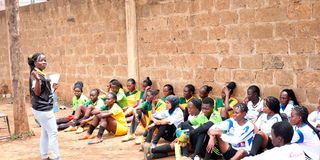
Mathare United Coach Ann Aluoch addresses her players during a training session for the FKF Women’s Premier League at the Mathare United Youth Sports Association headquarters in Komarock, Nairobi, on October 21, 2023.
She says lack of a maternity policy is one of the biggest setbacks for women players, who are often dropped from their teams once they fall pregnant. A lack of medical insurance is another major gap.
"Many women footballers are not able to take care of their medical expenses even when they have injuries. The monthly stipend they get of Sh10,000 to Sh15,000 is not even enough to take care of themselves," she says.
The gap between how men and women footballers are treated remains wide, Ann adds.
"Most women's clubs do not have training grounds, thus resort to using school playgrounds. There are, however, some men's clubs that are allowed to use Kasarani, Nyayo and City stadiums for training," she says.
That lack of proper training facilities, she adds, affects performance, especially against international teams, and contributes to more injuries.
"Male players are well remunerated. The least is earning Sh50,000, and there are those earning close to Sh150,000 a month. Many of their team members have sponsorships that motivate them. Women's teams, on the other hand, have no sponsorships, which affects our operations," she says.
Lack of resources, she believes, is one of the biggest contributors to the game’s slow growth. She is, however, optimistic. Much has changed in the last decade, she notes, pointing to a Fifa and CAF rule that now makes it mandatory for each national team to have a female coach, either as head coach or assistant.
Also read: From Mathare to Fifa: Woman who shattered glass ceiling for female football administrators
Ann's own daughter recently won a football scholarship to the United States, and she is quick to point out why such opportunities matter.
"The scholarships bridge the gap between athletic talent and academic advancement, allowing girls to build secure futures both on and off the pitch," she says, calling on corporations to step up and support women's football teams.
"It is through sponsorship that professionalism and commercialisation of women's football will be realised. This will enable the players to have careers out of their passion for football and help them earn a decent living, contrary to what many of them have now," she says. With adequate sponsorship, she adds, football academies could also be built to grow the capacity of female players.
Ann started out at Speda Ladies FC before moving to Mathare United Women FC, where she earned a reputation as a solid, fearless defender, despite the early loss of her mother and becoming a teenage mother herself at just 14. She went on to captain Harambee Starlets at that maiden 2016 Wafcon in Cameroon, coached Kenya's first-ever Women's Under-20 national team, and served as assistant coach at Mathare United Women FC. In 2024, as assistant coach of the Junior Starlets, she helped guide the team to Kenya's first-ever Fifa Under-17 Women's World Cup in the Dominican Republic, where they beat Mexico 2-1, Kenya's first win at a Women's World Cup. She remains a passionate advocate for girls’ football, focused on scouting, development and mentorship.
Why the game matters beyond the pitch
Christine Odhiambo, an ardent football fan and primary school teacher, says women's football matters in Kenya because it is a vital catalyst for socio-economic empowerment and gender equality. By keeping girls in school and opening career opportunities, she says, the sport challenges patriarchal norms, protects women from gender-based violence (GBV), and helps unite communities across the country.
"Supporting the women's game redefines sports from a male-dominated hobby into a professional career path. The Harambee Starlets have consistently carried the country's flag high on the continent, thus helping enhance the image of the country.”
Fifa has been critical in that growth. In 2023, it launched the Women's Football Campaign, one of its flagship development programmes. The Fifa-FKF Women's Football Campaign focuses on grassroots growth, moving players from Under-13 and Under-15 leagues into top-tier competition, and building administrative and coaching capacity.
"The Women's Football Campaign has been instrumental in getting young girls to play football in many countries around the world. It's often the first taste of the game for many, so it's important to provide these girls with a fun experience to ensure they want to stay in the game," says Sue Ronan, Fifa's Technical Advisor for Women's Football. Girls benefit, she adds, because the programme gives them a fun, safe, non-competitive environment to play in, develop life skills and form new friendships, something that particularly appeals to younger girls in sport.
In 2022, Fifa, through the Confederation of African Football (CAF), introduced a new club licensing requirement, making it mandatory for clubs competing in the CAF Champions League and CAF Confederation Cup to have a functional women's team. The regulation took effect from the 2022/23 season, and FKF began monitoring clubs in the Sportpesa League for compliance from the start of the 2023/24 season.
Several clubs have embraced it, though many are yet to fully meet CAF standards. Among local league clubs with active women's teams are Gor Mahia, AFC Leopards, Shabana FC, Kenya Police FC, Bandari FC, Ulinzi Stars, Mathare United and KCB.
Strong in schools, but the trail goes cold
David Ngugi, secretary-general of the Kenya Secondary School Sports Association, says football is very vibrant among girls in schools. Girls' schools regularly take part in secondary school sports competitions organised annually by the association, which run in two main terms, building up from grassroots to regional, national and East African championships.
"Many of the girls' schools participate in the secondary schools' sports competition, and football is one of the games in which girls are active. I can say that schools are doing their best to nurture girls in this sport," says Ngugi. The association, however, has no mandate to follow up on the girls once they leave school.
That vibrancy was on full display in 2024, when Kenya's Under-18 girls' secondary school football team won silver at the International Schools Sports Federation Football World Cup in Dalian, China, losing 6-4 on penalties to hosts China in the final. Along the way, the largely high-school squad knocked out defending champions Brazil 3-1 in the semi-finals, capping an unbeaten run to the final.
The clubs carrying the domestic game
Vihiga Queens remain one of the most vibrant clubs in Kenya. The four-time FKF Women's Premier League champions are the only Kenyan club to have qualified for the CAF Women's Champions League, a place they earned by winning the 2021 CAF Women's Champions League Cecafa qualifiers, representing the region at the inaugural edition hosted in Nairobi. No other Kenyan club has qualified since. Locally, the mantle has passed to Kenya Police Bullets' sister club, Police FC, in the Sportpesa League. The club has won three consecutive Women's Premier League titles and will represent Kenya at the 2026 CAF Women's Champions League and Cecafa Qualifiers in August, hoping to become only the second Kenyan club to reach the continental finals.
Funding remains the biggest obstacle
Funding and sponsorship remain the biggest obstacles for women's football. Most clubs operate on tight budgets, making it difficult to pay competitive salaries or provide quality training facilities, medical care, transport and player welfare programmes. Women's football is modestly financed, relying on short-term injections and small-scale corporate sponsorships rather than major TV rights or large commercial deals. Elite clubs such as Kenya Police Bullets pay their top players between Sh50,000 and Sh70,000 a month, but most players across lesser-funded Women's Premier League teams earn between Sh4,000 and Sh20,000 a month. Still, many go through unpaid stretches when club cash flows dry up.
Some players, who asked to remain anonymous for fear of victimisation, say sexual harassment and GBV are also a cause of concern in the women's game. With most clubs and football institutions still dominated by male coaches and administrators, they say female players are left vulnerable to exploitation.
"Cultural and societal attitudes also continue to slow the growth of women's football. Gender stereotypes, together with challenges such as pregnancy, motherhood, and the lack of maternity protection at club level, have forced many talented players to retire early, or abandon their careers altogether," one player says.
A study by the Aga Khan University's Graduate School of Media and Communications (GSMC) released last year, found that SGBV in Kenyan sport has risen sharply over the last three years. The study, titled "Exploring Sexual and Gender-Based Violence against Women in Sports in Kenya, Uganda, and Tanzania," found that coaches, team officials and teammates account for 55 per cent of reported perpetrators in East Africa. It also said 62 per cent of respondents had either experienced or knew a sportsperson who had experienced SGBV. At country level, prevalence stood at 69 per cent in Kenya, 62 per cent in Tanzania and 48 per cent in Uganda. Fans led as perpetrators of sexual abuse at 34 per cent, followed by coaches at 23 per cent and teammates at 14 per cent.
Female athletes, particularly those new to their sporting careers and those in elite or dependent positions, are especially vulnerable to exploitation by coaches and officials who take advantage of the limited opportunities available to them, the study found. It drew on players, athletes, managers and administrators from more than 22 sporting disciplines across Kenya, Uganda and Tanzania, examining the prevalence, root causes, impacts and existing responses to SGBV in the sports sector. A lack of awareness and education on SGBV emerged as the most common underlying cause.
Neddie Atieno, FKF's Women's Football Administrative Manager, says women's football in Kenya has grown significantly in recent years, with a structured competition pyramid now running from the County Leagues up to the FKF Women Premier League.
"We have also seen increased girls’ participation, improved youth competitions, more women taking up coaching and refereeing roles, and stronger national team performances. While there is still work to be done, the future of women's football is promising," Neddie says.
She too, acknowledges that funding is a huge challenges. While FKF may not directly fund every club, she says, it supports the game in other ways: organising structured competitions, strengthening club governance through licensing, running coach, referee and administrator education programmes, and conducting safeguarding training. The federation is also working to raise the visibility of women's football and attract more partners and sponsors, with the aim of building a more sustainable football ecosystem.
The Fifa Women's Football Campaign, Neddie says, has had a positive impact at grassroots level, reaching 189 schools across six counties and engaging more than 2,756 girls through structured football activities.
"The campaign has introduced organised Under-12, Under-13 and Under-15 football programmes and contributed to the registration of over 10,000 girls into organised football. More importantly, it has strengthened the pathway for young girls to progress from grassroots football into youth competitions and future national team programmes," she says.
Access to quality training grounds remains a challenge, Atieno too admits. FKF is working with county governments, schools, clubs and other stakeholders to improve access to facilities, while exploring partnerships for better playing and training environments. The federation is also continuing to invest in coaching courses, referee training and club administration.
On safeguarding, she says FKF has strengthened its measures by running workshops for clubs, appointing safeguarding officers in the Women's Premier League, and promoting awareness around player protection.
"We continue to strengthen our safeguarding policies, reporting mechanisms and education programmes to ensure football remains a safe environment where every girl and woman can participate with dignity, respect and confidence," she says.
Programmes like the Tujiamini Program are trying to close the funding gap. Launched by SportsPesa in 2024, it is a talent and sports initiative designed to identify, fund and empower grassroots athletes, including women's football teams. They offer a funding pool of up to Sh30 million distributed across various tiers, with up to Sh50,000 specifically for women's grassroots teams. The programme offers direct cash grants and long-term sponsorships to help female footballers overcome financial constraints and a lack of equipment, along with one-time cash awards for tournament winners to help cover gear, travel and training costs.
.


