At just 16, Monicah Awino Osore became a mother for the first time. Like many young female footballers in Kenya, motherhood nearly ended her football career before it had truly begun.
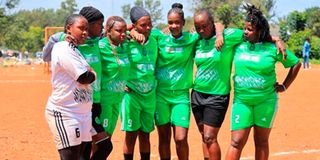
Now aged 29, Awino is raising three children while captaining Young Mothers FC, a community football team that she co-founded in Kibra to provide a second chance for women whose football careers were cut short by pregnancy and motherhood.
Her journey back onto the pitch was anything but easy. She returned to football a year after giving birth and briefly played in Kenya Women’s Division One League in Kibra. Instead of encouragement, she met ridicule.
“I stopped pursuing professional football at 17 after getting pregnant. When I returned to the game, I was constantly reminded that I had given birth, and that I would never be the same player again. Some male coaches made it look like motherhood marked the end of my football career,” she recalls.
Unable to find stability in organised football, she teamed up with 13 other young mothers and formed a team and called it ‘Young Mothers FC’.
That was in 2021 before her mother died. She now earns a living through local tournaments in Kibra, and uses the modest prize money to support her children.
“We all had children. Some simply wanted to stay fit, others had left clubs where they felt unwanted because they had become mothers. We decided to create a team where everyone would feel accepted,” she says.
Awino founded the club along with her younger sister, 25-year-old Gift Gladys, who plays for Equity Queens in Football Kenya Federation Women’s Division One League.
Awino doubles up as captain, organiser, and mentor in the absence of a coach. She organises friendly matches and community tournaments, and uses her football network to help talented players secure opportunities with clubs in Nairobi.
The youngest mother in the team, Bellah Achieng, has a three-month-old baby. The former Sunderland Women’s FC forward says that her passion for football motivated her to return to the pitch just three months after giving birth.
“I came here to regain fitness before looking for another club. I can't return to competitive football until I'm fit again,” she says.
Achieng' believes that many young players unknowingly sign contracts that they do not fully understand because nobody explains the terms to them.
Players in action during the Football Mums Tournament organised by Path to Russia at Kibra Stadium in Nairobi on May 23, 2026.
Photo credit: Pool
“We are often handed papers to sign without anyone explaining what they mean. I think I signed a three-year contract, but honestly, I’m not sure,” she says. Achieng is not sure whether she is still under contract at her club.
“Getting pregnant was a setback because I love football so much. I felt like I had let myself down, but my passion for the game pushed me to return as soon as possible,” Achieng’ says.
Living with her mother after giving birth, Achieng’, who is a former student at Olympic High School and the now-defunct St Catherine Primary School in Nairobi, says that many talented girls abandon football after becoming mothers.
“There is so much talent in the community. Getting pregnant should not be the end of someone's footballing journey,” she says.
She wants the Football Kenya Federation (FKF) to develop policies that protect female footballers during pregnancy and after childbirth.
“Many women have given up the sport because juggling football and motherhood is difficult. Most of us raise our children alone because the men disappear once they have got us pregnant. We need support to enable us continue playing the beautiful game.”
For its members, Young Mothers FC has evolved into much more than a football club. It has become a support network where women facing financial hardship, domestic violence, and emotional challenges can find encouragement.
“When someone is struggling with something in life, we stand with them. Many of the girls have experienced gender-based violence. We encourage one another and offer help and advice whenever someone needs it,” says Awino.
Whenever players require professional counselling, she turns to her elder sister, who works with survivors of gender-based violence, for guidance. Awino says her late mother was the team’s biggest supporter.
“Before she passed away in 2021, she encouraged us to keep the club alive. She was our biggest fan. Even when she became ill, she reminded us that we had stopped playing football at a young age and urged us to keep chasing our dreams,” she says.
“After childbirth, your body naturally changes. Male coaches kept telling us that we had gained weight and that we could no longer perform like before. Those comments made many of us feel unwanted.”
She says clubs often treat mothers as a liability rather than as athletes capable of returning to top form.
“Very few people consider the mental health of players. Once you become a mother, clubs simply assume your career is over,” she says.
Away from football, life remains difficult for many members of Young Mothers FC who stay in slum areas. Most survive by doing casual jobs such as washing clothes, cleaning homes, and doing other domestic work, all while raising children on their own.
Goalkeeper Nancy Njeri of Young Mothers FC in action during Football Mums Tournament in Kibera, Nairobi on May 23, 2026.
Photo credit: Pool
Although she studied graphic design, she has never landed formal employment and continues to rely on football and casual work to make ends meet.
Awino says that a lack of opportunities means that women's football in informal settlements continues to suffer because of inadequate sponsorship.
“We used to play in a league in Kibera, but it was discontinued. The sponsor said that women’s football was not attracting as much interest as men’s game.”
She argues that community tournaments are essential because they prevent young people from getting involved in crime, drugs, theft and early pregnancies. But financial challenges are not the only obstacle facing female footballers.
Awino says that some young players continue to face sexual harassment from coaches and people in positions of authority.
“Male coaches often take advantage of young girls. Once a player joins a team, the pressure begins because they are expected to exchange sex for opportunity. We advise them to walk away. Talent should never be traded for sex,” she says, adding that some promising players have given up football altogether after such experiences.
Awino hopes that more organisations will invest in women’s football and introduce programmes to support young mothers who are determined to continue playing.
“These women are talented. All they need is someone who believes in them, rather than judging them for becoming mothers,” she says.