Land, power and tradition: Why women are still shut out
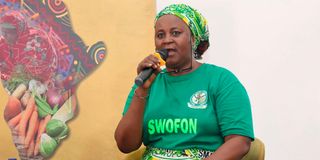
In October 2016, Mary Afan (pictured) led about 400 women farmers from 22 African countries up Mount Kilimanjaro to demand equal land rights.

What you need to know:
- Across Africa, women continue to battle against entrenched traditions and legal gaps denying them equal rights to land ownership.
- Despite legal reforms, millions of women remain excluded from land ownership due to cultural norms and systemic inequality.
When Mary Afan's father died, she assumed the property he had left behind would pass to all his children. It did not.
Her three brothers refused to share the inheritance with Mary and her five sisters, arguing that because the women were all married, they had no claim to their father's property. For Mary, a small-scale farmer in Nigeria, this was not just a family dispute; it was a fight for survival.
She took her brothers to court and won. But she did not stop there. Mary mobilised other women farmers facing similar situations and built a movement for women's land rights, starting at the local level before establishing a national presence.


The movement gained international attention in October 2016, when she led about 400 women farmers from 22 African countries to climb Mount Kilimanjaro, carrying their demands on a flag to the continent's highest summit. They later presented a petition to the African Union, calling on governments to guarantee women the same land rights as men and to make inheritance easier for women and girls.
Across the continent, women like Mary are fighting the same battle. The GeoPoll Equality Report 2026, released recently, reveals how deeply entrenched obstacles continue to block women from inheriting property equally across Kenya, Nigeria, South Africa, and Egypt.
Cultural and traditional beliefs remain the biggest barrier, cited by 62 per cent of respondents, suggesting that societal norms carry more weight than formal legal frameworks when land changes hands.
Other barriers include the perception that women are not permanent family members, accounting for 12 per cent of responses, followed by religious interpretations at 10 per cent. Male-dominated decision-making processes and a lack of legal awareness among women also play a significant role.
Title deeds
Kenya's own figures show how little has changed on the ground. Despite having legal rights, over 70 per cent of women do not own land. The 2022 Kenya Demographic and Health Survey (KDHS) found that 75 per cent of women lack ownership of agricultural land and 93 per cent have no claim to non-agricultural land.
Only between 1.0 and 10.3 per cent hold title deeds in their own names. Women also receive less than 10 per cent of agricultural credit, despite working longer hours on farms and in households.
Prof Mary Mbithi, principal investigator at the Women's Economic Empowerment Hub at the University of Nairobi, says the problem runs deeper than culture.
"Structural barriers, including limited land ownership rights, restrictive cultural norms, and limited access to finance, continue to hinder women's full economic participation," she says.
"Addressing these barriers is not just a gender issue; it is an economic imperative. Closing the gender gap in agriculture can significantly improve productivity, food security, and household incomes. We need policies that strengthen women's land and inheritance rights, expand access to affordable finance, and support women-led enterprises across agricultural value chains."
Kenya has made some legislative progress. The Constitution has shifted the conversation on land from a patriarchal framework to one anchored in equality: Article 60(f) calls for the elimination of gender discrimination in law, customs, and practices related to land and property, while Article 45(3) provides that women automatically become joint landowners with their husbands.
The Matrimonial Property Act, 2013, has reinforced these rights further. Under the law, women can buy and register land individually and inherit it from their parents. Women now have an equal say in land bought or sold in their name.
In polygamous marriages, each wife has a right to a portion of land based on her contribution to its purchase and upkeep, and when land is divided after divorce, non-monetary contributions, including domestic work, childcare, and farm work, are considered alongside financial ones.
Yet despite these reforms, many women still cannot access what the law says is theirs, held back by cultural traditions and a lack of awareness about their rights.


