Linda Kasonde's Sh600 campaign that shattered Zambia's glass ceiling

Linda Kasonde.

What you need to know:
- Prof Peter Cumper’s lectures inspired Linda and motivated her desire to protect and defend the vulnerable.
- Linda was the first woman to become the president of the Law Association of Zambia.
Six years before Linda Kasonde was born, Zambia ditched multiparty democracy and adopted a one-party rule under President Kenneth Kaunda. The country degenerated into dictatorship in the 1970s. As a result, it developed one of the most repressive intelligence services in Africa. Linda would be cautioned to refrain from uttering certain words on the phone or in public, to avoid the wrath of law enforcement.
Linda started her education at Lake Road School in Woodlands, Lusaka. Her mother was First Lady Betty Kaunda’s personal physician. In the 1980s, her father became a luminary of the Movement for Multiparty Democracy (MMD). MMD galvanised support across the Copper-belt cities of Mufulira, Ndola and Luanshya. It extended its popularity to Kitwe, Livingstone and Lusaka.
In the presidential election of 1991, MMD defeated Kaunda. Through the Minister for Finance and Linda's Uncle, Emmanuel Kasonde, the new MMD administration circulated a demoralising message that the country's economic woes would persist.


Inflation soared and interest rates skyrocketed to triple digits. Linda's parents narrowly avoided losing their home after they defaulted on their mortgage payments. At the age of 11, Linda and her sister were sent to an international boarding school in Eswatini, named Waterford Kamhlaba. She despised it. She had been an introvert, who found gratification in solitude and privacy. For her, staying in a boarding school was challenging.
Waterford was established as a counter to apartheid in neighbouring South Africa, which denied blacks comprehensive education. Several anti-apartheid activists, including Nelson Mandela, enrolled their children at the school. They regularly visited Waterford and shared their inspirational stories with learners. Those experiences elevated Linda's perception of the planet, entrenched her insatiable appetite for reforms, and built and reinforced her convictions.
Her self-assured, industrious persona led her to complete an international baccalaureate diploma before she graduated from Waterford in 1996. In the preceding months leading to her graduation, her Welsh boyfriend helped her submit applications to British universities.
Given her passion for writing poems and short stories, her father assumed she'd study journalism at the University of Zambia (UNZA), which was renowned for producing progressive intellects. However, her inquisitive nature and love for defending the oppressed led her to the legal fraternity. UNZA was prone to student protests that delayed course conclusions, so Linda opted to study law at the University of Leicester, England.
She travelled to Leicester in September 1997, a hospitable city acclaimed for its greenery pies, potato chips and tranquil ambience. Having spent seven years at Waterford boarding school, Linda found reprieve in the adventurous walks and nightlife of Leicester.
As a second-year student, she intensified her preoccupation with civil liberties through the influence of her Northern Irish professor Peter Cumper, who triggered her interest in human rights law. Prof Cumper’s lectures inspired Linda and motivated her desire to protect and defend the vulnerable. When she graduated with a law degree in July 2000, she returned to Lusaka and enrolled for a Bar course at the Zambia Institute for Advanced Legal Education (Ziale).
Ziale exams were strenuous and had a three per cent pass rate. Senior lawyers were deliberately sabotaging new entrants from joining the legal profession to avert competition. Linda was made to fail three times and as she sat her repeater exams in 2001, she volunteered in the National Legal Aid Clinic for Women, which provided free legal services for society's most indigent women and children.
She was admitted to the Zambian Bar Association in December 2001, and licensed to practise law in Zambia. The onus rested on her to inscribe her legal epitaph, and she became the greatest champion of gender equality.
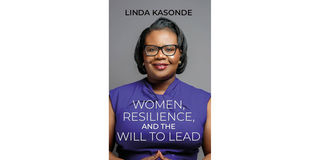
The cover of Linda Kasonde's memoir, Women Resilience and the Will to Lead.
In Linda's memoir, Women Resilience and the Will to Lead, she narrates how in 2013, she successfully contested the executive position of Honorary Secretary of the Law Association of Zambia (Laz) and in April 2014, she was elected its vice president. She subsequently selected two trusted attorneys to lead her issues-based campaign for Laz presidency in November 2014.
No woman had ever been elected Laz president. Zambia’s misogynistic doctrine and conservative cultures were designed to preserve a masculine power structure. Leading a professional organisation was the preserve of men. Women were expected to submit and discouraged from seeking prominent positions. They were expected to have motherly traits. Ambitious women with an imperative assertion like Linda were labelled manly and aggressive, and falsely accused of using intimacy to elevate their careers.
In April 2016, during her first pregnancy and after spending 100 Kwacha (Ksh647) on her campaign and delivering a convincing victory, Linda became Laz president. Her success had a ripple effect. She founded the LCK Chambers and became the executive director of Chapter One Foundation, an organisation that advocated human rights and the rule of law in Zambia.
The writer is a novelist, Big Brother Africa 2 Kenyan representative and founder of Jeff's Fitness Centre (@jeffbigbrother).